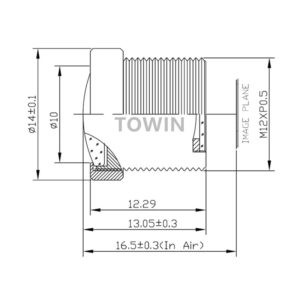



Fisheye Lens – S6420024F69
10/10/2025
Wide Angle Lens – S6719024F – AR1335
10/10/2025
Fisheye Lens – S6420028F-IMX390
3MP 1.9mm M12 fisheye lens for IMX390 with 200° FOV, <1% F-Theta distortion, F2.8 aperture and 0.02m M.O.D. for ultra-close-range vision.
S6420028F-IMX390 is 3-Megapixel Fisheye CCTV Lens with Built-In IR Filter, 200° M12-mount lens, F2.8 aperture, for security or specialized imaging applications.
| IMAGE FORMAT | Φ6.9 |
| FOCAL LENGTH | 1.9mm |
| F.O.V.@IMX390 (1920X1080) | 200°(D=6.61) |
| 183°(H=5.76) | |
| 104°(V=3.24) | |
| RESOLUTION | 3 MP |
| F-THETA DIST. | <1% |
| APERTURE | F2.8 |
| MOUNT | M12x0.5 |
| IRIS | Fixed |
| M.O.D. | 0.02m |
| T.T.L. | 15.94mm |
| STRUCTURE | 6G+IRCF |
M12 1.9mm 3MP Ultra-Wide Fisheye Lens
This 1.9mm M12 fisheye lens is designed for ultra-wide and close-range imaging applications requiring 3MP resolution, a 200° diagonal field of view, and F-Theta distortion below 1%. With an exceptionally short 0.02m minimum object distance and compact M12 × 0.5 mount, it is well suited to embedded vision systems that need to observe both nearby objects and a very broad surrounding area.
The combination of 200° ultra-wide coverage and a 0.02m M.O.D. makes this lens particularly useful for compact vision devices that must capture objects at very close range without sacrificing environmental coverage. Engineers can use the FOV Calculator to evaluate the relationship between sensor format, working distance, and image coverage.
M12 Fisheye Lens Core Highlights
- 200° Ultra-Wide FOV: Captures an exceptionally broad scene from a compact camera module.
- <1% F-Theta Distortion: Provides controlled image mapping for an ultra-wide fisheye design.
- 0.02m M.O.D.: Supports extremely close-range imaging at approximately 20mm.
- IMX390 Compatibility: Designed around the 3MP Sony IMX390 1920 × 1080 configuration.
- Compact M12 × 0.5 Mount: Simplifies integration into embedded and space-constrained vision devices.
M12 1.9mm Fisheye Lens Applications
Core Application Scenes
This M12 1.9mm low distortion fisheye lens is particularly suited to vision systems that need to observe objects at extremely short distances while maintaining a very broad field of view. Its 0.02m minimum object distance is the defining characteristic of this configuration, allowing the camera to focus on subjects positioned approximately 20mm from the lens.
The 200° diagonal FOV and 183° horizontal FOV allow a single compact camera to observe a large surrounding area. This makes the lens useful in applications where the camera is positioned close to equipment, surfaces, moving objects, or other structures and still needs broad environmental visibility.
The <1% F-Theta distortion provides controlled optical mapping despite the extreme field of view. This can be beneficial when wide-angle images are subsequently processed by computer vision software, panoramic stitching algorithms, or other image-analysis systems.
The lens can be integrated into compact robotic vision modules where a camera may be installed close to the robot body or working area. Its very short M.O.D. can also be useful for equipment monitoring, close-range inspection, embedded sensing, and compact spatial-awareness devices.
For engineers selecting a lens based on focal length, sensor size, working distance, and FOV, the Lens Selection Guide provides additional optical selection guidance.
Compatible Device List
- Close-Range Vision Modules: The 0.02m M.O.D. allows the camera to image objects positioned extremely close to the optical system.
- Robotics Vision Cameras: Suitable for compact robots requiring broad environmental awareness from a camera mounted close to the robot structure.
- Embedded AI Vision Devices: The M12 × 0.5 interface supports integration into small embedded camera modules for wide-area visual sensing.
- Compact Panoramic Cameras: The 200° FOV enables extensive scene capture from a single miniature camera.
- Equipment Monitoring Cameras: Suitable for applications where the camera must be installed close to machinery or equipment while maintaining a broad viewing range.
- Close-Range Environmental Sensing: The combination of ultra-wide FOV and extremely short M.O.D. is useful for detecting nearby objects around compact devices.
For robotic and embedded vision development, the Robotics Vision solutions provide additional examples of optical integration for intelligent vision systems. For broader machine vision applications, see the Machine Vision solutions.
Optical Performance for Close-Range Imaging
- 0.02m M.O.D.: Supports imaging at approximately 20mm from the lens, significantly closer than conventional wide-angle configurations.
- 183° Horizontal FOV: Delivers broad lateral scene coverage even with short working distances between camera and subject.
- 104° Vertical FOV: Maintains substantial vertical environmental coverage.
- 15.94mm T.T.L.: Provides a compact optical package suitable for embedded camera integration.
- F2.8 Fixed Aperture: Provides a stable optical configuration for dedicated imaging modules.
Designed for ultra-close-range fisheye imaging, compact robotics vision, embedded visual sensing, panoramic cameras, and wide-area machine vision applications.
Frequently Asked Questions
Q: What is the minimum object distance of this M12 fisheye lens?
A: The specified M.O.D. is 0.02m, or approximately 20mm, making this configuration suitable for extremely close-range imaging.
Q: What is the field of view of this 1.9mm M12 lens?
A: With the specified IMX390 1920 × 1080 configuration, the lens provides 200° diagonal FOV, 183° horizontal FOV, and 104° vertical FOV.
Q: Is this a low distortion fisheye lens?
A: Yes. The specified F-Theta distortion is below 1%, providing controlled image mapping despite the lens’s extremely wide field of view.
Q: What sensor is this lens designed for?
A: The lens is specified for the Sony IMX390 at 1920 × 1080, with a 3MP resolution configuration.
Q: What makes the 0.02m M.O.D. useful?
A: A 0.02m minimum object distance allows the lens to focus on subjects positioned approximately 20mm from the optical system. This is useful when the camera must be installed very close to the object while still requiring a broad field of view.
Q: Is this lens suitable for robotics vision?
A: Yes. Its 200° ultra-wide FOV and extremely short M.O.D. make it suitable for compact robotic systems that need both close-range object awareness and broad environmental coverage.
Q: Is this lens an automotive lens?
A: This particular configuration does not specify an automotive waterproof rating such as IP67 or IP69K. Therefore, automotive suitability should be evaluated according to the complete camera housing and system requirements rather than the optical parameters alone.
Q: Does IRCF mean this lens is IR corrected?
A: No. IRCF generally refers to an IR Cut Filter configuration. It should not be interpreted as an IR-corrected optical design. The spectral characteristics should be confirmed based on the complete camera module.
Online contact