


Fisheye Lens – S6420020F67
10/09/2025
Fisheye Lens – S6420028F-IMX390
10/10/2025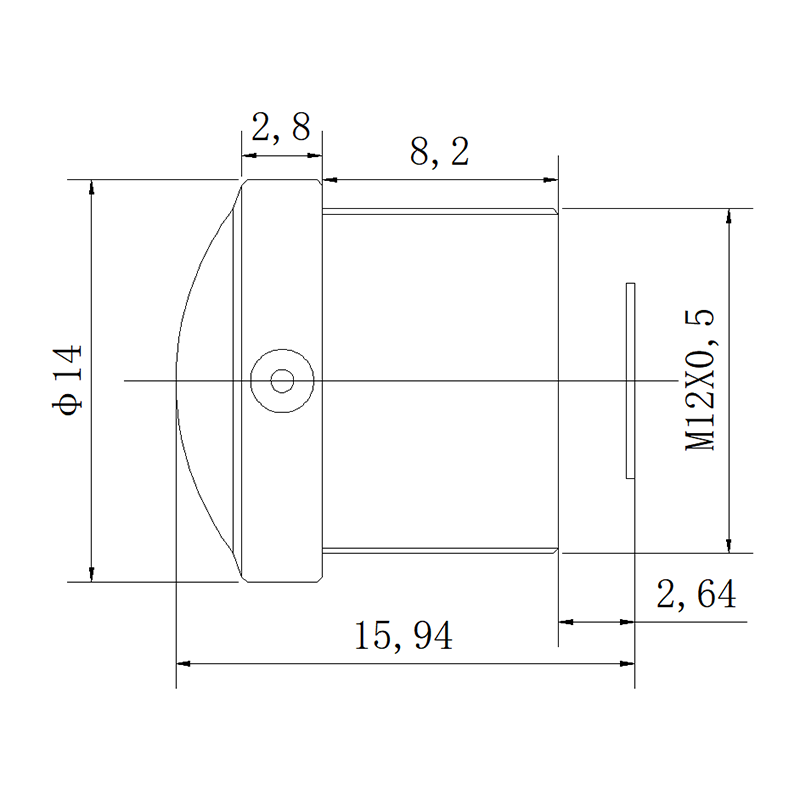
Fisheye Lens – S6420024F69
3MP 1.9mm M12 fisheye lens for IMX390 with 200° FOV, <1% F-Theta distortion, F2.4 aperture and IP69K protection for automotive vision.
S6420024F69 is IP69K waterproof Fisheye CCTV M12-mount lens with Built-In IR Filter, 200° diagonal FOV, F2.4 aperture, for security or automotive applications.
| IMAGE FORMAT | Φ6.9 |
| FOCAL LENGTH | 1.9mm |
| F.O.V.@IMX390 (1920X1080) | 200°(D=6.61) |
| 183°(H=5.76) | |
| 104°(V=3.24) | |
| RESOLUTION | 3 MP |
| F-THETA DIST. | <1% |
| APERTURE | F2.4 |
| MOUNT | M12x0.5 |
| IRIS | Fixed |
| M.O.D. | 0.2m |
| T.T.L. | 15.94mm |
| STRUCTURE | 6G+IRCF |
| WATERPROOF | IP69K |
M12 1.9mm Fisheye Automotive Lens
This 1.9mm M12 fisheye lens is optimized for automotive and outdoor vision systems requiring an ultra-wide 200° field of view, controlled F-Theta distortion below 1%, and reliable IP69K protection. Designed around the Sony IMX390 3MP sensor format, it combines a compact M12 × 0.5 mount with a rugged optical configuration for wide-area environmental sensing.
The combination of an ultra-wide field of view, controlled F-Theta distortion, and IP69K protection makes this lens suitable for applications where both extensive scene coverage and environmental durability are required. Engineers can use the Lens Selection Guide when evaluating sensor, FOV, focal length, and optical distortion requirements.
M12 Fisheye Lens Core Highlights
- 200° Ultra-Wide FOV: Captures an exceptionally broad scene with a single camera.
- <1% F-Theta Distortion: Provides controlled geometric mapping for an ultra-wide fisheye design.
- IMX390 Compatibility: Optimized for the 3MP Sony IMX390 1920 × 1080 imaging configuration.
- IP69K Protection: Designed for demanding automotive and exposed outdoor environments.
- Compact M12 Mount: M12 × 0.5 interface simplifies integration into compact camera modules.
M12 1.9mm Fisheye Lens Applications
Core Application Scenes
This 3MP M12 low distortion fisheye lens is designed for automotive cameras that need to observe a very large area around a vehicle while maintaining controlled optical distortion. With a 183° horizontal FOV and 104° vertical FOV on the Sony IMX390, the lens can provide extensive lateral coverage from a compact camera installation.
Its <1% F-Theta distortion is particularly valuable for vision systems that need to process ultra-wide images using computer vision algorithms. Compared with a conventional wide-angle lens, the 1.9mm optical design provides much broader environmental coverage, while the controlled F-Theta characteristic helps maintain a more predictable image-to-scene relationship.
The IP69K rating makes this lens particularly suited to automotive exterior camera modules exposed to high-pressure water jets, dust, road contamination, and demanding cleaning conditions. This makes it appropriate for vehicle surround-view cameras, exterior environmental perception modules, and rugged transportation vision equipment.
The lens is also suitable for mobile robots and outdoor intelligent devices where a wide field of view is required together with strong environmental protection. Its 0.2m M.O.D. allows the camera to observe nearby objects while maintaining a very broad perspective.
For automotive perception systems, the ADAS solutions provide additional information about camera-based vehicle vision applications. Engineers working on intelligent transportation systems can also explore the Smart Traffic solutions.
Compatible Device List
- Automotive Surround-View Cameras: The 200° diagonal FOV provides extensive visual coverage around vehicles while the IP69K design supports demanding exterior installation environments.
- ADAS Camera Modules: Compatible with the Sony IMX390 3MP imaging configuration for wide-angle environmental perception.
- Vehicle Exterior Cameras: IP69K protection makes the lens suitable for camera modules exposed to rain, dust, road spray, and high-pressure cleaning.
- Mobile Robotics Cameras: The ultra-wide FOV helps autonomous mobile platforms detect nearby obstacles and surrounding environmental features.
- Smart Transportation Cameras: Suitable for rugged camera modules requiring broad scene coverage in exposed transportation environments.
- Outdoor Embedded Vision Devices: The compact M12 × 0.5 mount supports integration into space-constrained, weather-exposed camera systems.
Environmental & Optical Performance
- IP69K Protection: Designed for applications requiring high resistance to dust and high-pressure, high-temperature water exposure.
- Controlled F-Theta Distortion: Less than 1% distortion supports more predictable ultra-wide image geometry.
- 15.94mm T.T.L.: Provides a compact optical package for vehicle and embedded camera integration.
- F2.4 Fixed Aperture: Offers a stable optical configuration for dedicated camera modules.
- 0.2m M.O.D.: Supports close-range environmental sensing while maintaining an extremely wide viewing angle.
Designed for automotive surround-view, ADAS environmental perception, rugged outdoor cameras, mobile robotics, and intelligent transportation imaging applications.
Frequently Asked Questions
Q: What sensor is this M12 fisheye lens designed for?
A: The lens is specified for the Sony IMX390 sensor at a 1920 × 1080 imaging configuration, with a 3MP resolution specification.
Q: What is the field of view of this 1.9mm M12 lens?
A: With the specified IMX390 configuration, the lens provides a 200° diagonal FOV, 183° horizontal FOV, and 104° vertical FOV.
Q: Is this a low distortion fisheye lens?
A: Yes. The specified F-Theta distortion is below 1%, making it suitable for applications that require ultra-wide fisheye coverage with controlled geometric distortion.
Q: What makes this lens suitable for automotive applications?
A: The combination of a 200° ultra-wide FOV, <1% F-Theta distortion, M12 × 0.5 mounting, compact optical dimensions, and IP69K environmental protection makes it suitable for automotive exterior vision applications.
Q: Is this lens waterproof?
A: Yes. It is specified with an IP69K rating, making it suitable for demanding environments involving dust, high-pressure water jets, and high-temperature cleaning conditions.
Q: Can this lens be used for ADAS cameras?
A: Yes. Its ultra-wide FOV and compatibility with the Sony IMX390 make it suitable for certain ADAS and automotive environmental perception camera configurations. Final system suitability should be confirmed based on the complete camera and image-processing design.
Q: What is the difference between F-Theta distortion and conventional TV distortion?
A: F-Theta distortion is commonly used to describe image mapping performance in ultra-wide and fisheye optical systems. This lens specifies F-Theta distortion below 1%, indicating controlled image mapping for its very wide field of view.
Q: Does IRCF mean that this is an IR corrected lens?
A: No. IRCF generally refers to an IR Cut Filter configuration. It should not be interpreted as an IR-corrected optical design. The actual spectral response should be evaluated according to the complete camera module.
Online contact