


Wide Angle Lens – CCL132036MPF
07/14/2025
Wide Angle Lens – S02013212420
07/14/2025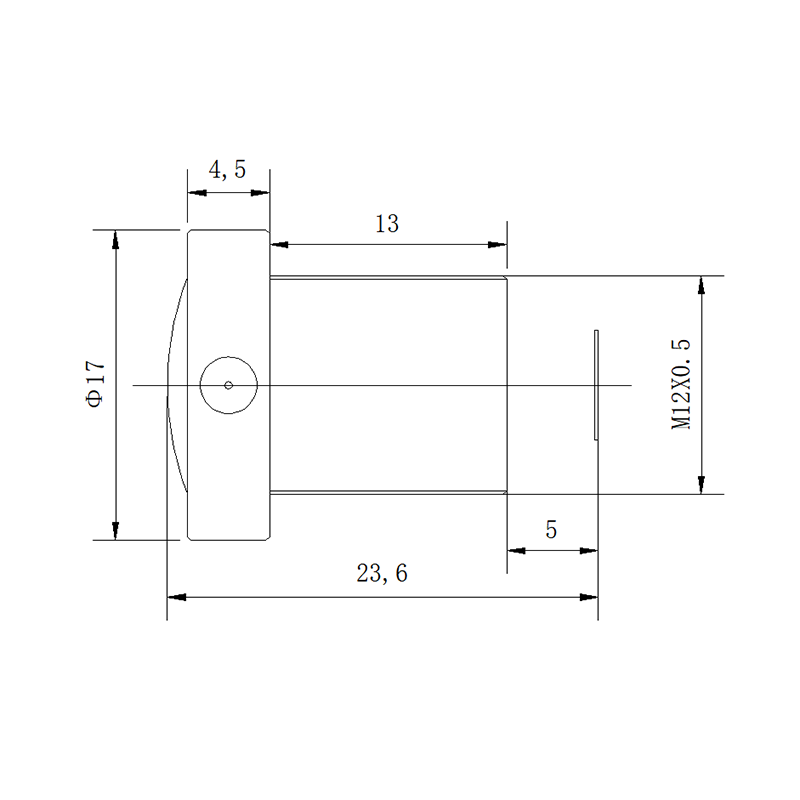
Fisheye Lens – CCL1302322MPFR
This 2.3mm M12 4MP fisheye lens delivers 172° diagonal FOV, 127° horizontal FOV, F2.2 aperture, and 0.1m MOD for panoramic, robotics, security, and ultra-wide imaging applications.
CCL1302322MPFR is 172° F2.2 2.3mm Wide-angle 4 – Megapixel 1/3″ M12 – mount fisheye HD lens with Built-In Filter security surveillance lens.
| IMAGE SIZE | 1/3″ |
| FOCAL LENGTH | 2.3mm |
| F.O.V. | 172°(D) |
| 127°(H) | |
| 92°(V) | |
| RESOLUTION | 4 Megapixel |
| DISTORTION | <-41% (H) |
| APERTURE | F2.2 |
| MOUNT | M12X0.5 |
| IRIS | Fixed |
| T.T.L. | 23.6mm |
| B.F.L. | 5.18mm |
| M.B.F.L. | 5mm |
| M.O.D. | 0.1m |
| CONSTRUCTION | 6G+IRCF |
2.3mm M12 4MP Fisheye Wide Angle Lens for Ultra-Wide Imaging
This 2.3mm M12 fisheye wide angle lens is designed for 1/3″ camera systems requiring an exceptionally broad field of view. It delivers a 172° diagonal FOV, 127° horizontal FOV, and 92° vertical FOV with 4MP resolution and an F2.2 aperture, making it suitable for panoramic monitoring, compact embedded cameras, robotics, smart security, and other applications where maximum scene coverage is a priority.
With an M12×0.5 mount, 5.18mm BFL, 23.6mm total optical length, and 0.1m minimum object distance, the lens combines an ultra-short focal length with a compact camera interface. Its 6G+IRCF construction provides a practical optical configuration for high-coverage camera systems using an integrated infrared-cut filter.
M12 Fisheye Lens Core Highlights
- 172° Ultra-Wide FOV: The 2.3mm focal length provides 172° diagonal coverage, allowing a single compact camera to capture an exceptionally large scene.
- 127° Horizontal Coverage: The wide horizontal FOV is suitable for panoramic and situational-awareness applications where broad lateral coverage is required.
- 4MP Resolution: Supports detailed imaging for wide-area monitoring and embedded vision systems using a 1/3″ image format.
- 0.1m Minimum Object Distance: The very short MOD allows the lens to capture nearby objects while maintaining an exceptionally broad viewing angle.
- Compact M12×0.5 Integration: The M12 interface simplifies integration into small camera modules and embedded imaging equipment.
M12 Fisheye Lens Applications
Core Application Scenes
This lens is designed for applications where maximum field of view is more important than geometric accuracy. With 172° diagonal coverage and 127° horizontal coverage, it can capture a very large area from a single camera position, reducing blind spots in wide-area imaging systems.
The 2.3mm focal length makes the lens particularly suitable for panoramic monitoring, situational awareness, compact security devices, robotics, and embedded cameras. The 0.1m minimum object distance further expands its usability for close-range wide-angle imaging where the camera must observe objects positioned near the lens.
The specified distortion of less than -41% in the horizontal direction should be understood as part of the ultra-wide optical design rather than a defect for applications that intentionally prioritize extreme FOV. For applications requiring accurate dimensional measurement or straight-line preservation, a lower-distortion lens should be selected instead.
Designed for ultra-wide-angle and fisheye imaging applications, this lens is a strong option when one camera needs to cover a very large viewing area.
For application-specific optical selection, TOWIN’s Smart Security solutions, Robotics Vision solutions, and Machine Vision solutions provide additional system-level references.
Compatible Device List
Panoramic Security Cameras
The 172° diagonal FOV allows a compact camera to observe a very broad area, making the lens suitable for panoramic monitoring and situational-awareness systems.
Compact Embedded Cameras
The M12×0.5 mount and short 2.3mm focal length allow integration into small camera modules where maximum scene coverage is required within a limited installation space.
Robotics Vision Systems
The ultra-wide FOV can help robots and autonomous devices observe their surroundings, detect nearby obstacles, and maintain broad situational awareness.
Indoor Monitoring Devices
The 127° horizontal FOV can reduce blind spots in indoor monitoring applications such as room observation, equipment monitoring, and smart-device cameras.
Near-Field Imaging Systems
With a 0.1m MOD, the lens can capture very close objects while retaining its wide viewing range, making it useful for close-range monitoring and embedded sensing.
Wide-Area Machine Vision
The lens can be considered for machine vision tasks where detecting the presence or position of objects across a very large area is more important than maintaining low geometric distortion.
For additional M12 configurations, explore TOWIN’s M12 Lens product range. For more specialized ultra-wide optical requirements, contact TOWIN for optical configuration support.
Frequently Asked Questions
Q: What is the field of view of this 2.3mm M12 lens?
A: The lens provides a 172° diagonal, 127° horizontal, and 92° vertical field of view on a 1/3″ image format, making it an ultra-wide-angle optical design.
Q: Is this lens a fisheye lens?
A: It is suitable for fisheye and ultra-wide-angle applications. The 172° diagonal FOV and high intentional distortion are characteristic of an extremely wide-angle optical configuration.
Q: Why is the distortion higher than a standard wide-angle lens?
A: The specified distortion of less than -41% in the horizontal direction is associated with the extremely wide 127° horizontal FOV. This optical trade-off allows the lens to capture a much larger scene.
Q: Is this lens suitable for low-distortion machine vision?
A: No. This lens is optimized for maximum scene coverage rather than geometric accuracy. Applications requiring dimensional measurement or precise shape analysis should use a dedicated low distortion lens.
Q: What is the minimum object distance of this lens?
A: The specified minimum object distance is 0.1m, allowing the lens to image objects positioned very close to the camera.
Q: Does the IRCF configuration mean the lens is IR corrected?
A: No. IRCF indicates an infrared-cut filter configuration. It does not by itself indicate IR-corrected optical performance across visible and near-infrared wavelengths.
Q: What cameras can use this lens?
A: The lens is designed for 1/3″ camera systems with an M12×0.5 interface. It is suitable for compact security cameras, embedded vision modules, robotics cameras, and selected industrial imaging systems.
Q: What applications benefit most from a 172° FOV?
A: Panoramic monitoring, robotics situational awareness, indoor surveillance, obstacle detection, and other applications that require maximum scene coverage from a single camera can benefit from this extremely wide field of view.
Optical Selection & Related Resources
When selecting an ultra-wide or fisheye lens, field of view, sensor size, working distance, distortion, and installation position should be evaluated together. TOWIN’s FOV Calculator can help estimate the required viewing area for a camera system.
For more information about matching lenses with sensor formats, visit the Sensor Guide. If you need guidance on selecting focal length, FOV, mounting, and other optical parameters, see the Lens Selection Guide.
For applications requiring a different FOV, sensor format, mechanical interface, or customized optical design, contact TOWIN to discuss your project requirements.
Online contact