


Low Distortion Lens – M720014001060
11/07/2025
Fisheye Lens – S4621018F67
11/07/2025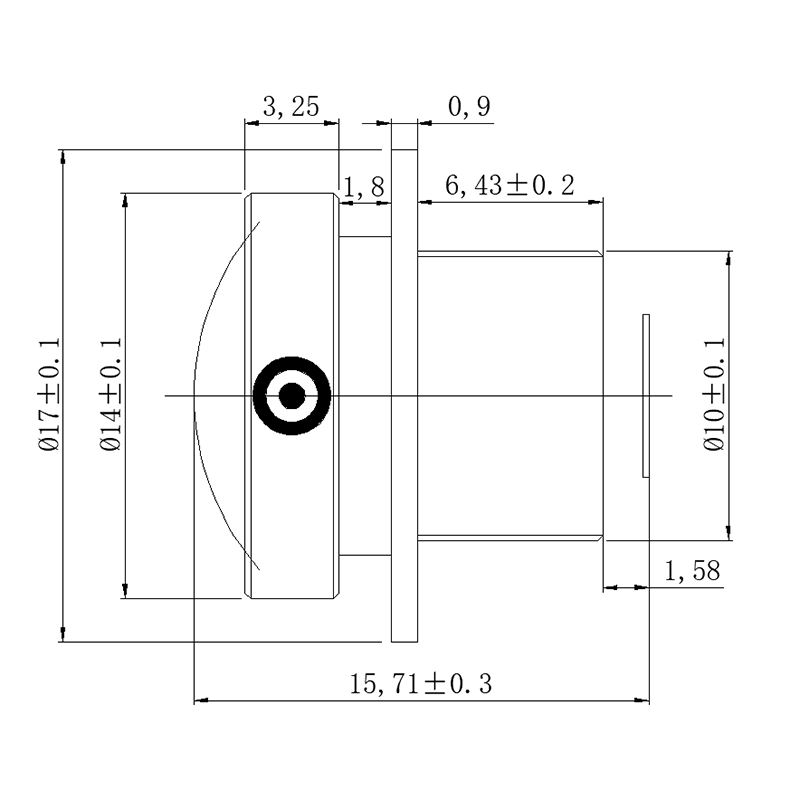
Automotive Lens – A5520220F69
1.7mm Φ10 IP69K fisheye automotive lens with 202° FOV, 3MP resolution, F2.0 aperture, integrated IRCF, and rugged waterproof construction for panoramic vehicle vision.
A5520220F69 is Fisheye 3-Megapixel automotive lens with IRCF, 1/2.4″ Φ5.51 M10 Mount,202° FOV F2.0 IP69K waterproof security surveillance lens.
| IMAGE FORMAT | Max Φ5.51, 1/2.4″ |
| FOCAL LENGTH | EFL=1.7mm |
| F.O.V. (ISX031) | 202°(D@5.51) |
| 202°(H@5.51) | |
| 165°(V@4.66) | |
| RESOLUTION | 3 MP |
| F-θ DISTORTION | <-3.9% |
| APERTURE | F2.0 |
| MOUNT | Φ10 |
| M.O.D. | 0.2m |
| B.F.L. | 3.29mm |
| T.T.L. | 15.71mm |
| CONSTRUCTION | With IRCF |
| WATERPROOF | IP69K |
1.7mm Φ10 IP69K 202° Fisheye Automotive Lens
This 1.7mm Φ10 fisheye automotive lens is designed for ultra-wide-angle imaging where a single camera needs to capture an exceptionally large surrounding area. Featuring a 202° field of view, 3MP resolution, F2.0 aperture, integrated IRCF, and IP69K waterproof construction, it is suitable for rugged automotive, intelligent transportation, and panoramic vision systems.
1.7mm Φ10 IP69K Automotive Lens Core Highlights
- 202° Ultra-Wide FOV: Captures an exceptionally broad surrounding scene with a single camera.
- 1.7mm EFL: Ultra-short focal length enables panoramic and fisheye imaging.
- IP69K Waterproof Construction: Designed for demanding environments requiring high protection against water and contamination.
- Integrated IRCF: Supports visible-light camera configurations requiring IR-cut filtering.
- Compact Φ10 Design: Provides a compact optical package for embedded and automotive camera modules.
1.7mm Φ10 IP69K Automotive Lens Applications
Core Application Scenes
This 1.7mm 202° fisheye lens is designed for imaging systems where maximizing scene coverage is more important than maintaining conventional rectilinear geometry. Its 202° horizontal and diagonal field of view enables a single camera to observe an exceptionally large surrounding area, reducing blind zones in panoramic imaging configurations.
The lens is particularly suited to rugged automotive camera modules, where a compact optical assembly must withstand water, dust, cleaning processes, and harsh outdoor conditions. The IP69K construction makes it appropriate for exposed camera locations that may encounter high-pressure water jets, road contamination, or demanding environmental conditions.
Within automotive‑vision applications, the ultra‑wide FOV supports surround‑view, panoramic observation, parking‑area monitoring, blind‑zone visualization, and other camera systems that demand extensive nearby‑scene coverage. The 1.7mm EFL and 0.2m M.O.D. are especially relevant where the camera needs to observe objects or obstacles located close to the vehicle.
The same optical characteristics can also be applied to smart traffic and panoramic security equipment, where a single camera needs to cover a broad intersection, vehicle approach area, entrance zone, or other large surrounding scene.
For automotive and advanced driver-assistance applications, the ADAS Solution provides additional information about optical solutions used in vehicle vision systems.
Compatible Device List
- Automotive Surround-View Cameras: Suitable for ultra-wide camera modules requiring extensive nearby scene coverage.
- ADAS Camera Modules: The 202° FOV can support specialized surrounding-environment observation systems.
- Rugged Vehicle Cameras: Its IP69K‑rated build fits camera assemblies that encounter water, dust, road contaminants, and harsh outdoor operating conditions.
- Smart Traffic Cameras: The ultra-wide optical design can capture a large area around traffic-monitoring equipment.
- Panoramic Security Cameras: Suitable for applications where a single camera needs to observe a very broad surrounding area.
- Embedded Panoramic Vision Modules: The compact Φ10 construction allows integration into small camera housings.
Designed for ultra-wide automotive surround-view, rugged vehicle imaging, and panoramic vision applications.
Optical Selection Considerations
The defining characteristic of this lens is its 202° field of view. Unlike conventional wide-angle lenses designed to maintain relatively natural perspective geometry, this lens uses an extreme fisheye configuration to capture an exceptionally large surrounding scene.
The specified F-θ distortion of < -3.9% should be interpreted differently from conventional TV distortion. F-θ optical systems intentionally use a specialized image-mapping relationship between angle and image height, making them suitable for applications such as panoramic imaging, scanning, and wide-field vision.
The 1/2.4″ image format and 3MP resolution are matched with the Sony ISX031-based FOV specification provided for this lens. When integrating the lens into a camera module, the actual sensor active area should be checked against the specified image circle and FOV requirements.
The IP69K construction is another key differentiator. It allows the lens to be considered for demanding outdoor and automotive environments where ordinary miniature optics may not provide sufficient environmental protection.
For automotive vision system development, engineers can review the Automotive Lens product range for additional waterproof optical configurations.
For systems requiring a broad viewing angle, the Wide Angle Lens category provides additional wide-field optical solutions.
Fisheye Imaging & Field-of-View Considerations
With a 202° field of view, this lens is intended for applications where maximizing angular coverage is a primary optical requirement. Engineers should therefore evaluate the relationship between camera placement, required coverage, image processing, and fisheye correction when designing the complete vision system.
For applications that need to convert lens and sensor parameters into practical scene coverage, the FOV Calculator can be used during the initial optical design stage.
Engineers can also review the Optical Design section for additional information when integrating specialized wide-field optics into embedded imaging equipment.
Frequently Asked Questions
Q: Is this a fisheye lens?
A: Yes. The 202° field of view and F-θ optical specification identify this lens as an ultra-wide fisheye lens designed for extremely broad scene coverage.
Q: What is the field of view of this 1.7mm lens?
A: With the specified ISX031 configuration, the field of view is 202° diagonal, 202° horizontal, and 165° vertical.
Q: What sensor size is this fisheye lens designed for?
A: The lens is specified for a 1/2.4″ image format with a maximum image circle of Φ5.51.
Q: Is this lens suitable for automotive applications?
A: Yes. Its 202° ultra-wide FOV, compact Φ10 configuration, and IP69K waterproof construction make it suitable for demanding automotive camera applications.
Q: What does the IP69K rating mean for this lens?
A: The IP69K construction indicates that the lens is designed for highly demanding environmental conditions involving dust and high-pressure/high-temperature water exposure.
Q: Is this a low distortion lens?
A: No. The lens uses a fisheye/F-θ optical configuration, so its specified F-θ distortion should not be interpreted in the same way as a conventional low-distortion lens. The optical design prioritizes extremely wide angular coverage.
Q: Does the lens include an IR-cut filter?
A: Yes. The specification states With IRCF, meaning an integrated IR-cut filter is included in the optical construction.
Q: What is the minimum object distance?
A: The specified M.O.D. is 0.2m, allowing the lens to capture relatively close objects while maintaining its ultra-wide viewing coverage.
Related Resources
For automotive imaging systems requiring broad environmental coverage, the ADAS Solution provides an overview of optical requirements for advanced vehicle vision applications.
For traffic-related applications, the Smart Traffic Solution provides additional information about camera and optical solutions used in intelligent transportation systems.
Engineers evaluating fisheye and wide-angle optical behavior can also explore the Lens Basics resources before selecting the appropriate optical configuration.
For customized requirements involving FOV, image format, waterproof construction, mechanical dimensions, or other optical specifications, Contact Towin to discuss the required lens configuration.
Online contact