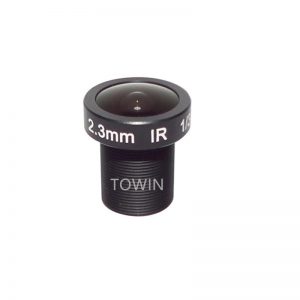



Industrial Lens – S03514006012IR
08/31/2025
TOF Lens – S08012004812IR
08/31/2025

TOF Lens – S04112009316IR
4.1mm M12 TOF lens for 1/2″ sensing systems, featuring 120° FOV, F1.6 aperture and <8.5° CRA for wide-area 3D depth sensing.
S04112009316IR is Wide-angle 1/2″ M12 TOF lens with significant optical, having a 120° diagonal FOV, F1.6 aperture, and 6G + 1ASPG construction.
| IMAGE FORMAT | 1/2″ |
| FOCAL LENGTH | 4.1mm |
| F.O.V. | 120°(D) |
| 93°(H) | |
| 69°(V) | |
| OPTICAL DISTORTION | <-41% |
| TV DISTORTION | <-13% |
| RESOLUTION | 320×480 |
| APERTURE | F1.6 |
| MOUNT | M12X0.5 |
| IRIS | Fixed |
| FOCUS | Manual |
| ZOOM | Fixed |
| C.R.A. | <8.5° |
| CONSTRUCTION | 6G+1ASPG |
4.1mm M12 TOF Wide Angle Lens
This 4.1mm M12 TOF lens is designed for 1/2″ time-of-flight sensing systems that require a wide field of view and compact optical integration. Boasting a 120° diagonal FOV, F1.6 aperture, <8.5° low C.R.A., and support for 320 × 480 imaging, it targets wide‑area depth‑sensing and 3D‑perception use cases.
Product Highlights at a Glance
- 120° diagonal FOV for broad depth-sensing coverage.
- 4.1mm fixed focal length for compact TOF camera systems.
- F1.6 aperture supports efficient light transmission for sensing applications.
- Low C.R.A. below 8.5° for sensor and optical system integration.
- M12 × 0.5 mount for compact 3D sensing modules.
4.1mm M12 TOF Lens Applications
Core Application Scenes
This 4.1mm M12 TOF lens is specifically designed for time-of-flight imaging systems where wide spatial coverage is required for depth measurement and 3D perception. Its 120° diagonal field of view allows a single TOF camera to observe a relatively large surrounding area, making it suitable for depth-sensing systems that need broad environmental awareness rather than conventional high-resolution 2D image capture.
The 93° horizontal and 69° vertical FOV provide extensive scene coverage, which can be valuable for indoor 3D sensing, human presence detection, spatial monitoring, gesture recognition, and robotic perception. The F1.6 aperture provides a practical optical configuration for compact sensing modules, while the fixed iris and fixed zoom simplify integration into dedicated TOF camera hardware.
A particularly important characteristic is the C.R.A. below 8.5°. For TOF systems, optical and sensor matching can directly affect the usable sensing area and overall module performance. Therefore, reference this specification while selecting the image sensor and designing the full optical path.
The lens has substantial optical distortion at less than -41%, which is consistent with its very wide field-of-view design. For TOF applications, assess optical distortion alongside sensor calibration and the depth‑processing pipeline; do not apply the same benchmarks used for standard precision 2D machine‑vision lenses.
For engineers developing 3D perception systems, the TOF Lens Solution provides additional information about TOF optical applications. The TOF Lens category can also be used to compare compatible TOF optical solutions.
Compatible Device List
- TOF Depth Cameras: Designed for time-of-flight camera modules requiring broad depth-sensing coverage.
- 3D Vision Systems: Suitable for spatial perception and depth-mapping equipment where a wide viewing area is required.
- Robotics Perception Modules: The wide FOV can help robots detect surrounding objects and understand nearby spatial structures.
- Human Presence and Gesture Sensing: Suitable for embedded TOF modules used for presence detection, gesture interaction, and spatial monitoring.
- Smart Environment Sensors: Can be integrated into intelligent devices requiring wide-area depth information.
- Custom 3D Sensing Equipment: The M12 × 0.5 mechanical interface supports integration into customized TOF camera housings and OEM sensing modules.
Designed for wide-area TOF depth sensing, 3D perception, robotics, and intelligent spatial sensing applications.
When designing a TOF system, the required field of view should be evaluated together with sensor size and installation geometry. The FOV Calculator can help estimate optical coverage, while the Sensor Guide can assist with sensor and lens matching.
For customized TOF optical requirements, including mechanical integration or application-specific lens configurations, contact TOWIN for OEM/ODM optical support.
Frequently Asked Questions
Q: What type of lens is this 4.1mm M12 lens?
A: This is a dedicated TOF lens designed for time-of-flight depth-sensing systems. It also features a wide-angle 120° diagonal field of view and an M12 × 0.5 mount.
Q: What is the field of view of this TOF lens?
A: The specified field of view is 120° diagonal, 93° horizontal, and 69° vertical.
Q: Why does this TOF lens have high optical distortion?
A: The optical distortion is specified at less than -41%, which is associated with the lens’s very wide field of view. In TOF applications, optical distortion can be handled as part of the system calibration and depth-processing workflow.
Q: Is this lens a low distortion lens?
A: No. Its optical distortion is specified at less than -41%, so it should not be classified as a low distortion lens.
Q: What sensor format is this lens designed for?
A: The lens is designed for a 1/2″ image format and is specified for 320 × 480 imaging performance.
Q: What advantage does the F1.6 aperture provide for TOF applications?
A: The F1.6 aperture provides a practical balance between light transmission and optical design for compact TOF sensing modules.
Q: Why is the C.R.A. specification important for a TOF lens?
A: Chief ray angle can affect how the optical system interacts with the image sensor. The specified C.R.A. below 8.5° should therefore be considered during sensor and lens integration.
Q: Can this lens be used for robotics and 3D vision?
A: Yes. Its wide FOV and TOF-specific design make it suitable for applications such as robotic spatial perception, 3D sensing, human presence detection, and other depth-based vision systems.
Online contact