


Fisheye Lens – S3421020
11/10/2025
Fisheye Lens – S7018020F
11/10/2025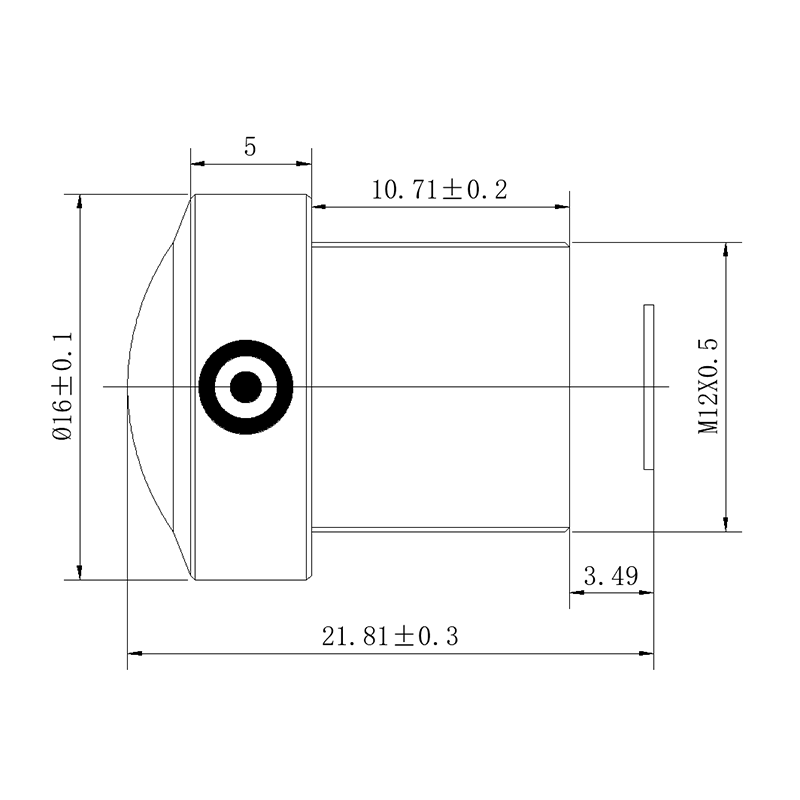
Fisheye Lens – S6822023F – IMX335
2.0mm M12 5MP fisheye lens for IMX335 with 220° FOV, F2.3 aperture, M12 × 0.5 mount, 0.2m M.O.D., and integrated IRCF for ultra-wide imaging.
S6822023F – IMX335 is 2.0mm 5-Megapixel Fisheye lens with Built-In IR Filter, 1/2.8″ Φ6.79 M12/S Mount 220°(D) F2.3 security surveillance lens.
| IMAGE FORMAT | Max Φ6.79, 1/2.8″ |
| FOCAL LENGTH | 2.0mm |
| F.O.V.@IMX335 | 220°(D=6.52) |
| 158°(H=5.22) | |
| 117°(V=3.92) | |
| RESOLUTION | 5 MP |
| DISTORTION | <-125% |
| APERTURE | F2.3 |
| MOUNT | M12x0.5 |
| IRIS | Fixed |
| M.O.D. | 0.2m |
| T.T.L. | 21.81mm |
| STRUCTURE | With IRCF |
2.0mm M12 5MP Fisheye Lens
This 2.0mm M12 5MP fisheye lens is designed for ultra-wide-angle imaging systems requiring extensive scene coverage from a compact camera module. With a 220° diagonal FOV on the IMX335 sensor, F2.3 aperture, integrated IRCF, and M12 × 0.5 mount, it is suitable for panoramic surveillance, embedded vision, robotics, and wide-area perception applications.
M12 Fisheye Lens Core Highlights
- 220° Ultra-Wide FOV: Captures an exceptionally broad scene with a single camera.
- 5MP Resolution: Provides detailed image data for wide-area visual monitoring.
- 2.0mm Fisheye Design: Delivers extreme scene coverage in a compact optical configuration.
- Built-In IRCF: Supports integrated camera-module designs requiring IR-cut filtering.
- Compact M12 × 0.5 Mount: Simplifies integration into miniature embedded vision equipment.
2.0mm M12 Fisheye Lens Applications
Core Application Scenes
This 2.0mm M12 fisheye lens is engineered for applications where a conventional rectilinear lens cannot provide sufficient scene coverage. Its 220° diagonal FOV allows the camera to capture an exceptionally large surrounding area, making it suitable for panoramic observation, near-field spatial awareness, and wide-area monitoring from a compact installation point.
The lens is particularly useful in single-camera coverage scenarios where reducing the number of cameras can simplify system architecture. The 2.0mm focal length and extreme fisheye projection allow designers to monitor a broad environment while maintaining a compact optical assembly.
For smart security equipment, the combination of 5MP resolution and ultra-wide FOV can support applications such as ceiling-mounted panoramic cameras, compact indoor monitoring modules, and wide-area observation devices. The integrated IRCF also simplifies optical integration when the camera module requires built-in visible-light filtering.
In robotics, this lens can provide a broad visual context around a mobile platform. A single ultra-wide camera can observe nearby obstacles and surrounding areas, complementing forward-facing cameras used for detailed object recognition.
Engineers developing compact embedded systems can explore Towin’s M12 Lens solutions when evaluating this type of optical configuration.
Compatible Device List
- Panoramic Security Cameras: Suitable for camera modules requiring extremely broad scene coverage from a single installation position.
- Ceiling-Mounted Monitoring Systems: The ultra-wide FOV can cover large indoor areas with a compact camera module.
- Robotics Vision Modules: Provides broad environmental awareness for mobile robots and autonomous platforms.
- Embedded AI Cameras: 5MP image output provides detailed source data for computer vision and AI-based scene analysis.
- Compact IoT Cameras: The M12 × 0.5 mount and 21.81mm TTL support integration into space-constrained imaging equipment.
- Specialized Automotive Perception Modules: The extreme FOV may be considered for specialized close-range surround-view configurations where the optical projection is compatible with the image-processing architecture.
Designed for panoramic surveillance, robotic environmental awareness, and ultra-wide embedded vision applications.
Ultra-Wide Fisheye Imaging
The defining optical characteristic of this lens is its 220° diagonal FOV, combined with a 158° horizontal FOV and 117° vertical FOV when paired with the specified IMX335 sensor. This places the lens firmly within the fisheye lens category rather than conventional wide-angle imaging.
The -125% distortion specification is also consistent with the extreme fisheye projection used to achieve such a large field of view. This type of optical distortion should not be interpreted as a defect or as a low-distortion characteristic. Instead, it is part of the projection behavior that enables extremely broad scene capture.
For applications that require software correction, panoramic stitching, or geometric interpretation of fisheye images, system designers should consider the camera ISP and image-processing pipeline together with the optical design.
The Distortion Guide provides additional information for engineers evaluating lens distortion and image geometry.
Sensor & FOV Compatibility
The lens is specified for an IMX335 sensor with a 1/2.8″ image format. The maximum image format is Φ6.79, so the active sensor area and optical image circle should be checked during camera development.
With a 2.0mm focal length, the lens produces an extremely large viewing angle. The actual usable image area, projection characteristics, and image-processing requirements should therefore be evaluated using the target sensor rather than relying on focal length alone.
Engineers can use the Sensor Guide when comparing sensor formats and optical compatibility. The FOV Calculator can also help estimate coverage when designing a camera around a particular sensor and working distance.
Compact M12 Optical Integration
The M12 × 0.5 mount, 21.81mm TTL, and fixed F2.3 aperture make this lens suitable for compact camera-module integration. Its 0.2m M.O.D. also provides relatively close-range imaging capability, which is useful for near-field monitoring and spatial-awareness applications.
Because the lens is specified With IRCF, the optical assembly already incorporates an IR-cut filter configuration. This can be useful for visible-light camera modules where IR filtering is part of the imaging architecture.
For additional compact M12 configurations, engineers can compare this product with the M12 Lenses product range.
Frequently Asked Questions
Q: Is this a fisheye lens?
A: Yes. The 220° diagonal FOV, 158° horizontal FOV, 117° vertical FOV, and -125% distortion specification indicate an extreme fisheye optical design.
Q: What sensor is this 2.0mm M12 fisheye lens designed for?
A: The specified FOV data is based on the Sony IMX335 sensor. The lens supports a maximum image format of Φ6.79 and is specified for a 1/2.8″ format.
Q: What is the field of view of this lens?
A: On the specified IMX335 configuration, the FOV is 220° diagonal, 158° horizontal, and 117° vertical.
Q: Why is the distortion specified as less than -125%?
A: This is characteristic of the extreme fisheye projection used to achieve an exceptionally large field of view. It should not be interpreted using the same criteria as a low-distortion machine vision lens.
Q: Is this lens suitable for CCTV applications?
A: Yes. Its ultra-wide FOV makes it suitable for specialized panoramic and wide-area surveillance systems where a single camera needs to observe a large surrounding area.
Q: Can this lens be used for robotics vision?
A: Yes. Its broad field of view can provide environmental awareness and near-field scene coverage for mobile robots and compact autonomous platforms.
Q: What mount does this fisheye lens use?
A: The lens uses an M12 × 0.5 mount, making it suitable for compact embedded camera modules and miniature vision systems.
Q: Does this lens include an IRCF?
A: Yes. The specification states With IRCF, meaning an integrated IR-cut filter configuration is included in the optical assembly.
Related Resources
Engineers evaluating fisheye and ultra-wide-angle imaging can review Lens Basics for fundamental information about focal length, field of view, and optical imaging characteristics.
For panoramic and AI-based monitoring systems, the Smart Security solution provides a relevant reference for integrating wide-area camera systems.
For robotic applications requiring broad environmental perception, the Robotics Vision solution provides additional information about optical requirements in robotic imaging.
If a project requires a customized focal length, sensor configuration, mount, housing, or filtering specification, engineers can Contact Towin for optical customization support.
Online contact