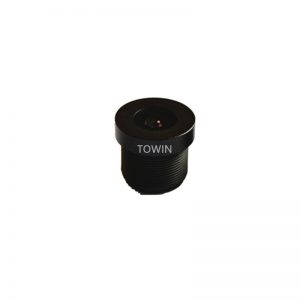



Fisheye Lens – S01705721218F
10/11/2025
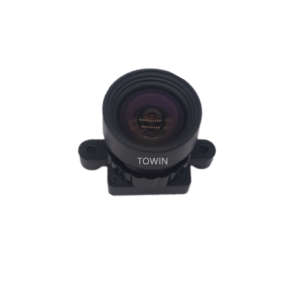
Fisheye Lens – S02212815022F – IMX224
10/12/2025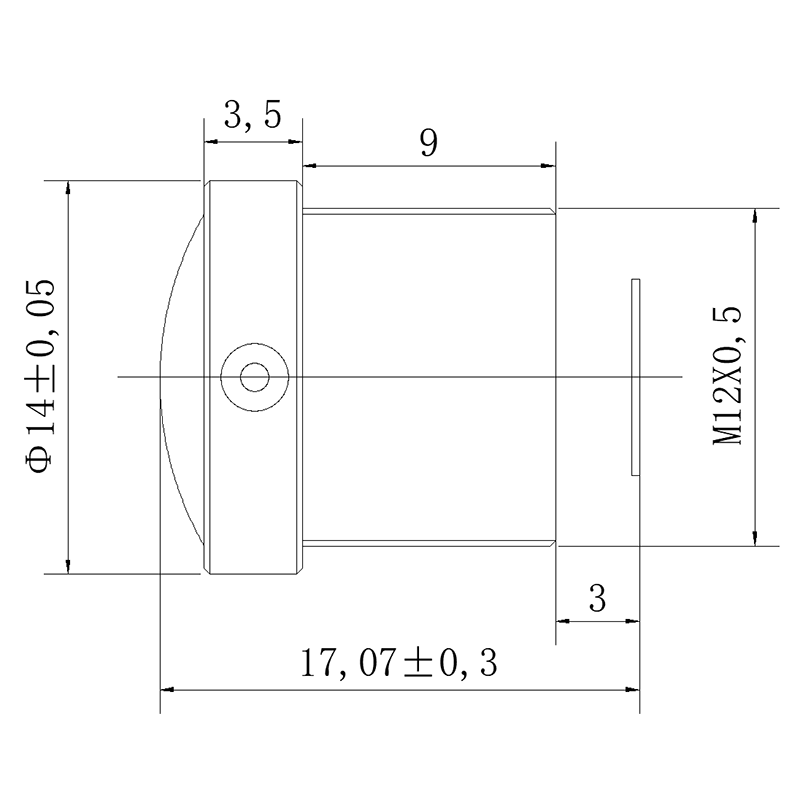
Fisheye Lens – S02212814824F
2.2mm M12 170° fisheye lens for IMX307 3MP cameras, featuring F2.4 aperture, 0.1m M.O.D., M12x0.5 mount, and 6G+IRCF structure.
S02212814824F is Wide-Angle 3-Megapixel Fisheye Lens with Built-In IR Filter, M12 Mount, 170° (Diagonal) F2.4 Lens for Security Surveillance.
| IMAGE FORMAT | Φ6.8 |
| FOCAL LENGTH | 2.2mm |
| F.O.V. (IMX307) | 170°(D=6.39) |
| 148°(H=5.57) | |
| 82°(V=3.13) | |
| RESOLUTION | 3 MP |
| TV DISTORTION | <-29% |
| APERTURE | F2.4 |
| MOUNT | M12x0.5 |
| IRIS | Fixed |
| M.O.D. | 0.1m |
| T.T.L. | 17.07mm |
| STRUCTURE | 6G+IRCF |
2.2mm M12 170° Fisheye Lens for IMX307 3MP Imaging
This 2.2mm M12 fisheye lens is designed for the IMX307 sensor, providing a 170° diagonal field of view with 148° horizontal coverage and 82° vertical coverage. With 3MP resolution, an F2.4 fixed aperture, 0.1m M.O.D., and M12x0.5 mount, it is suitable for compact machine vision, robotics, embedded imaging, and ultra-wide monitoring applications.
Product Core Highlights
- 170° diagonal FOV provides very broad scene coverage for compact camera systems.
- 148° horizontal FOV is well suited to applications requiring extensive lateral environmental visibility.
- 3MP resolution support provides practical image detail for embedded and industrial vision systems.
- 2.2mm fixed focal length delivers ultra-wide imaging without the complexity of a zoom mechanism.
- F2.4 fixed aperture provides a consistent optical configuration for embedded camera integration.
- 0.1m M.O.D. supports close-range wide-area imaging.
- M12x0.5 mount and 6G+IRCF structure facilitate integration into compact vision modules.
2.2mm M12 170° Fisheye Lens Applications
Core Application Scenes
The main advantage of this lens is its combination of a 2.2mm focal length and 170° diagonal field of view. Compared with conventional wide-angle M12 lenses, it can capture a substantially larger surrounding area from a single camera position, making it appropriate for systems where scene coverage is a primary optical requirement.
For embedded machine vision, the 170° diagonal FOV can be useful when a camera needs to monitor a large workspace from a relatively close position. The 3MP resolution provides sufficient image information for applications such as area observation, object presence monitoring, and environmental inspection where extreme pixel density is not the primary requirement.
In robotics vision, the 148° horizontal FOV provides broad lateral coverage around the camera. This can help compact robotic systems observe a larger portion of their operating environment without requiring multiple conventional lenses.
The 0.1m M.O.D. is particularly relevant to close-range imaging. When the camera is positioned near equipment, objects, or structures, the lens can maintain a very broad view while accommodating relatively short working distances.
For embedded monitoring systems, the M12x0.5 interface and 17.07mm TTL support integration into compact camera assemblies. The fixed iris also provides a straightforward optical configuration where manual or automatic iris adjustment is not required.
Because the specified TV distortion is < -29%, this lens should be treated as a dedicated fisheye optical solution rather than a conventional low-distortion wide-angle lens. If the application requires a rectilinear image or accurate geometric measurements, image dewarping should be incorporated into the camera or software pipeline.
Compatible Devices
This lens can be considered for:
- IMX307-based 3MP camera modules
- M12 embedded camera modules
- Compact machine vision cameras
- Robotics vision cameras
- Embedded AI vision devices
- Ultra-wide monitoring cameras
- Compact inspection cameras
- Environmental observation systems
- Wide-area imaging modules
- Fisheye camera systems
For additional M12 configurations, explore the M12 Lens product range; For other ultra-wide optical designs, visit the Fisheye Lens category.
For applications requiring broad image coverage in automated systems, see the Machine Vision solution; For robotic platforms requiring wide environmental visibility, see the Robotics Vision solution.
Use the FOV Calculator to evaluate field-of-view requirements when matching a lens to a specific camera and installation distance.
For additional guidance on choosing focal length and optical configuration, visit the Lens Selection Guide.
Designed for ultra-wide machine vision, robotics vision, and embedded fisheye imaging applications.
Frequently Asked Questions
Q: What is the field of view of this 2.2mm M12 lens?
A: With the specified IMX307 configuration, the lens provides a 170° diagonal FOV, 148° horizontal FOV, and 82° vertical FOV.
Q: Is this a fisheye lens?
A: Yes. The 170° diagonal field of view combined with TV distortion below -29% indicates a fisheye optical design.
Q: Is this lens a low distortion lens?
A: No. The TV distortion is specified at < -29%, which represents substantial optical distortion. This lens is intended for fisheye imaging rather than low-distortion applications.
Q: Is this lens compatible with the IMX307?
A: Yes. The FOV specification is provided for the IMX307 sensor, and the lens supports 3MP imaging.
Q: What is the minimum object distance of this lens?
A: The specified M.O.D. is 0.1m, making the lens suitable for relatively close-range ultra-wide imaging.
Q: What does the F2.4 aperture mean?
A: F2.4 is the fixed aperture specification of the lens. It provides a consistent optical configuration for camera modules that do not require adjustable iris control.
Q: What does IRCF mean in the 6G+IRCF structure?
A: IRCF refers to an infrared cut filter. It should not be interpreted as IR correction. The filter is used to control infrared wavelengths reaching the image sensor.
Q: Can the fisheye distortion be corrected?
A: Yes. Depending on the camera system, software-based fisheye correction or dewarping can be used to transform the highly distorted fisheye image into a more conventional viewing geometry.
Online contact