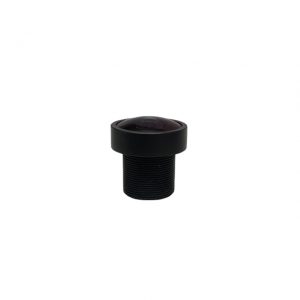



Fisheye Lens – S7018020F
11/10/2025
TOF Lens – S01714012013IRB9
11/12/2025
Fisheye Lens – S7820026F
2.29mm M12 8MP fisheye CCTV lens for AR0821 with 199° FOV, F2.6 aperture, M12 × 0.5 mount, 0.2m M.O.D., and integrated IRCF for ultra-wide panoramic imaging.
S7820026F is 8-Megapixel Fisheye CCTV lens with Built-In IR Filter, 199° diagonal M12x0.5 mount, F2.6 aperture, and for security surveillance.
| IMAGE FORMAT | Max Φ7.79mm |
| FOCAL LENGTH | 2.29mm |
| F.O.V.(AR0821) | 199°(D=9.28) |
| 199°(H=8.08) | |
| 90°(V=4.55) | |
| RESOLUTION | 8 MP |
| DISTORTION | <-98% |
| APERTURE | F2.6 |
| MOUNT | M12x0.5 |
| IRIS | Fixed |
| M.O.D. | 0.2m |
| T.T.L. | 22.98mm |
| STRUCTURE | With IRCF |
2.29mm M12 8MP Fisheye CCTV Lens
This 2.29mm M12 8MP fisheye CCTV lens is designed for high-resolution ultra-wide-angle imaging where extensive scene coverage is required from a compact camera module. Optimized for the AR0821 sensor, it provides up to 199° diagonal and horizontal FOV, F2.6 aperture, integrated IRCF, and M12 × 0.5 mounting for panoramic surveillance, robotics, embedded vision, and spatial-awareness applications.
M12 Fisheye Lens Core Highlights
- 199° Ultra-Wide FOV: Captures an exceptionally broad scene with a single compact camera.
- 8MP High Resolution: Provides detailed imagery for wide-area monitoring and vision processing.
- 2.29mm Fisheye Design: Combines an ultra-short focal length with extreme scene coverage.
- AR0821 Compatibility: Designed around the optical requirements of the specified 8MP sensor.
- Integrated IRCF: Supports camera modules requiring built-in IR-cut filtering.
M12 8MP Fisheye Lens Applications
Core Application Scenes
This 2.29mm M12 fisheye lens is designed for vision systems that need to capture an exceptionally broad environment from a compact installation point. With up to 199° diagonal and horizontal FOV, it can cover a much larger surrounding scene than conventional rectilinear lenses, making it suitable for panoramic observation, spatial awareness, and wide-area monitoring.
The 8MP resolution gives this lens an advantage in applications where broad coverage needs to be combined with detailed source imagery. It can be used in panoramic camera modules where the captured image is subsequently processed, corrected, or analyzed by an ISP, computer vision system, or AI algorithm.
For smart security equipment, the extreme FOV can be useful in ceiling-mounted panoramic cameras, compact indoor monitoring devices, and specialized surveillance modules. The single-camera architecture can provide broad scene visibility where installing several conventional cameras would increase system complexity.
The lens can also be used in robotic vision systems that require broad near-field environmental awareness. A fisheye camera can complement narrower forward-facing cameras by providing additional peripheral scene information around the robotic platform.
For compact embedded camera development, engineers can explore Towin’s M12 Lens solutions when evaluating this type of ultra-wide optical configuration.
Compatible Device List
- Panoramic Security Cameras: Suitable for compact monitoring modules requiring exceptionally broad scene coverage.
- Ceiling-Mounted Vision Cameras: The ultra-wide FOV can capture extensive indoor areas from a single camera position.
- Robotics Vision Modules: Provides broad peripheral and near-field environmental information for mobile robotic platforms.
- 8MP Embedded AI Cameras: High-resolution imagery can provide source data for object detection, scene analysis, and AI vision processing.
- Compact IoT Vision Devices: The M12 × 0.5 mount and 22.98mm TTL support compact camera-module integration.
- Specialized Wide-Area Imaging Systems: Suitable for applications where extreme viewing angles are required and fisheye image processing is available.
Designed for high-resolution panoramic surveillance, robotic environmental awareness, and ultra-wide embedded vision applications.
199° Fisheye Imaging Performance
The primary optical characteristic of this lens is its 199° diagonal and horizontal FOV, combined with a 90° vertical FOV when paired with the specified AR0821 sensor.
This extremely large viewing angle places the lens firmly within the fisheye lens category. It is designed to capture a very broad scene using a compact optical assembly rather than maintain the straight-line geometry associated with conventional rectilinear lenses.
The specified distortion of less than -98% is therefore an important part of the optical projection. It should not be interpreted as a low-distortion specification. Instead, the high distortion enables the lens to compress a very large viewing area into the camera sensor.
For systems adopting digital distortion correction, panoramic stitching, or computer‑vision algorithms, system designers must account for optical projection alongside the camera ISP and downstream image‑processing pipeline.
Engineers can review the Distortion Guide when evaluating how fisheye distortion affects image geometry and image processing.
AR0821 & 8MP Sensor Compatibility
This lens is specified for the AR0821 sensor and provides 8MP imaging performance. Its maximum image format measures Φ7.79 mm, so system integrators must verify the sensor’s active imaging area against the lens image circle during integration work.
The 2.29mm focal length should also be evaluated together with sensor format and the desired field coverage. With an extreme FOV, the actual image projection and usable coverage depend on the sensor and optical configuration rather than focal length alone.
The Sensor Guide can help engineers evaluate sensor-format compatibility. For estimating coverage during camera development, the FOV Calculator can also be used to compare focal length, sensor format, and field of view.
Compact M12 Optical Integration
The M12 × 0.5 mount, 22.98mm TTL, and fixed F2.6 aperture make this lens suitable for compact embedded camera designs. The 0.2 m M.O.D. also delivers close‑range imaging capability for applications that place the camera relatively near the monitored environment.
The lens is specified With IRCF, incorporating an IR-cut filter configuration into the optical assembly. This can simplify integration into visible-light camera modules that require IR filtering.
For additional M12 optical configurations, engineers can compare this lens with the M12 Lenses product range.
Fisheye Lens Selection Considerations
When selecting an extreme fisheye lens, engineers should evaluate more than the nominal FOV. Sensor compatibility, image circle, distortion behavior, working distance, image-processing requirements, and camera housing constraints should all be considered.
The 199° horizontal FOV makes this lens suitable for applications where peripheral or surrounding scene information is important. However, users must evaluate the resulting fisheye image alongside the target correction or image‑analysis method.
For general optical selection, the Lens Selection Guide can help engineers compare focal length, sensor format, field of view, and application requirements.
Frequently Asked Questions
Q: Is this a fisheye lens?
A: Yes. The lens provides up to 199° diagonal and horizontal FOV with -98% distortion on the specified AR0821 configuration, clearly indicating an extreme fisheye design.
Q: What sensor is this 2.29mm M12 fisheye lens designed for?
A: The specified FOV data is based on the AR0821 sensor. The lens has a maximum image format of Φ7.79mm and supports 8MP imaging.
Q: What is the field of view of this lens?
A: With the specified AR0821 configuration, the FOV is 199° diagonal, 199° horizontal, and 90° vertical.
Q: Why is the distortion as high as -98%?
A: The high distortion is a characteristic of the extreme fisheye projection. It allows the lens to capture a very large viewing area within a compact camera sensor.
Q: Is this lens suitable for CCTV applications?
A: Yes. Its extreme field of view is suitable for specialized panoramic and wide-area surveillance cameras where broad scene coverage is required.
Q: Can this lens be used for robotics vision?
A: Yes. The 199° FOV can provide broad peripheral and near-field environmental information for mobile robots and embedded robotic vision systems.
Q: What mount does this fisheye lens use?
A: It uses an M12 × 0.5 mount, making it suitable for compact embedded camera modules and miniature vision equipment.
Q: Does this lens include an IRCF?
A: Yes. The specification states With IRCF, indicating that an IR-cut filter configuration is integrated into the optical assembly.
Related Resources
Engineers evaluating ultra-wide and fisheye optical systems can review Lens Basics for fundamental information about focal length, field of view, and optical imaging.
For panoramic security applications, the Smart Security solution provides a relevant reference for wide-area surveillance and embedded camera development.
For robotic applications requiring broad environmental perception, the Robotics Vision solution provides additional information about optical requirements for robotic imaging systems.
If a project requires a customized focal length, sensor configuration, M12 mount, housing, or optical filtering solution, engineers can Contact Towin to discuss the required configuration.
Online contact