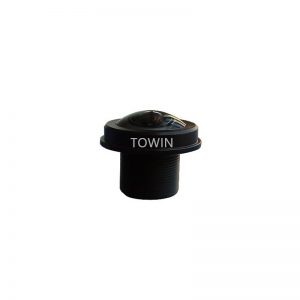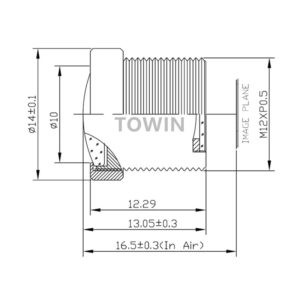



Fisheye Lens – S3122922
09/28/2025
Fisheye Lens – S3620018F
09/29/2025
Fisheye Lens – S3219020F
1mm M12 fisheye lens with 190° FOV, F2.0 aperture and M12 × 0.5 mount for panoramic, robotics and wide-area imaging.
S3219020F is 3-Megapixel Fisheye CCTV lens with Built-In IR Filter, Φ3.2, F2.0 Aperture, M12 mount, 190° F.O.V., for security surveillance.
| IMAGE FORMAT | Φ3.2 |
| FOCAL LENGTH | 1.0mm |
| F.O.V. | 190°(D) |
| 190°(H) | |
| 190°(V) | |
| RESOLUTION | 3 MP |
| TV DISTORTION | <-99% |
| APERTURE | F2.0 |
| MOUNT | M12x0.5 |
| IRIS | Fixed |
| M.O.D. | 0.3m |
| T.T.L. | 19.68mm |
| STRUCTURE | 6G+IRCF |
M12 1mm 190° Fisheye Lens
This 1mm M12 fisheye lens delivers an ultra-wide 190° field of view with 3MP resolution, making it suitable for panoramic and wide-area imaging systems. Its F2.0 fixed aperture, compact M12 × 0.5 mount, and 0.3m minimum object distance provide a practical optical solution for embedded cameras requiring maximum scene coverage.
The extremely wide viewing angle makes optical geometry an important consideration during camera design. Engineers can use the FOV Calculator to evaluate the required field coverage for different installation distances and sensor configurations.
M12 Fisheye Lens Core Highlights
- 190° Ultra-Wide FOV: Captures an exceptionally broad scene for panoramic and surround-view imaging.
- 1mm Ultra-Short Focal Length: Maximizes image coverage from a compact camera position.
- 3MP Resolution: Provides detailed imaging for wide-area monitoring applications.
- M12 × 0.5 Mount: Compatible with widely used compact embedded camera architectures.
- F2.0 Fixed Aperture: Provides a stable optical configuration for consistent imaging performance.
M12 1mm 190° Fisheye Lens Applications
Core Application Scenes
This 190° M12 fisheye lens is designed for applications where maximizing the visible scene is more important than maintaining conventional rectilinear image geometry. With a 1.0mm focal length and 190° field of view, it can capture an exceptionally broad area from a single compact camera position.
The lens is particularly suitable for panoramic monitoring, compact surround-view cameras, indoor spatial awareness, and embedded wide-area imaging. Its extreme FOV can reduce the number of cameras required to monitor a defined space, while the M12 × 0.5 mounting interface makes integration into compact camera housings straightforward.
For smart surveillance applications, the lens can be integrated into compact network camera modules or embedded vision devices where a very wide viewing area is required. It can also be used in robotics and autonomous systems for environmental awareness, where broad visual coverage helps detect objects approaching from different directions.
Because this is a true fisheye design with extremely high negative distortion, it should be selected when ultra-wide scene coverage and panoramic information are priorities rather than when accurate dimensional measurement or low-distortion machine vision is required. For engineers evaluating optical characteristics, the Lens Basics section provides useful background on focal length, FOV, and lens behavior.
Compatible Device List
- Panoramic Camera Modules: Suitable for compact cameras requiring an exceptionally wide viewing angle from a single optical channel.
- Smart Security Cameras: Can be integrated into wide-area surveillance devices for rooms, entrances, retail spaces, and other monitored environments.
- Robotics Vision Modules: The 190° FOV can provide broad environmental awareness for compact mobile robots and autonomous platforms.
- Embedded Vision Systems: The M12 × 0.5 mount allows integration into space-constrained camera modules and embedded imaging equipment.
- 360° and Surround-View Imaging Systems: Suitable for multi-camera panoramic architectures where each fisheye lens covers a large portion of the surrounding scene.
- Experimental AI Vision Platforms: The wide image coverage can support visual perception systems requiring broad scene acquisition before software-based image correction or panoramic processing.
For integrated robotics applications, the lens can be paired with TOWIN’s Robotics Vision solutions, particularly where wide environmental visibility is required.
Designed for ultra-wide panoramic monitoring, embedded vision, robotics perception, and wide-area imaging applications.
Frequently Asked Questions
Q: Is this a fisheye lens?
A: Yes. The 1.0mm focal length, 190° field of view, and TV distortion below -99% are characteristic of an ultra-wide fisheye optical design.
Q: What is the field of view of this M12 fisheye lens?
A: The specified FOV is 190° diagonally, horizontally, and vertically, providing extremely broad scene coverage from a single camera position.
Q: What is the focal length of this fisheye lens?
A: The lens uses a 1.0mm fixed focal length, optimized for extremely wide-angle imaging.
Q: Is this lens suitable for low-distortion machine vision?
A: No. This lens is designed for maximum wide-area coverage rather than low-distortion imaging. Its TV distortion is specified as less than -99%, which is consistent with its fisheye optical design.
Q: What camera mount does this fisheye lens use?
A: It uses an M12 × 0.5 mount, making it suitable for compact embedded camera modules and other M12-compatible camera assemblies.
Q: What is the minimum object distance of this M12 lens?
A: The specified M.O.D. is 0.3m, allowing the lens to capture scenes from relatively close installation positions while maintaining its ultra-wide viewing capability.
Q: What does IRCF mean in the lens specification?
A: IRCF generally refers to an IR Cut Filter. It should not be interpreted as proof that the lens is IR corrected. The supplied specification identifies the structure as 6G + IRCF.
Q: What applications are suitable for a 190° fisheye lens?
A: Typical applications include panoramic surveillance, wide-area monitoring, robotics perception, embedded vision, surround-view imaging, and other systems requiring exceptionally broad scene coverage.
For specific sensor, housing, optical, or mechanical requirements, customers can discuss their application with the TOWIN engineering team.
Online contact