


Fixed focal length C-mount industrial lenses
02/07/2026
C-mount vs CS-mount adapter compatibility guide
02/09/2026Choosing between spherical vs aspherical lenses is an important consideration in optical system design. Both lens types are widely used in imaging systems, but they differ in surface geometry, aberration correction capabilities, design complexity, and manufacturing requirements.
Spherical lenses offer a well-established and often cost-effective optical solution, while aspherical lenses provide additional design flexibility for controlling spherical aberration and optimizing compact optical systems. However, neither design is automatically better for every application.
For machine vision engineers, camera manufacturers, and industrial equipment buyers, the right choice depends on image quality requirements, sensor specifications, working distance, field of view, production volume, and overall system cost. This guide explains the key differences between spherical vs aspherical lenses and how to evaluate them for industrial imaging applications.
Key Takeaways
- Spherical lenses have surfaces based on a constant spherical radius and are widely used in conventional optical systems.
- Aspherical lenses use a more complex surface profile to provide additional control over spherical aberration.
- Aspherical designs can improve optical performance or reduce the number of elements in certain systems, but they require careful design and manufacturing.
- The best choice depends on resolution, field of view, distortion, working distance, sensor size, and budget.
- For industrial machine vision, complete lens performance matters more than whether a lens is simply spherical or aspherical.
1. What Is the Difference Between Spherical VS Aspherical Lenses?
The main difference between spherical vs aspherical lenses is the geometry of their optical surfaces.
A spherical lens has an optical surface that forms part of a sphere, with a constant radius of curvature across the surface. An aspherical lens has a surface profile that deviates from a perfect sphere, allowing the optical designer to control how light rays are refracted at different positions across the aperture.
This difference provides additional flexibility in correcting optical aberrations, particularly spherical aberration. It can also help optimize lens size, element count, and overall optical performance.
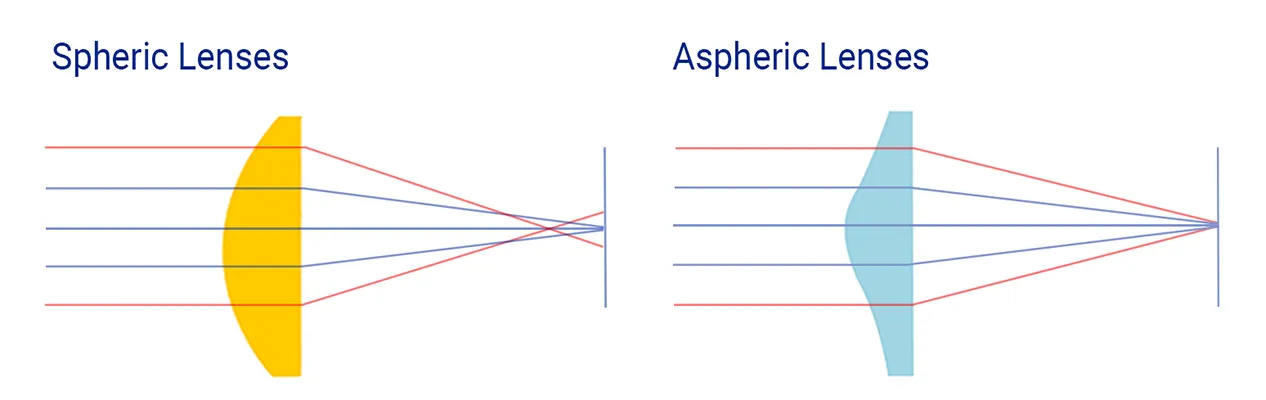
Spherical vs Aspherical Lenses
| Comparison | Spherical Lens | Aspherical Lens |
|---|---|---|
| Surface Geometry | Constant spherical curvature | Non-spherical surface profile |
| Optical Design | Conventional optical design | More flexible surface optimization |
| Spherical Aberration | May require additional correction | Can be significantly reduced through design |
| Element Count | May require additional elements | May reduce the number of elements |
| Manufacturing | Generally established processes | Requires process-specific precision control |
| Cost | Often economical for standard designs | Depends on design, process, and volume |
| Typical Applications | General imaging and industrial optics | Compact and aberration-sensitive optical systems |
2. How Do Spherical and Aspherical Lens Designs Work?
2.1 Spherical Lens Design
A spherical lens uses one or more optical surfaces with spherical curvature. Its surface shape is relatively straightforward to describe and manufacture, making spherical elements common in many conventional optical assemblies.
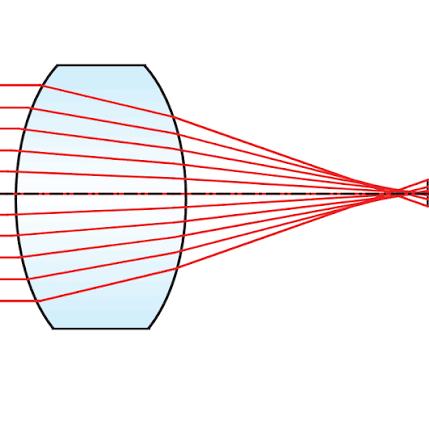
When parallel light rays pass through a spherical lens, rays near the optical axis and rays near the edge of the aperture may focus at different positions. This phenomenon is known as spherical aberration.
In practical optical systems, designers can control this aberration through lens curvature, glass selection, aperture size, element spacing, and multi-element optical configurations.
2.2 Aspherical Lens Design
An aspherical lens uses at least one optical surface whose profile is not part of a perfect sphere. Its curvature changes across the aperture according to the optical design.
This additional design freedom allows optical engineers to adjust the paths of marginal and paraxial rays more precisely. An appropriately designed aspherical surface can reduce spherical aberration and may also help control other aberrations when used as part of a complete optical system.
Aspherical elements are especially useful when an optical system needs a compact structure, controlled aberrations, or specific imaging performance without relying on a large number of conventional spherical elements.
Spherical aberration
3. Image Quality: Spherical vs Aspherical Lenses
Image quality is one of the main reasons optical designers consider aspherical surfaces. However, the comparison should focus on specific optical performance indicators rather than assuming that every aspherical lens produces a better image.
3.1 Spherical Aberration
Spherical aberration occurs when light rays passing through different zones of a spherical optical surface do not converge at exactly the same focal position.
Depending on the optical design and aperture, this can reduce image sharpness and contrast. Aspherical surfaces provide an additional degree of freedom for controlling this aberration.
3.2 Resolution and MTF Performance
Resolution describes the ability of an optical system to reproduce fine details. Modulation Transfer Function (MTF) is commonly used to evaluate how effectively a lens transfers contrast at different spatial frequencies.
An aspherical design may improve MTF performance when spherical aberration is a limiting factor. However, actual results depend on the complete optical prescription, including glass properties, surface accuracy, alignment, aperture, and sensor characteristics.
For industrial applications, it is important to evaluate image quality across the entire image field rather than considering only the center.
3.3 Distortion and Field Performance
Spherical and aspherical surface designs do not independently determine image distortion. Distortion is influenced by the entire optical configuration, including lens arrangement, focal length, field of view, and design constraints.
For machine vision measurement and automated inspection, low distortion can be especially important because geometric image errors may affect positioning and dimensional analysis.
Explore TOWIN low distortion lens options for applications that require controlled geometric imaging performance.
3.4 Light Transmission and Lens Structure
An aspherical element may allow an optical designer to reduce the number of lens elements in some systems. Fewer air-glass interfaces can potentially reduce reflection losses and simplify the optical assembly.
Nevertheless, overall transmission also depends on glass absorption, surface coatings, element count, and the quality of optical assembly. An aspherical surface alone does not guarantee higher transmission.
4. Spherical Lens Manufacturing vs Aspherical Lens Manufacturing
Manufacturing complexity is another important consideration when comparing spherical and aspherical lenses. Both designs require careful control of optical surface quality, dimensional accuracy, and inspection standards, but their production processes may differ considerably.
4.1 Spherical Lens Manufacturing
Spherical optical surfaces are commonly produced through processes such as grinding, polishing, centering, and optical coating.
Their relatively regular surface geometry supports established manufacturing and inspection methods. This can make spherical elements suitable for a wide range of standard optical designs and production volumes.
4.2 Aspherical Lens Manufacturing
Aspherical lens manufacturing requires the production and verification of a non-spherical surface profile. Depending on the optical material, geometry, precision requirements, and production volume, possible manufacturing approaches include:
- Precision glass molding: Used for suitable glass materials and production requirements.
- Precision grinding and polishing: Used when demanding surface accuracy and optical performance are required.
- Diamond turning: Used for suitable optical materials and specialized precision applications.
- Precision metrology: Used to verify surface form, irregularity, and other optical specifications.
The appropriate process depends on the material, aperture, aspheric departure, surface accuracy, roughness, and required production volume. Not every process is suitable for every aspherical lens.
4.3 What Determines the Cost Difference?
There is no universal price ratio between spherical and aspherical lenses. The cost difference should be evaluated for a specific optical design and manufacturing requirement.
| Cost Factor | What to Evaluate |
|---|---|
| Optical Design | Surface profile, number of elements, and design complexity |
| Material | Glass type, refractive index, and material availability |
| Manufacturing Process | Molding, grinding, polishing, and process time |
| Precision Requirements | Surface form, centering, surface roughness, and tolerances |
| Coating | Wavelength range, reflectance, and coating specifications |
| Production Volume | Tooling investment, setup costs, yield, and batch size |
For OEM and industrial imaging projects, the most useful comparison is often the total system cost rather than the price of an individual optical element. An aspherical design may have higher element costs but could simplify the assembly or reduce the number of components. A conventional spherical design may be more economical when its optical performance already meets the application requirements.
Learn more about industrial lens manufacturing and OEM/ODM optical solutions when evaluating lens development requirements.
5. Applications of Spherical and Aspherical Lenses
The right lens design depends on the imaging task, optical performance target, and system constraints. The following examples explain how both lens types can be considered in practical applications.
5.1 Industrial Machine Vision
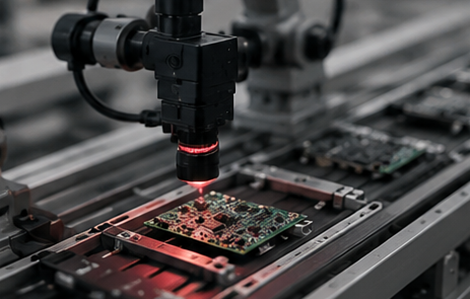
Machine vision systems are used for automated inspection, component recognition, dimensional measurement, and production-line quality control.
In these systems, lens selection should consider resolution, MTF performance, distortion, sensor size, working distance, and field of view. An aspherical element may be useful when aberration correction or compact optical construction is a key design requirement. A well-designed spherical lens assembly can also deliver suitable performance for many industrial imaging tasks.
Explore TOWIN machine vision lens solutions for inspection, automation, and industrial imaging applications.
Industrial Inspection
5.2 Robotics Vision and Factory Automation
Robotics vision systems need reliable image acquisition to support object detection, positioning, navigation, and automated handling.
In compact robotic cameras, an aspherical optical design may help control aberrations while maintaining a smaller optical structure. However, the final choice must also account for mounting space, focal length, field of view, depth of field, and environmental conditions.
See robotics vision lens applications for more information.
5.3 Automotive Imaging and ADAS
Automotive cameras are used in driver assistance, parking systems, surround-view imaging, and traffic perception. These applications may require compact optical structures, stable image quality, controlled distortion, and reliable performance under varying environmental conditions.
Aspherical surfaces can provide useful optical design flexibility, but automotive lens selection must evaluate the complete optical system and its operating environment.
Discover TOWIN ADAS imaging solutions for automotive camera applications.
5.4 Security and Surveillance Imaging
Security cameras need suitable image coverage, resolution, low-light performance, and reliable operation. Both spherical and aspherical optical designs can be used, depending on the required field of view, camera size, image sensor, and cost target.
The optical design should be evaluated according to the actual surveillance environment rather than selecting a lens based only on its surface geometry.
6. How to Choose Between Spherical and Aspherical Lenses
Selecting the right lens requires a systematic evaluation of the optical system. Before choosing a spherical or aspherical design, consider the following factors.
6.1 Define the Required Image Quality
Determine the resolution, contrast, MTF performance, and image quality required for the application. If spherical aberration is a major limitation, an aspherical design may provide an effective correction option.
6.2 Match the Lens to the Image Sensor
Sensor format and pixel size affect the optical performance requirements. A lens must provide suitable image coverage and resolution for the selected sensor. A high-resolution sensor cannot achieve its full potential if the lens does not deliver sufficient optical performance.
6.3 Evaluate Field of View and Working Distance
Focal length, object distance, sensor size, and field of view should be evaluated together. These parameters determine whether the lens can capture the required inspection area while maintaining appropriate image detail.
Use the TOWIN Field of View Calculator to estimate the relationship between focal length, sensor size, and field of view.
6.4 Consider Distortion and Measurement Accuracy
If the imaging system is used for dimensional measurement or precise object positioning, distortion should be evaluated as part of the optical specification. A dedicated low-distortion design may be more important than whether the lens uses spherical or aspherical surfaces.
6.5 Compare Total Cost and Production Requirements
Consider not only the initial lens price but also tooling, production volume, assembly, inspection, maintenance, and integration costs. The most suitable design is the one that meets the required imaging performance within the project’s budget and production constraints.
For a more comprehensive selection process, read the Industrial Lens Selection Guide.
7. Frequently Asked Questions
Q1: What is the main difference between spherical and aspherical lenses?
A: The main difference is their optical surface geometry. Spherical lenses have surfaces based on a constant spherical radius, while aspherical lenses use non-spherical surface profiles to provide additional control over light refraction and optical aberrations.
Q2: Are aspherical lenses always better than spherical lenses?
A: No. Aspherical lenses offer additional design flexibility and can reduce spherical aberration, but they are not automatically superior in every application. A properly designed spherical lens system may provide sufficient image quality at a more suitable cost.
Q3: Do aspherical lenses reduce spherical aberration?
A: Yes. An appropriately designed aspherical surface can significantly reduce spherical aberration by controlling how light rays are refracted across the optical aperture. The actual correction depends on the complete optical design.
Q4: Are spherical lenses cheaper to manufacture?
A: Spherical lenses are often more economical because their manufacturing processes are well established. However, actual costs depend on material, precision, surface size, production volume, and inspection requirements.
Q5: Can aspherical lenses improve machine vision image quality?
A: They can improve image quality when spherical aberration or other correctable optical limitations are affecting system performance. However, machine vision performance also depends on MTF, distortion, sensor matching, illumination, and mechanical alignment.
Q6: Which lens type is suitable for industrial inspection?
A: Both spherical and aspherical optical designs can be suitable. The choice depends on required resolution, field of view, distortion, working distance, sensor format, and budget. Industrial inspection systems should be evaluated using the complete optical performance specifications.
Q7: What information is needed when requesting a custom industrial lens?
A: Important information includes sensor size, resolution, pixel size, focal length, field of view, working distance, aperture, mounting requirements, distortion limits, operating environment, and estimated production volume. These details help optical engineers evaluate an appropriate lens design.
8. Conclusion: Choosing the Right Optical Design for Your Application
The comparison of spherical vs aspherical lenses is ultimately about balancing optical performance, manufacturing requirements, and application needs. Spherical lenses remain a practical choice for many conventional optical systems, while aspherical lenses provide additional flexibility for aberration correction and compact optical design.
For industrial imaging and machine vision, the most important decision is not simply choosing between spherical and aspherical surfaces. Engineers should evaluate the complete optical system, including resolution, MTF, distortion, sensor compatibility, field of view, working distance, and production cost.
TOWIN provides industrial imaging lens options for machine vision, automation, and other optical applications. If you are developing an industrial camera or evaluating lens requirements for a new project, explore our industrial lens manufacturing capabilities or contact our team to discuss your application requirements.
Looking for the Right Industrial Lens?
Share your sensor specifications, focal length, field of view, and application requirements with TOWIN to explore suitable industrial lens options.