


1/1.8″ vs 2/3″ Lens Sensor Size Compatibility
02/06/2026
Spherical vs Aspherical Lenses: Balancing image quality and manufacturing cost
02/08/2026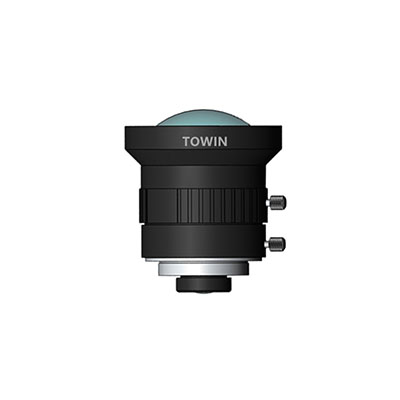
Introduction
In the era of industrial automation, machine vision systems are the backbone of quality control and operational efficiency—and the lens is the system’s “critical visual core.” Fixed focal C-Mount industrial lenses have become indispensable across electronics manufacturing, automotive component inspection, logistics sorting, and more, thanks to their standardized interface, reliable optical performance, and cost-effectiveness.
As a trusted manufacturer specializing in industrial optics, TOWIN has engineered a full range of fixed focal C-Mount lenses tailored to diverse industrial needs. This guide breaks down everything you need to know—from foundational definitions and key parameters to step-by-step selection, real-world applications, and product advantages—helping you make fast, informed decisions to maximize your machine vision system’s performance.
Foundational Knowledge: What Are Fixed Focal C-Mount Industrial Lenses?
1.1 What Is a C-Mount Lens?
A C-Mount lens is a standardized threaded optical lens with industry-unified technical specifications:
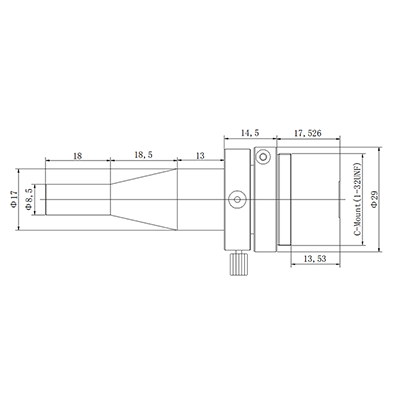
- Fixed flange focal length (B.F.L.): 17.526mm (distance between the lens mount and image sensor), ensuring compatibility across brands.
- Thread specification: 1-inch diameter with 32 threads per inch (1″-32 UN-2A), enabling secure, tool-free installation.
- Compact design: Ideal for space-constrained industrial setups, compatible with industrial cameras, surveillance devices, and machine vision terminals.
- Versatile optical adaptation: Works with cameras of varying resolutions and sensor sizes, from entry-level to professional-grade imaging.
1.2 What Is a Fixed Focal Industrial Lens?
A fixed focal (prime) industrial lens is designed for stable imaging in industrial environments, with a non-adjustable focal length:
- Optimized image quality: No focal length drift—delivers sharp, low-distortion results at a fixed magnification.
- Durable construction: Fewer moving parts reduce wear and maintenance costs, supporting 24/7 continuous operation.
- Superior light transmission: Optical design optimized for specific focal lengths, outperforming zoom lenses in light gathering under the same aperture.
- Cost-efficiency: Simplified manufacturing (no complex zoom mechanisms) makes them ideal for high-volume industrial applications.
1.3 Key Differences Between C-Mount and CS-Mount Interfaces (Critical for Selection)
Interface compatibility is make-or-break for lens performance. Here’s how C-Mount and CS-Mount—two common industrial interfaces—compare:
| Comparison Factor | C-Mount Interface | CS-Mount Interface |
| Flange Focal Length | 17.526mm (industry standard) | 12.5mm (compact design) |
| Compatible Devices | C-Mount industrial cameras, machine vision terminals | Native CS-Mount cameras; requires a 5mm spacer for C-Mount devices |
| Typical Applications | Industrial automation inspection, precision measurement, professional machine vision | Compact surveillance, lightweight imaging terminals, space-constrained basic inspection |
| Selection Risk | No sensor damage when installed correctly; stable compatibility | Risk of sensor scratches and misfocus if used with C-Mount cameras without a spacer |
Core Parameters: What to Look for When Selecting a Fixed Focal C-Mount Lens
A lens’s performance is defined by its key parameters—matching these to your application is critical to avoiding imaging issues. Here’s a breakdown of what matters most:
| Core Parameter | Definition | Selection Tips |
| Image Format/Sensor Size | Maximum sensor area the lens can cover (e.g., 1/1.8″, 2/3″, 1.1″, 1″) | Lens format ≥ camera sensor size to avoid vignetting/blur; e.g., 2/3″ sensor needs ≥2/3″ lens. |
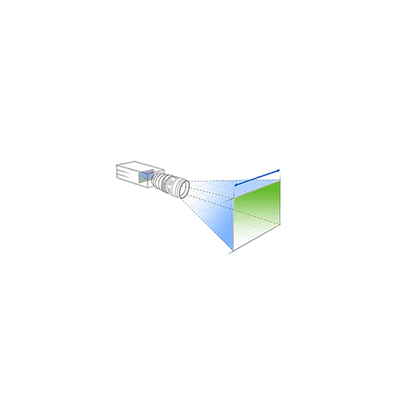
| Focal Length | Distance between lens optical center and image sensor (industrial specs: 2.2mm, 4.5mm, 6mm, 8mm, 12.5mm) | Inverse to F.O.V.: Shorter (2.2/4.5mm) = ultra-wide F.O.V. (large-area); longer (8/12.5mm) = narrow F.O.V. (long-distance magnification). |
| Field of View (F.O.V.) | Captured area (measured H/V/D) | Calculate by target size and working distance; e.g., 1m-wide object at 2m needs ≥30° diagonal F.O.V. |
| Resolution | Maximum effective pixel support (5MP, 10MP, 20MP mainstream) | 5-10MP for general defect detection; 10-20MP for high-precision tasks (e.g., micro-component measurement). |
| Aperture (F-Number) | Light transmission range (e.g., F1.4~16, F1.8~16, F2.8~16) | Small F-numbers (F1.4/F1.8) for low-light; large (F8~16) for deep depth of field (multi-layer inspection). |
| TV Distortion | Geometric distortion (industrial lenses: typically <2.5%) | <1% for measurement tasks; <2.5% sufficient for general imaging. |
| Minimum Object Distance (M.O.D.) | Closest sharp focus distance (common: 5mm, 0.1m) | 5mm for close-range inspection (e.g., PCB solder joints); 0.1m+ for long-distance monitoring. |
| Iris Control Type | Manual Iris or Auto Iris | Manual: Cost-effective, precise for stable lighting; Auto: Adapts to variable lighting (e.g., outdoor sorting). |
Core Benefits: Why Fixed Focal C-Mount Lenses Dominate Industrial Applications
Compared to zoom lenses or non-standard interface lenses, fixed focal C-Mount industrial lenses offer unmatched advantages for industrial use:
1. Standardized Interface Design: Compatibility and Flexibility Combined
- C-Mount Standardization: The 25.4 mm (1-inch) threaded locking interface ensures secure connections between lenses and industrial cameras or imaging systems, guaranteeing universal compatibility.
- Cross-Brand Interoperability: Lenses from different manufacturers seamlessly integrate with industrial cameras via C-mount, reducing system integration costs and eliminating waste from mismatched interfaces.
- Rapid Deployment and Maintenance: In automated production lines or security surveillance, users can swiftly swap lenses with varying focal lengths without complex adjustments, significantly cutting maintenance time. For example, in forestry fire monitoring projects, C-mount lenses reduced single-point installation time from 4 hours to under 90 minutes.
2. High-Precision Imaging: Meeting Industrial Inspection Demands
- Superior Optical Performance: Fixed focal lenses employ advanced optical designs to deliver high resolution, low distortion, and high contrast, ensuring sharp image details.
- Ultra-Low Distortion Control: In precision inspection fields (e.g., semiconductors, electronic components), lenses with distortion rates below 0.1% minimize measurement errors, enhancing accuracy.
- Large Aperture Design: Some lenses (e.g., TECHSPEC® C-Series) feature wide apertures (e.g., f/1.4), capturing clear images even in low-light conditions, adapting to complex industrial lighting environments.
3. Stability and Durability: Withstanding Harsh Industrial Conditions
- Robust Construction: Metal housings provide shockproof, dustproof, and waterproof capabilities, enduring extreme temperatures, humidity, and vibrations for long-term reliability.
- Strong Anti-Interference Performance: In scenarios with production line vibrations or rapid object movement, mechanical locking mechanisms reduce image blur, ensuring consistent imaging quality.
- Long Lifespan and Low Maintenance: The absence of motorized components reduces failure points, lowering maintenance costs and suitability for 24/7 industrial operations.
4. Cost-Effectiveness: Balancing Performance and Budget
- Affordable Pricing: Compared to motorized zoom lenses, fixed focal lenses have simpler structures, lower costs, and further price reductions through bulk purchases.
- Multi-Lens Strategy: Users can deploy multiple fixed focal lenses tailored to specific needs (e.g., wide-angle surveillance and macro inspection) at a lower total cost than a single high-end zoom lens.
- Long-Term ROI: High durability and low failure rates minimize equipment replacement frequency, reducing lifecycle costs.
5. Specialized Scenario Optimization: Addressing Industrial Pain Points
- Automated Production Lines: Fixed focal lenses monitor component positioning, dimensions, and defects in real time during assembly and quality checks, ensuring process compliance.
- Precision Inspection: In medical devices or semiconductor manufacturing, their high-precision imaging supports micron-level defect detection, meeting stringent industry standards.
- Security Surveillance: For border control or traffic management, fixed focal lenses combine with wide-angle or telephoto lenses for full-scene coverage, reducing missed detections.
6. Complementarity with Motorized Zoom Lenses
- Scenario-Specific Adaptability: Fixed focal lenses excel in applications with constant focal length requirements (e.g., fixed-station inspections), while motorized zoom lenses suit dynamic scenarios needing flexible adjustments (e.g., mobile surveillance).
- Technological Synergy: In complex industrial systems, fixed focal lenses handle routine inspections, and zoom lenses address anomalies, improving overall system efficiency.
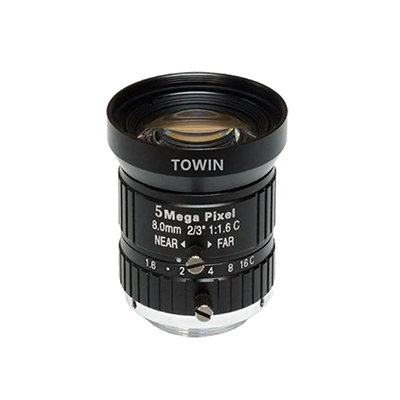
low distortion wide angle C-mount industrial lens
Step-by-Step Selection Process: How to Choose the Right Lens
Industrial applications vary widely—follow these 7 steps to select the perfect fixed focal C-Mount lens and avoid costly mistakes:
1: Confirm Camera Sensor Size & Match Image Format
Start by identifying your camera’s sensor size (e.g., 1/1.8″, 2/3″). The lens’s image format must equal or exceed the sensor size:
- Camera sensor = 1/1.8″ → Compatible lens formats: 1/1.8″, 2/3″, 1.1″
- Camera sensor = 2/3″ → Avoid 1/1.8″ lenses (risk of vignetting or cropped images)
2: Calculate Focal Length & F.O.V. Based on Your Application
Use this formula to find the required focal length (or adjust F.O.V. for existing lens options):
Focal Length (mm) = (Sensor Size (mm) × Working Distance (mm)) / Target Object Size (mm)
Example: Using a 2/3″ sensor (8.8mm horizontal size) to inspect a 100mm-wide part at 500mm working distance:
Focal Length = (8.8 × 500) / 100 = 44mm → Choose a lens with a similar focal length (e.g., 8mm, 12.5mm) or adjust F.O.V. accordingly.
3: Select Resolution Based on Inspection Precision
- General Inspection (e.g., part presence checks, surface scratches): 5MP–10MP
- High-Precision Tasks (e.g., micro-component measurement, print clarity checks): 10MP–20MP
4: Choose Aperture Range for Lighting Conditions
- Low-Light/Backlit Environments: Wide aperture (F1.4~F2.8) for better light gathering
- Bright/Deep Depth of Field Needs: Narrow aperture (F8~F16) for sharp foreground/background
5: Control Distortion for Your Task Type
- Geometric Measurement (e.g., part dimensions, gap checks): Ultra-low distortion (<1%) → TOWIN C0823028M10 (<1%), C0802316M5 (<0.75%)
- Visual Inspection (e.g., surface defects, color checks): Distortion <2.5% → TOWIN C0611018M20 (<2.5%)
6: Match M.O.D. to Working Distance
- Close-Range Inspection (<0.1m): M.O.D. ≤0.1m → TOWIN C02211828M10 (M.O.D. = 5mm)
- Long-Distance Inspection (>1m): M.O.D. ≥0.1m → Ensure clear focus at your operating distance
7: Select Iris Type for Lighting Stability
- Stable Lighting: Manual Iris (cost-effective, locked parameters for consistency)
- Variable Lighting: Auto Iris (real-time exposure adjustment to avoid detection errors)
2.2mm wide-angle lens
Real-World Applications: Where Fixed Focal C-Mount Lenses Excel
Fixed focal C-Mount lenses are versatile enough to power critical tasks across industries. Here’s how they’re used in key sectors:
1. Electronics Manufacturing
- Use Cases: PCB solder joint inspection, electronic component dimension measurement, chip pin defect detection
- Recommended Lenses: High-resolution (10MP–20MP) + ultra-low distortion models → TOWIN C0823028M10 (10MP), C0611018M20 (20MP)
- Key Requirement: Capture tiny defects to ensure assembly precision
2. Automotive Components
- Use Cases: Automotive screw tightening checks, component surface scratch detection, assembly gap measurement
- Recommended Lenses: Medium-to-long focal lengths (8mm–12.5mm) + deep depth of field → TOWIN C1201014M5 (12.5mm)
- Key Requirement: Long-distance inspection of large components with sharp detail
3. Logistics & Packaging
- Use Cases: Barcode/QR code scanning, package dimension measurement, label alignment checks
- Recommended Lenses: Ultra-wide angles (2.2mm–4.5mm) + fast focusing → TOWIN C02211828M10 (2.2mm, 180° F.O.V.), C04511828M5 (4.5mm)
- Key Requirement: Wide coverage for high-speed sorting lines
4. Medical & Life Sciences
- Use Cases: Medical device component inspection, lab sample imaging, microscope auxiliary imaging
- Recommended Lenses: High-resolution (10MP+) + low distortion → TOWIN C0802316M5 (5MP, <0.75% distortion)
- Key Requirement: Distortion-free imaging for medical-grade quality control
5. Industrial Security & Monitoring
- Use Cases: Workshop panoramic surveillance, hazard zone monitoring, equipment status checks
- Recommended Lenses: Ultra-wide angles (2.2mm–6mm) + rugged design → TOWIN C0611018M20 (6mm, 118° F.O.V.)
- Key Requirement: Large F.O.V. to cover wide areas in harsh industrial environments
TOWIN Fixed Focal C-Mount Lens Series: Key Advantages
TOWIN’s fixed focal C-Mount lenses are engineered to solve industrial pain points, with standout features:
1. Full-Spectrum Compatibility
- Focal lengths: 2.2mm (ultra-wide) to 12.5mm (standard)
- Sensor support: 1/1.8″, 2/3″, 1″, 1.1″
- Resolutions: 5MP, 10MP, 20MP → Balances cost and performance for every use case
2. Ultra-Low Distortion for Precision
- Select models (e.g., C0802316M5) offer distortion as low as 0.75%
- Most models <1% distortion—outperforming industry averages for measurement accuracy
3. Industrial-Grade Durability
- Metal housings + sealed construction: Dustproof, vibration-resistant, and temperature-tolerant (-10℃~60℃)
- Non-slip manual controls: Precise adjustment for frequent use without wear
4. Plug-and-Play Integration
- Strict adherence to C-Mount standards (17.526mm B.F.L., 1″-32 UN-2A threads)
- Compatible with Sony ICX674ALG, IMX178, e2v EV76C570, and other mainstream sensors
- Standardized mounting holes: No custom brackets required—fast installation
Recommended Models: TOWIN’s Top Fixed Focal C-Mount Lenses
Choose the perfect lens for your application with these high-performance options:
| Model | Key Specifications | Ideal For |
| C1201014M5 | 1″ sensor, 12.5mm focal length, 5MP, F1.4~16 aperture, <1.6% distortion, 15.6mm B.F.L. | General industrial imaging, medium-distance inspection, low-light environments |
| C0823028M10 | 2/3″ sensor, 8mm focal length, 10MP, F2.8~16 aperture, <1% distortion, 11.5mm B.F.L. | Precision inspection, low-distortion measurement, electronic component checks |
| C0802316M5 | 2/3″ sensor, 8mm focal length, 5MP, F1.6~C aperture, <0.75% distortion, 0.1m M.O.D. | Ultra-low distortion imaging, barcode scanning, biometrics |
| C0611018M20 | 1.1″ sensor, 6mm focal length, 20MP, F1.8~16 aperture, 118° diagonal F.O.V., <2.5% distortion | High-resolution large-area inspection, workshop panoramic monitoring |
| C04511828M5 | 1/1.8″ sensor, 4.5mm focal length, 5MP, F2.8~16 aperture, 82° horizontal F.O.V., 0.1m M.O.D. | Compact wide-angle applications, logistics sorting, small part inspection |
| C02211828M10 | 1/1.8″ sensor, 2.2mm focal length, 10MP, F2.8~16 aperture, 180° F.O.V., 5mm M.O.D. | Panoramic imaging, ultra-wide surveillance, close-range wide-angle inspection |
FAQs
Q1: Can C-Mount and CS-Mount lenses be used interchangeably?
A: Yes—with caveats:
- C-Mount lens → CS-Mount camera: Requires a 5mm spacer to compensate for B.F.L. differences (without it, focus fails and sensors may be damaged).
- CS-Mount lens → C-Mount camera: Not recommended—shorter B.F.L. prevents proper imaging.
Q2: Fixed focal vs. zoom lenses—Which is better for industrial use?
A: Prioritize fixed focal lenses for: Batch production inspection, stable lighting, and fixed task requirements (e.g., single-part inspection)—they’re more stable, cost-effective, and durable.Choose zoom lenses only if: You need to inspect multiple part sizes (frequent focal length adjustments) or require flexible F.O.V.—but expect higher costs and maintenance.
Q3: Does higher resolution always mean better image quality?
A: No—resolution must match your camera:
- 5MP camera + 20MP lens: Image quality equals 5MP (wasted lens capability).
- 20MP camera + 5MP lens: Insufficient detail for high-precision tasks.
- Rule of thumb: Lens resolution ≥ camera resolution, aligned with your inspection needs.
Q4: Is a shorter minimum object distance (M.O.D.) always better?
A: It depends on your working distance:
- Close-range inspection (<0.1m): Shorter M.O.D. (e.g., 5mm) enables macro imaging.
- Long-distance inspection (>1m): Short M.O.D. adds no value—choose a lens matched to your operating distance.
Q5: How do I ensure TOWIN lenses are compatible with my camera?
A: TOWIN lenses adhere strictly to C-Mount standards:
- 17.526mm B.F.L. and 1″-32 UN-2A threads.
- Compatible with mainstream sensors (Sony, e2v, etc.).
- Free compatibility testing available—contact our technical team to verify your camera model.
Conclusion
Fixed focal C-Mount industrial lenses are the backbone of high-performance machine vision systems—their compatibility, stability, and cost-effectiveness directly impact industrial automation precision and efficiency. With this guide’s foundational knowledge, step-by-step selection process, and application insights, you’re equipped to choose the perfect lens for your needs.
TOWIN’s fixed focal C-Mount series—with ultra-low distortion, full-resolution coverage, and rugged industrial design—delivers reliable performance across electronics, automotive, logistics, and more. Whether you need ultra-wide panoramic imaging or high-precision measurement, TOWIN has a tailored solution.