


How to Choose a CS-Mount Lens for Industrial Cameras
11/13/2026
What Is MTF in an Industrial Camera Lens?
11/20/2026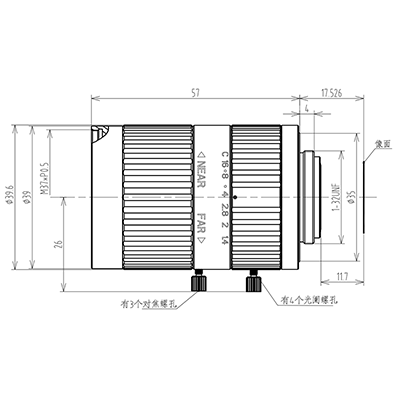
When should you use a C-Mount industrial lens? This is an important question when designing an industrial imaging system, selecting a machine vision camera, or upgrading an existing inspection setup. The lens mount affects mechanical compatibility, while the optical design determines image quality, sensor coverage, and overall imaging performance.
C-Mount lenses are widely used in machine vision, factory automation, industrial inspection, and precision measurement. Their standardized threaded interface and broad range of focal lengths, sensor formats, and optical configurations make them suitable for many industrial imaging requirements.
However, C-Mount is not necessarily the best choice for every camera system. M12 and CS-Mount lenses may be more appropriate when compact dimensions, specific camera compatibility, or surveillance requirements are important.
In this guide, we explain when to use a C-Mount industrial lens, its main advantages, how it compares with M12 and CS-Mount lenses, and which industrial applications can benefit from this lens format.
1. When Should You Use a C-Mount Industrial Lens?
A C-Mount industrial lens is a suitable choice when your camera supports the C-Mount interface and your application requires an appropriate combination of optical performance, sensor coverage, focal length flexibility, and mechanical integration.
There are several situations where choosing a C-Mount lens makes practical sense.
1.1 When Your Industrial Camera Uses a Standard C-Mount Interface
If your industrial camera is designed with a standard C-Mount interface, using a compatible C-Mount lens provides a straightforward mechanical connection without requiring an additional mount adapter.
A standard C-Mount uses a 1-inch, 32-threads-per-inch mounting thread (1″-32 UN) and has a flange focal distance of 17.526 mm.
This interface is widely used in industrial cameras, including many USB3 Vision, GigE Vision, and other machine vision camera systems.
Before installation, verify the camera’s mount specification, flange geometry, back focal clearance, and available mechanical space. Mechanical compatibility should always be confirmed using the camera and lens specifications.
1.2 When Your Application Requires Larger Sensor Coverage
C-Mount lenses are available in a variety of optical designs for different sensor formats. They can be suitable for industrial cameras with 1/2-inch, 2/3-inch, 1-inch, 1.1-inch, and larger sensors when the specific lens provides sufficient image circle coverage.
This flexibility is particularly useful when developing high-resolution inspection systems or upgrading camera sensors without changing the entire imaging configuration.
However, not every C-Mount lens supports every sensor size. Always check the specified image circle and maximum compatible sensor format to avoid vignetting and insufficient edge coverage.
1.3 When High-Resolution Industrial Imaging Is Required
For applications involving small defects, fine structures, or detailed component inspection, a suitable high-resolution C-Mount lens can help a camera capture the required image information.
Typical applications include:
- PCB and electronic component inspection.
- Semiconductor and precision component inspection.
- Surface defect detection.
- Automated optical inspection (AOI).
- Industrial product recognition.
When selecting a high-resolution lens, consider more than the megapixel rating. Lens MTF, pixel size, edge sharpness, image circle, and illumination conditions all influence the final image quality.
Explore TOWIN high-resolution C-Mount industrial lenses to compare available optical configurations for different camera sensors.
1.4 When Low Distortion Is Important for Measurement
In industrial measurement systems, accurate image geometry is essential. Lens distortion can change the apparent shape and position of objects, potentially affecting dimensional measurements and positioning results.
A low-distortion C-Mount lens is worth considering for:
- Dimensional measurement and metrology.
- PCB inspection and component alignment.
- Precision positioning.
- Automated optical inspection.
- Industrial calibration systems.
For these applications, check the actual distortion specification of the lens rather than assuming that every C-Mount lens provides low-distortion imaging.
Learn more about lens distortion in industrial vision systems and explore TOWIN’s C-Mount lens range for suitable low-distortion options.
1.5 When You Need Flexible Focal Length and Optical Configurations
Industrial imaging applications have different field-of-view, working-distance, and magnification requirements.
C-Mount lenses are available in different focal lengths and optical configurations, including:
- Fixed focal length lenses for stable inspection setups.
- Wide-angle lenses for larger inspection areas.
- Long focal length lenses for narrower fields of view.
- Varifocal lenses for adjustable imaging coverage.
- High-resolution lenses for detailed inspection.
- FA lenses for factory automation.
This variety allows engineers to configure an imaging system according to the camera sensor, target size, working distance, and inspection requirements.
1.6 When Your System Requires Stable Industrial Imaging
In automated production environments, cameras often need to capture consistent images over long operating periods.
C-Mount industrial lenses are commonly integrated into fixed inspection stations, production lines, robotic vision systems, and automated measurement equipment.
For these applications, lens selection should consider not only optical performance but also mechanical stability, focusing arrangements, aperture adjustment, operating conditions, and integration requirements.
2. Key Advantages of C-Mount Industrial Lenses
The popularity of C-Mount lenses in industrial imaging comes from their mechanical standardization and the broad selection of compatible optical designs.
| Advantage | Industrial Benefit |
|---|---|
| Standardized Interface | Simplifies integration with compatible industrial cameras. |
| Broad Lens Selection | Provides different focal lengths and optical configurations. |
| Sensor Format Options | Supports different sensor formats when the image circle is sufficient. |
| High-Resolution Options | Suitable models support detailed industrial inspection. |
| Optical Flexibility | Available in low-distortion, FA, wide-angle, and specialized designs. |
| System Integration | Suitable for various fixed industrial imaging configurations. |
It is important to remember that C-Mount describes the mechanical interface rather than a guaranteed level of optical performance. The actual image quality depends on the specific lens design and its compatibility with the camera.
3. C-Mount vs M12 vs CS-Mount: Which One Should You Use?
Choosing the correct lens mount is an important step in industrial camera integration. C-Mount, M12, and CS-Mount lenses have different mechanical characteristics and are commonly used in different imaging configurations.
The following comparison highlights their main differences.
| Comparison | C-Mount | M12 / S-Mount | CS-Mount |
|---|---|---|---|
| Thread | 1″-32 UN | Typically M12×0.5 | 1″-32 UN |
| Flange Focal Distance | 17.526 mm | Design-dependent | 12.526 mm |
| Typical System | Industrial cameras | Compact board cameras | Compatible CCTV and camera systems |
| Lens Options | Broad industrial optical configurations | Compact optical configurations | Fixed and varifocal designs |
| Typical Applications | Machine vision, FA, inspection | Embedded vision, robotics, compact AI cameras | CCTV, IP cameras, surveillance |
| Main Consideration | Sensor coverage and optical performance | Size and camera integration | Camera compatibility and imaging requirements |
3.1 C-Mount vs M12: When Should You Choose Each?
C-Mount lenses are often suitable for industrial cameras that require a broad selection of focal lengths, sensor coverage options, and specialized optical configurations.
M12 lenses have a more compact mechanical design and are commonly used in embedded vision systems, board cameras, compact AI cameras, and space-constrained imaging devices.
Choose C-Mount when your industrial camera supports the interface and your application benefits from the available industrial optical configurations. Choose M12 when compact dimensions, lightweight integration, and the camera’s mechanical design are more important.
Explore TOWIN M12 lenses for compact imaging systems or browse the C-Mount industrial lens range for machine vision applications.
3.2 C-Mount vs CS-Mount: What Is the Difference?
C-Mount and CS-Mount lenses share the same 1″-32 UN mounting thread, but their flange focal distances are different.
- C-Mount: 17.526 mm.
- CS-Mount: 12.526 mm.
A C-Mount lens can generally be installed on a compatible CS-Mount camera using a 5 mm C-to-CS adapter or spacer to compensate for the flange focal distance difference. The camera and adapter specifications should still be checked.
CS-Mount lenses are commonly used in CCTV, IP cameras, and surveillance systems, including fixed focal length, varifocal, and IR-corrected configurations.
If your project involves security monitoring or day-and-night imaging, explore TOWIN CS-Mount lenses.
For a broader explanation, read our related guide: How to Choose a C-Mount Lens for Machine Vision.
4. Which Industrial Applications Benefit from C-Mount Lenses?
C-Mount lenses are widely used across industrial imaging because different optical configurations can support different inspection and automation requirements.
However, the most suitable lens depends on the actual application, including the target size, camera sensor, working distance, illumination, and required image detail.
4.1 Machine Vision and Industrial Inspection
Machine vision systems use industrial cameras and lenses to capture images for automated inspection, defect detection, product recognition, and quality control.
C-Mount lenses are suitable for many machine vision systems because compatible models are available with different focal lengths, sensor formats, and optical performance specifications.
Typical requirements include sufficient resolution, appropriate field of view, suitable image circle coverage, and controlled distortion.
Learn more about TOWIN Machine Vision applications.
4.2 Factory Automation
Factory automation systems use machine vision to support automated positioning, assembly verification, production monitoring, and quality inspection.
For these applications, a C-Mount FA lens can provide an appropriate optical configuration for the camera and inspection station.
Engineers should consider working distance, field of view, depth of field, image sharpness, and mechanical integration when selecting the lens.
4.3 Precision Measurement and Dimensional Inspection
Precision measurement systems require images that preserve important geometric details. Lens distortion, resolution, edge sharpness, and system calibration can all influence measurement results.
A low-distortion C-Mount lens may be suitable for applications such as component measurement, PCB inspection, dimensional verification, and optical inspection.
For demanding metrology applications, telecentric optics may also be worth evaluating, depending on the required magnification stability and measurement accuracy.
4.4 OCR and Barcode Recognition
Optical character recognition (OCR) and barcode recognition systems require sufficient image detail and suitable contrast to identify printed characters, labels, and codes.
A C-Mount lens can be a suitable choice when the camera needs a specific field of view, working distance, and image resolution.
Lens selection should account for the smallest character or code element that must be recognized, together with lighting, exposure time, and target movement.
4.5 Robotics Vision
Robotic vision systems use cameras to identify objects, determine positions, guide robotic movements, and support automated picking and assembly.
C-Mount lenses can be used in robotic vision setups where the camera supports the interface and the selected lens provides the necessary field of view, resolution, and working distance.
For compact robotic camera modules, M12 lenses may also be a practical alternative. The final choice should reflect the mechanical and optical requirements of the complete system.
Explore TOWIN industrial vision solutions to learn more about machine vision, robotics, and other application-specific imaging requirements.
5. When Should You Choose Another Lens Mount?
Although C-Mount lenses are widely used in industrial imaging, they are not the ideal solution for every camera system. Choosing another lens mount may be more practical when the mechanical or optical requirements are different.
5.1 Choose M12 Lenses for Compact Imaging Systems
M12 lenses are often preferred for small cameras, embedded vision modules, compact AI imaging devices, and systems where installation space and weight are limited.
Their compact design makes them useful for robotics, automotive cameras, drones, and other embedded imaging applications.
Explore M12 industrial and board lenses for compact camera integration.
5.2 Choose CS-Mount Lenses for Compatible Surveillance Systems
CS-Mount lenses are commonly used in CCTV and IP camera systems. Available configurations include fixed focal length, varifocal, manual iris, DC auto iris, P-Iris, and IR-corrected lenses.
They are worth considering when your camera uses a CS-Mount interface and the application involves security monitoring, surveillance, or day-and-night imaging.
View TOWIN CS-Mount camera lenses for available product configurations.
5.3 Consider Custom Optical Designs for Specialized Requirements
Some industrial projects require optical characteristics or mechanical dimensions that are not available in standard lens products.
These requirements may include special focal lengths, customized image circles, low distortion, specific sensor compatibility, unique mechanical dimensions, or particular wavelength performance.
When standard products do not meet the project requirements, a custom optical solution may be worth evaluating.
Contact TOWIN’s optical engineering team to discuss your camera specifications and application requirements.
6. How to Select the Right C-Mount Industrial Lens
After determining that C-Mount is suitable for your camera system, the next step is to identify a lens that matches the actual imaging requirements.
Use the following workflow as an initial selection checklist.
Step 1: Confirm Camera Compatibility
Verify that the camera supports a standard C-Mount interface. Check the mounting thread, flange focal distance, mechanical clearance, and installation requirements.
Step 2: Identify Sensor Size and Image Circle
Confirm the camera sensor format and active sensor dimensions. The lens image circle must cover the sensor to prevent vignetting and incomplete image coverage.
Step 3: Define Field of View and Working Distance
Determine the target area that needs to be captured and the available distance between the lens and the object.
Use the TOWIN FOV Calculator to estimate the required field of view and compare possible focal lengths.
Step 4: Match Resolution and Optical Performance
Check the camera resolution, pixel size, lens resolving capability, and MTF performance. For high-resolution inspection, consider both center and edge image quality.
Step 5: Evaluate Distortion, Aperture, and Depth of Field
Choose an appropriate distortion level for the application. Consider the available lighting, required exposure time, object height variation, and acceptable depth of field.
Step 6: Verify the Complete Imaging System
Before finalizing a lens model, evaluate it with the actual camera, target, illumination, and installation conditions. Check image coverage, sharpness, focus stability, distortion, and inspection performance.
For a more detailed selection process, refer to the Industrial Lens Selection Guide.
Explore TOWIN C-Mount Industrial Lenses
TOWIN offers C-Mount lens configurations for machine vision, factory automation, industrial inspection, traffic monitoring, and high-resolution imaging.
Compare focal length, sensor compatibility, resolution, field of view, distortion, and aperture to identify a suitable lens for your project.
7. Frequently Asked Questions
Q1: When should you use a C-Mount industrial lens?
A: Use a C-Mount industrial lens when your camera supports the standard C-Mount interface and your application requires suitable sensor coverage, flexible focal length options, and appropriate optical performance. C-Mount lenses are commonly used in machine vision, factory automation, industrial inspection, and precision measurement.
Q2: Are C-Mount lenses suitable for machine vision?
A: Yes. C-Mount lenses are widely used in machine vision because they are available in different focal lengths, sensor formats, resolutions, and optical configurations. The correct model should be selected according to sensor size, image circle, FOV, working distance, resolution, and distortion requirements.
Q3: What is the difference between C-Mount and M12 lenses?
A: C-Mount lenses use a 1″-32 UN threaded interface and are commonly used with industrial cameras. M12 lenses typically use an M12×0.5 thread and have a more compact design for board cameras and embedded imaging systems. The best choice depends on camera compatibility, mechanical space, sensor coverage, and optical requirements.
Q4: Can a C-Mount lens be used with a CS-Mount camera?
A: Yes. A C-Mount lens can generally be used with a compatible CS-Mount camera by adding a 5 mm C-to-CS adapter or spacer. This compensates for the difference between the standard C-Mount and CS-Mount flange focal distances. Always verify camera compatibility and mechanical clearance.
Q5: Are all C-Mount lenses compatible with 1-inch or larger sensors?
A: No. Sensor compatibility depends on the lens image circle and optical performance. A C-Mount lens designed for a smaller sensor may produce vignetting or insufficient edge coverage on a larger sensor. Always check the specified sensor format and image circle before purchasing.
Q6: Is a C-Mount lens better than an M12 lens for industrial inspection?
A: Not necessarily. C-Mount lenses offer a broad range of industrial optical configurations, while M12 lenses are useful for compact and embedded imaging systems. The correct choice depends on the inspection requirements, camera interface, sensor size, optical performance, and installation constraints.
Q7: Can TOWIN provide customized C-Mount industrial lenses?
A: TOWIN can evaluate customized industrial lens requirements according to sensor size, focal length, FOV, resolution, distortion, and mechanical dimensions. If standard products do not fully meet your application needs, contact TOWIN to discuss the feasibility of an OEM/ODM optical solution.
8. Conclusion
Choosing the right industrial lens requires understanding both the camera interface and the optical requirements of the imaging system. When should you use a C-Mount industrial lens? It is a suitable option when your industrial camera supports C-Mount and your application requires flexible optical configurations, appropriate sensor coverage, and reliable imaging performance.
For machine vision, factory automation, high-resolution inspection, and precision measurement, the right C-Mount lens should be selected according to sensor size, image circle, focal length, FOV, working distance, resolution, and distortion.
TOWIN provides a range of C-Mount industrial lenses for different imaging requirements, together with optical engineering and OEM/ODM support. Explore our C-Mount lens products or contact TOWIN to discuss the right optical solution for your project.