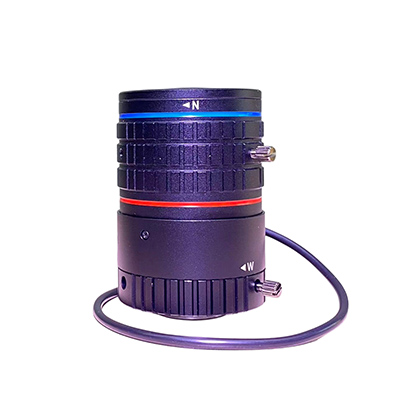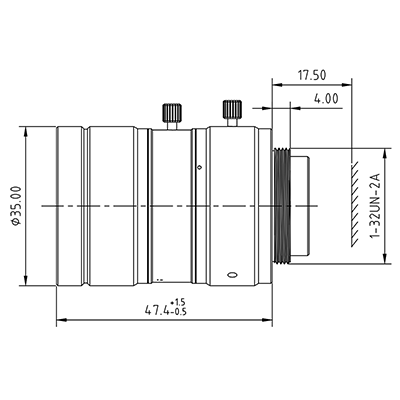



When Should You Use a C-Mount Industrial Lens?
11/17/2026
In industrial imaging, selecting a high-resolution camera is only one part of achieving reliable image quality. The optical performance of the lens also determines how accurately fine details, edges, and contrast are reproduced on the image sensor. This is why understanding what is MTF in an industrial camera lens is important when evaluating lenses for machine vision, automated inspection, and precision imaging.
MTF (Modulation Transfer Function) provides a practical way to evaluate how effectively an optical system transfers image contrast at different spatial frequencies. For engineers selecting industrial camera lenses, MTF data can help assess optical performance, compare lens designs, and determine whether a lens is suitable for a particular sensor and imaging application.
In this guide, we explore how MTF performance is evaluated in industrial lenses, how it relates to sensor specifications, and what engineers should consider when selecting a high-performance machine vision lens.
1. What Is MTF in an Industrial Camera Lens?
MTF stands for Modulation Transfer Function. It describes how effectively an optical system preserves the contrast of an object when reproducing its image at different levels of detail.
In industrial camera lenses, MTF is an important optical performance indicator because it helps engineers understand how clearly a lens can reproduce both large image structures and fine details.
For example, an industrial inspection system may need to identify small scratches, narrow gaps, printed characters, or subtle surface defects. Even when a camera has a high-resolution image sensor, insufficient lens performance can reduce the contrast of these details and make them more difficult to detect.
MTF evaluation helps engineers understand whether the optical system can provide sufficient image contrast for the required inspection task.
MTF is not simply a measurement of how sharp an image looks. It describes the contrast-transfer performance of an optical system at different spatial frequencies and image positions.
To understand the basic optical principles behind MTF, you can also read our guide to MTF and machine vision lens performance.
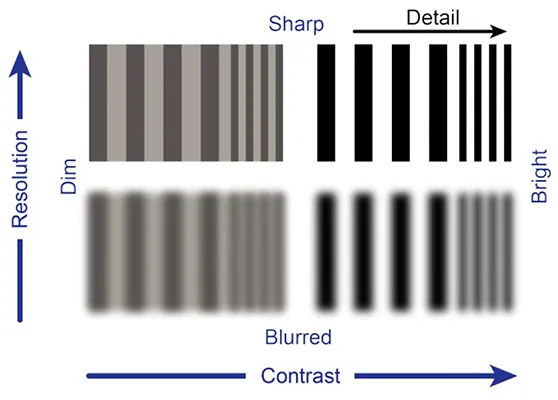
MTF concept showing contrast transfer in an industrial lens
2. What Does MTF Performance Tell You About an Industrial Lens?
MTF data provides useful information about how an industrial lens reproduces image details under specified optical conditions. Instead of relying only on a megapixel rating, engineers can evaluate the contrast performance of a lens at different spatial frequencies and across its image field.
2.1 Contrast Transfer at Different Spatial Frequencies
Spatial frequency describes how frequently light and dark patterns repeat over a given distance. It is commonly expressed in line pairs per millimeter (lp/mm) when evaluating optical performance.
Low spatial frequencies represent larger image structures, while high spatial frequencies represent finer details.
| Spatial Frequency | Image Information | Industrial Relevance |
|---|---|---|
| Low Frequency | Large structures and broad contrast patterns | General object inspection |
| Medium Frequency | Medium-sized features and edges | Component recognition and feature detection |
| High Frequency | Fine details and small structures | Fine defect inspection and detailed imaging |
A lens may maintain good contrast at low spatial frequencies but show a significant reduction at higher frequencies. This means that large structures may appear clear while smaller details become less distinguishable.
2.2 Image Quality from Center to Edge
Industrial lenses must often provide consistent imaging across the usable sensor area. However, optical performance can vary between the image center and the edges.
When evaluating MTF performance, engineers should consider:
- Center performance: The contrast and detail reproduction near the optical axis.
- Mid-field performance: Optical performance in the intermediate image region.
- Edge performance: The ability to maintain image detail toward the outer image field.
This is particularly important when using large-format sensors, where the lens must provide acceptable optical performance across a larger image circle.
2.3 Performance at Different Apertures
Aperture also influences MTF performance. Changing the F-number changes the balance between optical aberrations and diffraction.
At a relatively wide aperture, certain optical aberrations may reduce contrast. Stopping down can improve some aberrations, but diffraction gradually becomes more significant at smaller apertures.
Therefore, an industrial lens should be evaluated at the aperture settings relevant to its actual application rather than relying on a single MTF value.
3. MTF vs. Resolution vs. Megapixels: What Is the Difference?
MTF, optical resolution, and megapixels are related to image quality, but they describe different aspects of an imaging system. Understanding these differences helps engineers avoid choosing an industrial lens based only on the camera’s advertised resolution.
| Parameter | What It Measures | Why It Matters |
|---|---|---|
| Megapixels | Total number of image sensor pixels | Defines the sensor’s pixel count |
| Optical Resolution | Ability to distinguish fine image details | Determines how much detail the optical system can reproduce |
| MTF | Contrast transfer at different spatial frequencies | Shows how much image contrast is retained |
| Pixel Size | Physical dimensions of individual sensor pixels | Influences sampling capability and sensor resolution requirements |
A 20MP camera does not automatically produce 20MP-level optical detail. The lens must provide sufficient optical performance to support the sensor’s sampling capability.
For example, a camera with smaller pixels may require a lens with stronger contrast transfer at higher spatial frequencies. If the lens cannot reproduce these details with sufficient contrast, the additional sensor pixels may not provide the expected improvement in usable image information.
However, the final image quality also depends on focus accuracy, illumination, filters, sensor characteristics, and image processing.
Learn more about this relationship in our guide to matching an industrial lens to a camera sensor.
4. How Does Sensor Size and Pixel Size Affect MTF Requirements?
When selecting an industrial camera lens, engineers should evaluate MTF together with sensor specifications. Two important factors are sensor pixel size and sensor format.
4.1 Pixel Size and Nyquist Frequency
Pixel size determines the sampling capability of an image sensor. A smaller pixel pitch allows the sensor to sample finer spatial details, but the lens must also provide sufficient contrast at the corresponding spatial frequencies.
The theoretical Nyquist frequency of a regularly sampled sensor can be calculated using:
fN = 1 / (2 × p)
Where p is the pixel pitch in millimeters.
For example, consider an industrial camera with a pixel size of 3.45 μm (0.00345 mm).
Its theoretical Nyquist frequency is approximately:
145 lp/mm
This value describes the sensor’s theoretical sampling limit, not a guaranteed lens resolution or an MTF pass requirement. Engineers should evaluate the lens’s actual contrast performance at relevant spatial frequencies and verify the complete imaging system.
4.2 Sensor Format and Image Circle
Sensor format determines the image area that the lens must cover. A lens designed for a smaller sensor may not adequately cover a larger sensor without vignetting or degraded edge performance.
For example, when selecting a C-Mount lens for a 1-inch or 1.1-inch sensor, engineers should consider both image circle coverage and MTF performance across the required image field.
The correct lens should match the sensor format, resolution, pixel size, and application requirements.
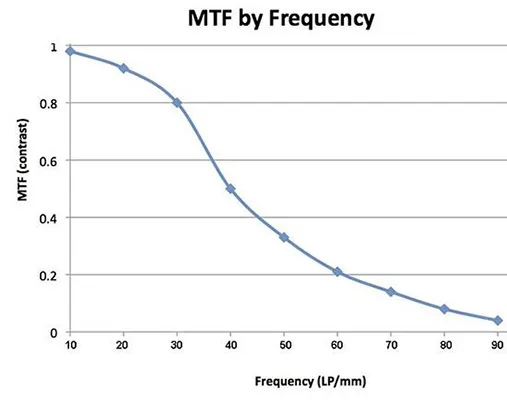
MTF curve showing contrast versus spatial frequency
5. Why Is MTF Important in Industrial Machine Vision?
MTF performance can influence how reliably an industrial vision system captures details required for inspection, recognition, and measurement. Its importance varies according to the application and the features that need to be detected.
5.1 Precision Industrial Inspection
Industrial inspection systems often need to identify small defects, scratches, cracks, and surface irregularities. Adequate contrast transfer helps preserve the visual information required by inspection algorithms.
For fine-detail inspection, engineers should evaluate lens performance at the spatial frequencies associated with the smallest features of interest.
5.2 Barcode and Character Recognition
Barcode reading and OCR applications depend on distinguishable edges, narrow line patterns, and clear character structures.
A suitable lens should provide sufficient contrast at the relevant feature sizes, together with appropriate focus, working distance, and illumination.
5.3 Dimensional Measurement
In measurement applications, clear image boundaries help vision software locate object edges and calculate dimensions. MTF is one important factor in maintaining image detail, but geometric accuracy also depends on distortion, calibration, perspective, and system stability.
5.4 Robotics and Automated Vision
Robotic vision systems use cameras to identify objects, locate features, and support automated positioning. Consistent optical performance can help provide reliable image information for recognition and positioning algorithms.
Explore TOWIN’s machine vision lens solutions for industrial inspection, object recognition, and automated imaging applications.

C-Mount Lenses
6. How to Choose an Industrial Lens Based on MTF Performance
MTF should be considered as part of a complete lens selection process. The following steps help engineers evaluate whether an industrial lens is suitable for a specific imaging system.
Step 1: Define Camera Sensor Specifications
Start by identifying the camera’s key sensor parameters:
- Sensor format and active image dimensions
- Pixel size and total resolution
- Sensor interface and lens mount
- Required image circle coverage
These specifications establish the optical requirements for the lens.
Step 2: Identify the Required Object Details
Determine the smallest feature that the imaging system must detect or measure. This may include a fine scratch, narrow gap, small printed character, or component edge.
Consider the object size, working distance, field of view, and required inspection accuracy. These factors help determine the spatial frequencies that should receive attention during MTF evaluation.
Step 3: Evaluate MTF Across the Required Image Field
Do not evaluate a lens using only its center MTF performance. Check the available MTF data at different image heights and spatial frequencies.
For applications that use the entire sensor area, edge performance may be just as important as center performance.
Step 4: Consider Aperture and Operating Conditions
Review the lens’s optical performance at the aperture and operating conditions used in the actual application.
Important factors include:
- F-number and aperture settings
- Working distance and focus position
- Operating wavelength and illumination
- Required depth of field
- Environmental and mechanical conditions
Step 5: Evaluate the Complete Imaging System
Finally, test the lens with the intended camera, sensor, illumination, and target. Laboratory MTF data provides valuable optical information, but actual system performance should also be verified under application conditions.
This process helps engineers select a lens based on real imaging requirements rather than relying on a single specification.
7. Comparing Industrial Lens Requirements for Different Applications
Different industrial imaging applications require different combinations of optical performance. MTF should therefore be evaluated according to the actual inspection task rather than using one universal performance target.
| Application | Key Imaging Requirement | MTF Evaluation Focus |
|---|---|---|
| General Machine Vision | Stable image quality | Contrast at relevant feature frequencies |
| Fine-Detail Inspection | Small defect detection | High-frequency contrast transfer |
| Precision Measurement | Reliable edge localization | Image detail and field consistency |
| Barcode and OCR | Clear line and character patterns | Contrast at relevant pattern frequencies |
| Robotic Vision | Reliable feature recognition | Contrast and consistency across the working field |
These are application-oriented evaluation guidelines, not measured performance ratings for specific TOWIN products. Actual lens selection should be based on optical specifications and application testing.
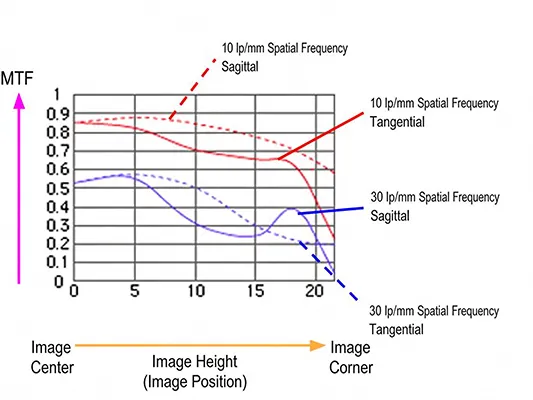
Sagittal and tangential MTF chart for an industrial camera lens
8. How Optical Design and MTF Testing Support Lens Performance
MTF performance is closely related to optical design, lens construction, and manufacturing quality. Achieving suitable contrast transfer requires engineers to consider the entire optical system rather than optimizing a single parameter.
During optical development, engineers evaluate factors such as:
- Lens element configuration and optical materials
- Spherical and chromatic aberrations
- Astigmatism and field curvature
- Sensor compatibility and image circle
- Aperture and working conditions
- Manufacturing and assembly tolerances
Optical simulation and optimization help predict lens performance during development. Prototype testing and production validation then help verify whether the manufactured lens meets its intended specifications.
MTF testing is particularly useful for evaluating contrast-transfer performance and checking consistency under defined measurement conditions.
Learn more about TOWIN’s industrial lens optical design process, including optical simulation, performance optimization, prototype development, and testing.
TOWIN Industrial Lens Development Capabilities
TOWIN provides C-Mount and other industrial optical lens solutions for machine vision, factory automation, and industrial imaging.
- Optical design and performance optimization
- High-resolution lens solutions for different sensor formats
- MTF and optical performance evaluation
- Custom focal length and optical configurations
- OEM/ODM development and production support
Explore TOWIN C-Mount industrial lenses to compare available lens configurations and specifications.
9. Frequently Asked Questions About MTF in Industrial Camera Lenses
Q1: What does MTF mean in an industrial camera lens?
A: MTF stands for Modulation Transfer Function. It describes how effectively a lens or optical system transfers image contrast at different spatial frequencies. It is an important indicator when evaluating optical performance for industrial imaging and machine vision.
Q2: Is a higher MTF value always better?
A: A higher MTF value generally indicates better contrast transfer at the specified spatial frequency and measurement position. However, lens performance should be evaluated across the relevant image field, frequencies, aperture settings, and operating conditions rather than using one value alone.
Q3: What is the difference between MTF and lens resolution?
A: Resolution describes the ability of an optical system to distinguish fine details, while MTF describes how much contrast is retained when reproducing those details at different spatial frequencies. Both parameters are important when selecting a high-resolution industrial lens.
Q4: Does MTF affect machine vision accuracy?
A: MTF can affect image contrast and the visibility of small features, which may influence edge detection, object recognition, and inspection reliability. However, measurement accuracy also depends on distortion, calibration, lighting, focus, and the complete imaging system.
Q5: How does pixel size affect MTF requirements?
A: Smaller sensor pixels increase the spatial sampling frequency of a camera. The lens should provide sufficient contrast at the spatial frequencies relevant to the sensor and application. Pixel size and optical performance should therefore be evaluated together.
Q6: Does aperture affect MTF performance?
A: Yes. Aperture changes the balance between optical aberrations and diffraction. Stopping down may improve certain aberrations, but diffraction can reduce contrast at higher spatial frequencies. The appropriate aperture depends on the application and operating conditions.
Q7: Why is MTF performance important for C-Mount machine vision lenses?
A: C-Mount lenses are widely used in industrial cameras and machine vision systems. Evaluating MTF helps engineers assess whether a lens can provide sufficient image contrast for the sensor resolution, pixel size, and inspection requirements of the application.
Q8: How can I choose an industrial lens with suitable MTF performance?
A: Start with the camera sensor specifications, pixel size, smallest object feature, working distance, and field of view. Then compare MTF data under relevant testing conditions and verify the complete imaging system through practical testing.
10. Conclusion: Choosing the Right Industrial Lens with MTF Performance in Mind
Understanding MTF in an industrial camera lens helps engineers evaluate how effectively an optical system reproduces image contrast and fine details. It is particularly useful when selecting lenses for high-resolution machine vision, precision inspection, and automated imaging applications.
However, MTF should never be considered independently. Sensor pixel size, optical resolution, distortion, aperture, image circle, and actual operating conditions all influence final imaging performance.
For industrial camera manufacturers and system integrators, selecting the right lens means balancing these optical requirements with application needs and system integration constraints.
TOWIN provides M12, C-Mount, CS-Mount, and custom industrial lens solutions for machine vision, factory automation, robotics, and other imaging applications. Explore our industrial lens product range or contact our team to discuss your optical requirements and find a suitable lens solution for your project.