


How to Choose a C-Mount Lens for Machine Vision
11/06/2026
How to Choose a CS-Mount Lens for Industrial Cameras
11/13/2026
A CS-mount lens is a threaded camera lens designed for imaging systems that use the CS-mount interface. With a standardized 1-inch-32 thread and a flange focal distance of 12.526 mm, CS-mount lenses are widely used in CCTV cameras, IP cameras, and compact surveillance systems. Their compact mechanical interface and availability of different optical configurations make them suitable for various video surveillance and imaging applications.
However, choosing the right CS-mount camera lens involves more than checking its mounting thread. Sensor size, image circle, focal length, field of view (FOV), resolution, aperture, and iris type all influence the final imaging performance. Understanding these specifications helps engineers, camera manufacturers, and system integrators select a lens that meets their application requirements.
In this guide, we explain what a CS-mount lens is, its key technical specifications, common applications, and how to choose the right model for your camera system. You can also explore TOWIN CS-Mount Lenses to compare available optical configurations.
1. What Is a CS-Mount Lens?
A CS-mount lens is a camera lens that uses a standardized threaded mounting interface with a nominal diameter of 1 inch (25.4 mm) and 32 threads per inch. Its standard flange focal distance (FFD) is 12.526 mm, measured from the lens mounting reference surface to the image sensor plane.
This mounting standard allows a compatible CS-mount lens to be installed directly on a CS-mount camera, provided that the lens and camera also meet the required optical and mechanical specifications.
1.1 CS-Mount Lens Structure and Mounting Standard
The CS-mount interface consists of a threaded connection and a defined flange focal distance. The thread secures the lens to the camera, while the flange focal distance determines the correct positioning of the optical system relative to the image sensor.
Correct positioning is essential for achieving accurate focus and maintaining the intended optical performance. Even when a lens can physically screw into a camera, the combination may not work correctly if their mounting standards are incompatible.
Key CS-Mount Specifications
- Thread diameter: 25.4 mm (1 inch)
- Thread specification: 1″-32 UN
- Flange focal distance: 12.526 mm
- Mount type: Threaded camera lens interface
- Typical applications: CCTV, IP cameras, and surveillance imaging
1.2 Main Features of CS-Mount Lenses
CS-mount lenses are available in different optical and mechanical configurations. Depending on the model, their main features may include:
- Compact mounting design: Suitable for camera systems designed around the CS-mount interface.
- Fixed focal length options: Provide a defined field of view for applications with stable imaging requirements.
- Vari-focal configurations: Allow focal length adjustment to accommodate different monitoring distances and coverage areas.
- Multiple iris options: Fixed iris, manual iris, DC auto iris, and P-Iris designs are available across different product models.
- IR-corrected options: Selected optical designs support day-and-night imaging with visible and near-infrared illumination.
- Different sensor formats: Available configurations depend on the image circle and optical performance of each lens.
2. Key Specifications of CS-Mount Lenses
Understanding CS-mount lens specifications is important when matching a lens to a camera. The mounting interface determines mechanical compatibility, while optical parameters determine whether the lens can produce the required image quality and field of view.
2.1 CS-Mount Lens Specification Comparison
| Parameter | CS-Mount Specification | Description |
|---|---|---|
| Mount Type | CS-Mount | Threaded lens interface |
| Thread Diameter | 25.4 mm | Nominal 1-inch thread |
| Thread Specification | 1″-32 UN | 32 threads per inch |
| Flange Focal Distance | 12.526 mm | Distance from mounting flange to sensor plane |
| Focal Length | Model dependent | Determines image scale and field of view |
| Image Format | Model dependent | Must cover the camera sensor |
| Resolution | Model dependent | Must meet the imaging requirements |
| Aperture | Model dependent | Controls light transmission and depth of field |
| Iris Type | Fixed / Manual / DC Auto / P-Iris | Controls aperture according to the lens design |
| Focus | Model dependent | Manual or other specified focus configurations |
| IR Correction | Selected models | Supports visible and near-infrared imaging requirements |
These specifications are not identical across all CS-mount lenses. Always check the individual product datasheet before selecting a lens for a camera project.
2.2 Flange Focal Distance
Flange focal distance is one of the most important mechanical specifications of a CS-mount lens. The standard distance is 12.526 mm, measured from the mounting flange to the image sensor plane.
This distance determines the correct mechanical position of the lens relative to the sensor. If the camera and lens use different flange standards, the lens may not achieve the required focus position even if their threads appear physically compatible.
For applications involving different camera mount standards, engineers should verify the camera manufacturer’s mounting specifications and use an appropriate optical or mechanical conversion solution.
2.3 Focal Length and Field of View
Focal length affects the field of view captured by the camera. Shorter focal lengths generally provide wider coverage, while longer focal lengths produce narrower views and greater image magnification at a given working distance.
The appropriate focal length depends on the sensor dimensions, working distance, and target area. For example, a surveillance camera monitoring a wide entrance may require a different focal length from a camera capturing details at a longer distance.
Use the TOWIN FOV Calculator to estimate the field of view based on sensor size, focal length, and working distance.
2.4 Sensor Size and Image Circle
Sensor compatibility depends on the image circle produced by the lens. The image circle must be large enough to cover the active sensor area. If the image circle is too small, the captured image may show dark corners, vignetting, or reduced usable image coverage.
It is important to distinguish between the mechanical mount standard and the optical image format. A CS-mount interface does not automatically indicate that a lens supports a particular sensor size.
Before selecting a lens, check its specified sensor format and confirm that its image circle covers the camera sensor. For more information, read our Image Sensor Guide.
2.5 Resolution and Aperture
Lens resolution describes its ability to reproduce fine image details. When selecting a CS-mount lens, consider the camera resolution, pixel size, optical resolving capability, and image quality across the required image area.
Aperture, expressed as an F-number, determines how much light can pass through the lens. A lower F-number generally allows more light to reach the sensor, which can be useful in low-light environments. However, a larger aperture may also reduce depth of field and affect optical performance. The appropriate aperture should therefore be selected according to lighting, focus range, and image quality requirements.
2.6 Iris Types
Different CS-mount lens designs use different iris configurations to control exposure:
| Iris Type | Main Characteristics | Typical Application |
|---|---|---|
| Fixed Iris | Aperture remains fixed | Stable lighting conditions |
| Manual Iris | Aperture is adjusted manually | Installations with adjustable settings |
| DC Auto Iris | Camera-controlled automatic aperture adjustment | Changing outdoor illumination |
| P-Iris | More precise aperture control with compatible camera systems | Advanced network surveillance |
The iris type should match the camera’s control interface and the lighting conditions of the application.
3. CS-Mount vs C-Mount: What Is the Difference?
CS-mount and C-mount lenses share the same nominal 1-inch-32 threaded interface, but they use different flange focal distances. This difference affects their compatibility with cameras and the adapters required for installation.
| Specification | CS-Mount | C-Mount |
|---|---|---|
| Thread Diameter | 25.4 mm | 25.4 mm |
| Thread Specification | 1″-32 UN | 1″-32 UN |
| Flange Focal Distance | 12.526 mm | 17.526 mm |
| Typical Applications | CCTV, IP Cameras | Machine Vision, Industrial Imaging |
The flange focal distance difference is 5 mm. A C-mount lens can generally be used on a CS-mount camera with a suitable 5 mm spacer. Using a CS-mount lens on a C-mount camera requires a specifically designed optical compensation solution; a simple spacer is not sufficient.
For a more detailed explanation of mounting compatibility, adapter requirements, and installation considerations, read our guide: C-Mount vs CS-Mount: Understanding the 5mm Difference and Adapter Usage.
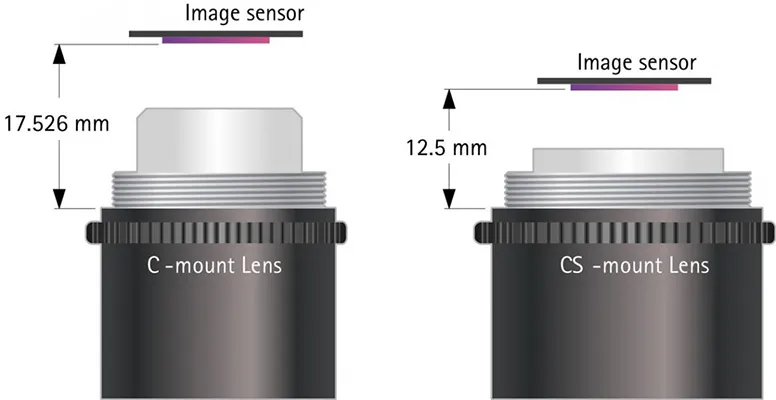
C-Mount VS CS-Mount Technical Diagram
4. Common Applications of CS-Mount Lenses
CS-mount lenses are commonly selected for compact camera systems where the mechanical interface, focal length, sensor coverage, and exposure control match the imaging requirements. Their applications include several types of surveillance and embedded imaging systems.
4.1 CCTV Surveillance
CS-mount lenses are widely used in CCTV systems for indoor and outdoor monitoring. Depending on the camera configuration, they can provide wide-angle scene coverage or narrower views for monitoring specific areas.
Important selection factors include focal length, horizontal field of view, aperture, sensor compatibility, and the expected lighting conditions.
4.2 IP and Network Cameras
IP cameras use network connectivity to transmit video for security monitoring and remote observation. CS-mount lenses with fixed focal length or vari-focal designs can support different installation distances and monitoring requirements.
For cameras operating under changing lighting conditions, an appropriate auto-iris configuration may help maintain usable exposure.
4.3 Day-and-Night Surveillance
Some surveillance cameras switch between visible-light imaging during the day and near-infrared illumination at night. In these systems, an IR-corrected lens can help reduce focus shift between visible and near-infrared wavelengths.
When choosing an IR-corrected CS-mount lens, check the supported wavelength range, sensor compatibility, and actual optical performance under the intended illumination conditions.
4.4 Compact and Embedded Imaging Systems
CS-mount lenses can also be considered for compact imaging equipment that requires a standardized threaded lens connection. Engineers should evaluate mechanical dimensions, cable and housing clearance, sensor coverage, focus adjustment, and the required field of view during system integration.
Explore TOWIN Vision Solutions to learn more about optical requirements across different industrial and imaging applications.
5. How to Choose the Right CS-Mount Lens
Selecting the right CS-mount lens requires evaluating both camera compatibility and the optical requirements of the application. The following six steps provide a practical selection process for camera engineers, system integrators, and OEM buyers.
Step 1: Confirm Camera Mount Compatibility
First, verify that the camera uses a CS-mount interface. Check the camera datasheet for the thread standard, flange focal distance, mounting structure, and any additional mechanical requirements.
Do not assume that two components are optically compatible simply because their threads can be connected. Correct lens positioning is necessary for achieving the intended focus.
Step 2: Match the Lens to the Sensor Size
Confirm the active sensor format and make sure the lens image circle covers the sensor. The lens should also provide sufficient optical resolution for the camera’s pixel size and imaging requirements.
For example, TOWIN’s CS-mount catalog includes different configurations for 1/2.5-inch, 1/1.8-inch, and 1/1.7-inch sensor formats. These are examples from individual product specifications, not universal limits of the CS-mount standard.
Step 3: Determine the Required Focal Length and FOV
Focal length should be selected according to the sensor dimensions, working distance, and required object coverage.
For a simplified thin-lens estimate, the object-space field width can be approximated by:
Object Field Width ≈ (Sensor Width × Working Distance) / Focal Length
All distance values must use consistent units.
For example, assume a camera has a sensor width of 6.4 mm, a focal length of 8 mm, and a working distance of 500 mm:
- Sensor width: 6.4 mm
- Focal length: 8 mm
- Working distance: 500 mm
- Estimated horizontal object coverage: approximately 400 mm
This is a simplified estimate. Actual coverage may vary due to lens distortion, optical design, focus position, and the definition of working distance. For a more practical calculation, use the TOWIN Field of View Calculator.
Step 4: Select the Appropriate Resolution
Choose a lens with sufficient optical resolving capability for the camera sensor and the details that need to be captured. Do not rely exclusively on the megapixel rating printed on a product specification.
For demanding applications, consider MTF performance, image sharpness across the field, distortion, pixel size, and the required level of detail.
Step 5: Choose the Correct Aperture and Iris Type
Evaluate the lighting environment and decide whether the camera needs a fixed, manual, DC auto iris, or P-Iris lens.
- Fixed iris: Suitable for relatively stable lighting conditions.
- Manual iris: Useful when aperture can be adjusted during installation.
- DC auto iris: Suitable for supported camera systems operating under changing illumination.
- P-Iris: Useful when more precise aperture control is required and supported by the camera.
Also consider depth of field and image sharpness when selecting the aperture.
Step 6: Consider IR Correction and Environmental Conditions
For day-and-night cameras, check whether IR correction is required. If the camera uses near-infrared illumination, the lens should be selected according to the intended wavelength range and focus requirements.
For outdoor and industrial installations, also evaluate operating temperature, vibration, mechanical stability, moisture protection at the system level, and other environmental requirements.
CS-Mount Lens Selection Checklist
- Camera mount and flange focal distance confirmed
- Sensor size and image circle matched
- Working distance and field of view defined
- Focal length and resolution selected
- Aperture and iris control matched to lighting conditions
- IR correction and environmental requirements checked
- Mechanical dimensions and installation space verified
6. TOWIN CS-Mount Lens Product Options
TOWIN offers a range of CS-mount lenses for CCTV cameras, IP cameras, surveillance systems, and other imaging applications. The product lineup includes fixed focal megapixel lenses, vari-focal lenses, manual iris designs, DC auto iris configurations, and selected IR-corrected optical solutions.
Different models support different focal lengths, sensor formats, fields of view, resolutions, and aperture configurations. The following examples illustrate some of the available product options.
6.1 Fixed Focal Length CS-Mount Lenses
Fixed focal length lenses provide a defined field of view and are suitable for installations where the camera position and monitoring coverage are relatively stable.
| Model | Sensor | Focal Length | Resolution | H-FOV | F-Number |
|---|---|---|---|---|---|
| CCL125028FMP | 1/2.5″ | 2.8 mm | 3MP | 123° | F1.6 |
| CCL117050MPCS | 1/1.7″ | 5 mm | 12MP | 87° | F2.0 |
The CCL125028FMP is a wide-angle option for applications requiring broad scene coverage. The CCL117050MPCS provides a higher-resolution configuration for compatible 1/1.7-inch sensors. Actual performance should be evaluated using the camera sensor, illumination, working distance, and product datasheet.
6.2 Vari-Focal CS-Mount Lenses
Vari-focal lenses allow users to adjust focal length within a specified range. They are useful when the final monitoring distance or field of view needs to be adjusted during installation.
For example, the TOWIN CCL120412AMP provides a 4–12 mm focal length range, supports a 1/2-inch sensor format, and features DC auto iris. Its listed horizontal field of view ranges from approximately 98° to 29°, depending on the focal length and imaging configuration.
6.3 Other CS-Mount Optical Configurations
In addition to fixed focal length and vari-focal designs, TOWIN’s CS-mount product range includes different iris configurations and selected IR-corrected lenses for specific camera requirements.
When comparing products, check the individual model specifications for sensor format, focal length, resolution, aperture, iris control, field of view, and IR performance.
Explore TOWIN CS-Mount Lens Solutions
Compare available lens models and find an optical configuration that matches your camera and application requirements.
For OEM and ODM projects, lens selection can also involve specific optical and mechanical requirements. TOWIN provides industrial optical lens solutions and supports project discussions based on sensor format, focal length, field of view, resolution, aperture, and installation conditions.
Learn more about TOWIN’s optical capabilities or contact our team to discuss your project.
7. Common Mistakes When Choosing a CS-Mount Lens
Even when the correct mount type is selected, several optical and mechanical issues can affect the final imaging result. Avoid these common mistakes during lens selection and system integration.
1. Ignoring Flange Focal Distance
Checking only the thread size is not enough. Confirm the camera’s mount standard and the required flange focal distance before installation.
2. Choosing an Incompatible Image Format
A lens with an image circle smaller than the active sensor area may produce vignetting or dark corners. Always check the supported sensor format.
3. Selecting Focal Length Without Calculating FOV
Choosing a focal length based only on experience may result in insufficient coverage or an unsuitable viewing angle. Define the working distance and target area before making a selection.
4. Ignoring Optical Resolution
A lens must provide sufficient resolving capability for the camera sensor and the details being captured. Consider actual optical performance rather than relying only on a megapixel label.
5. Selecting the Wrong Iris or IR Configuration
Fixed iris, auto iris, and P-Iris designs serve different exposure-control requirements. Similarly, day-and-night systems may require an IR-corrected lens. Select these features according to the actual camera and lighting conditions.
8. Frequently Asked Questions About CS-Mount Lenses
Q1: What is a CS-mount lens used for?
A CS-mount lens is commonly used in CCTV cameras, IP cameras, network cameras, and compact surveillance imaging systems. Depending on its optical specifications, it can support different monitoring distances, fields of view, and image quality requirements.
Q2: What is the flange focal distance of a CS-mount lens?
The standard CS-mount flange focal distance is 12.526 mm. It is measured from the lens mounting flange reference surface to the image sensor plane.
Q3: Are CS-mount and C-mount lenses interchangeable?
They share the same nominal 1-inch-32 thread but have different flange focal distances. A C-mount lens can generally be used on a CS-mount camera with a suitable 5 mm spacer. Using a CS-mount lens on a C-mount camera requires a specifically designed optical compensation solution and should be verified with the camera and lens manufacturers.
Q4: What sensor sizes are compatible with CS-mount lenses?
Compatibility depends on the image circle of the individual lens. TOWIN offers CS-mount models for different sensor formats, including 1/2.5-inch, 1/1.8-inch, and 1/1.7-inch configurations. Always check the product datasheet to confirm sensor coverage.
Q5: What focal length should I choose for a CS-mount lens?
The correct focal length depends on sensor size, working distance, and the required field of view. Shorter focal lengths generally provide wider coverage, while longer focal lengths provide narrower views. Use an FOV calculation to determine the appropriate focal length for your application.
Q6: What is the difference between fixed iris, DC auto iris, and P-Iris?
Fixed iris maintains a constant aperture. DC auto iris adjusts the aperture automatically through a compatible camera control system. P-Iris provides more precise aperture control when supported by the camera. The correct choice depends on lighting conditions and exposure requirements.
Q7: Are CS-mount lenses suitable for night vision cameras?
Selected CS-mount lenses feature IR-corrected optical designs for day-and-night imaging. These designs help reduce focus shift between visible and near-infrared wavelengths. Check the supported wavelength range and product specifications before selecting a lens.
Q8: Can TOWIN provide customized CS-mount lenses?
TOWIN supports OEM/ODM optical project discussions based on specific application requirements. Customization requirements can include focal length, sensor format, field of view, aperture, optical performance, and mechanical dimensions. Contact TOWIN to discuss your project and confirm the available customization options.
9. Conclusion: Choosing the Right CS-Mount Lens
A CS-mount lens is a practical optical solution for CCTV cameras, IP cameras, and compact surveillance imaging systems. Its standardized threaded interface and 12.526 mm flange focal distance provide a defined mounting specification, while the availability of fixed focal length, vari-focal, and different iris configurations supports a range of camera requirements.
However, selecting the right CS-mount camera lens requires more than checking the mount type. Sensor size, image circle, focal length, field of view, resolution, aperture, and operating conditions must all be considered to achieve the required imaging performance.
TOWIN provides a range of CS-mount lens solutions for different surveillance and imaging applications, together with OEM/ODM project support. Explore our CS-Mount Lens Products or contact our team to discuss your camera specifications and optical requirements.
Looking for the Right CS-Mount Lens?
Share your sensor size, focal length, working distance, and imaging requirements with TOWIN. Our team can help you explore suitable lens options for your project.