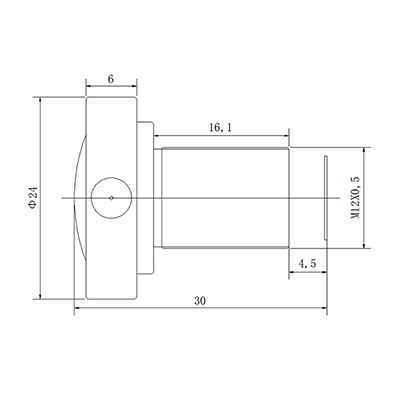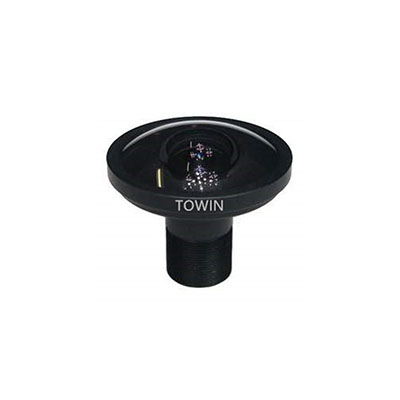



Low distortion wide angle 4.2mm M12 mount lens
03/04/2026
3.6mm M12 S-mount wide angle HD board lens
03/05/2026
When selecting an industrial camera lens, understanding the difference between C-Mount vs CS-Mount is essential for ensuring proper mechanical installation and accurate image focus. Although these two lens mounts use the same basic thread specification, they have different flange focal distances. This difference determines whether a lens can be used directly on a camera or requires a mounting adapter.
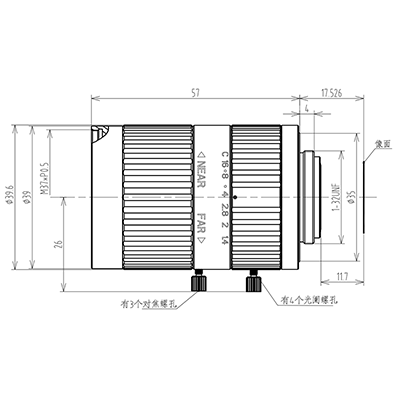
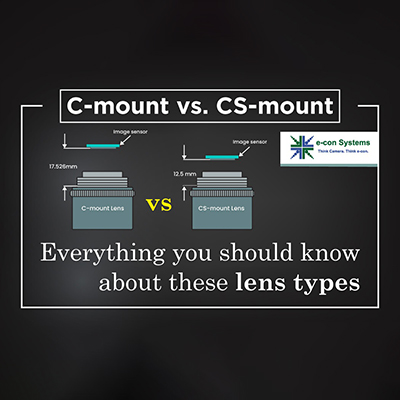
The key difference is the distance between the lens mounting flange and the camera sensor: C-Mount uses 17.526 mm, while CS-Mount uses 12.5 mm. The difference is approximately 5.026 mm, commonly addressed with a 5 mm C-CS adapter.
This guide explains the technical specifications, the working principle of the 5 mm adapter, C-Mount and CS-Mount compatibility, and how to select the right mount for machine vision and industrial imaging applications.
What Is the Difference Between C-Mount and CS-Mount?
C-Mount and CS-Mount are threaded lens mounting standards commonly used in industrial cameras, machine vision systems, CCTV cameras and other imaging equipment. Their thread dimensions are the same, but their flange focal distances are different.
Flange focal distance (FFD), also called flange-to-image distance, refers to the specified distance from the lens mounting reference flange to the image plane when the lens is correctly mounted.
C-Mount vs CS-Mount: Technical Comparison
| Specification | C-Mount | CS-Mount |
|---|---|---|
| Flange focal distance | 17.526 mm | 12.5 mm |
| Thread diameter | 1 inch (25.4 mm) | 1 inch (25.4 mm) |
| Thread specification | 1″-32 TPI | 1″-32 TPI |
| FFD difference | Approximately 5.026 mm | |
| Common accessory | C-CS adapter / spacer ring | |
| Typical use | Industrial imaging, machine vision, FA and CCTV | Compact industrial cameras and CCTV systems |
The two mounts share the same nominal thread size and thread pitch. Therefore, a lens may appear to screw into a camera even when the optical mounting distance is incorrect. Thread compatibility alone does not guarantee focusing compatibility.
What Is Flange Focal Distance?
Flange focal distance is one of the most important mechanical specifications in a camera lens mounting system. It defines the required distance between the lens mounting flange and the camera’s image sensor.
A lens is designed to form a focused image at a specific image plane. If the lens is installed at an incorrect distance from the sensor, the focusing range may shift and the camera may not achieve the intended focus.
- C-Mount: 17.526 mm from the mounting flange to the image plane.
- CS-Mount: 12.5 mm from the mounting flange to the image plane.
This is why C-Mount and CS-Mount lenses should not be treated as directly interchangeable, even though their threads are similar.
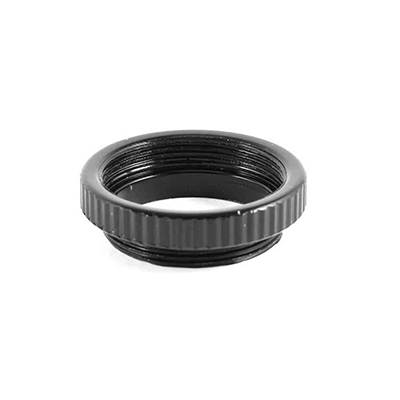
5mm Adapter Ring
Why Does the 5 mm C-CS Adapter Matter?
The commonly used 5 mm C-CS adapter compensates for the difference between the C-Mount and CS-Mount flange focal distances.
The nominal difference is:
C-Mount FFD: 17.526 mm
CS-Mount FFD: 12.500 mm
Difference: 17.526 – 12.500 = 5.026 mm
Common adapter designation: 5 mm C-CS adapter
The adapter adds the required mechanical spacing so that a C-Mount lens can be positioned at its intended flange-to-sensor distance when installed on a CS-Mount camera.
How Does a 5 mm Adapter Work?
A standard C-CS spacer is a mechanical component installed between the lens and the camera mount. It does not normally contain optical glass elements. Its purpose is to restore the required mounting distance.
C-Mount Lens on a CS-Mount Camera
The spacer compensates for the shorter CS-Mount flange focal distance.
A correctly specified adapter can allow a C-Mount lens to achieve its designed focus position on a CS-Mount camera. However, the actual result also depends on the camera’s mechanical design, adapter thickness, back-focus adjustment range and lens specifications.
For available mounting accessories, see the TOWIN C-CS Adapter and M12-CS Adapter range .
C-Mount and CS-Mount Compatibility Guide
The most important practical question is whether a C-Mount lens can be installed on a CS-Mount camera, or vice versa. The answer depends on the required flange focal distance.
1. Can You Use a C-Mount Lens on a CS-Mount Camera?
Generally, yes, with a suitable C-CS adapter.
A C-Mount lens requires a flange focal distance of 17.526 mm, while a CS-Mount camera uses 12.5 mm. A suitable spacer of approximately 5 mm compensates for this difference.
- Use a C-Mount lens.
- Install a compatible C-CS spacer between the lens and camera.
- Check that the adapter thickness and mechanical interface match the system.
- Confirm focus using the camera and lens specifications.
This is a common solution when an existing C-Mount lens needs to be used with a CS-Mount camera.
2. Can You Use a CS-Mount Lens on a C-Mount Camera?
Generally, not with a standard mechanical spacer or conventional C-CS adapter.
A CS-Mount lens is designed for a 12.5 mm flange focal distance. A standard C-Mount camera has a longer 17.526 mm flange focal distance. The lens would therefore be positioned too far from the sensor for its intended mounting geometry.
A conventional spacer cannot shorten the camera’s fixed flange-to-sensor distance. Any alternative solution would require a specifically designed camera, optical or mechanical arrangement. Always confirm compatibility with the camera and lens manufacturers before attempting installation.
3. C-Mount vs CS-Mount Compatibility Table
| Lens | Camera | Compatibility | What Is Required? |
|---|---|---|---|
| C-Mount | C-Mount | Generally compatible | Verify thread, FFD and optical specifications |
| CS-Mount | CS-Mount | Generally compatible | Verify thread, FFD and optical specifications |
| C-Mount | CS-Mount | Generally compatible with adapter | Approximately 5 mm C-CS spacer |
| CS-Mount | C-Mount | Not directly compatible in a standard setup | Requires a specifically engineered solution, if available |
Does C-Mount or CS-Mount Determine Sensor Size?
No. The mount standard does not, by itself, determine the maximum sensor size that a lens can support.
Sensor compatibility depends primarily on the lens’s image circle and optical design. The image circle must adequately cover the camera sensor to avoid unwanted vignetting or loss of image quality near the edges.
For example, a C-Mount lens may be designed for a 1/2-inch, 2/3-inch, 1-inch, 1.1-inch or larger sensor format, depending on its optical design. Not every C-Mount lens supports every sensor size.
The same principle applies to CS-Mount lenses: check the individual product’s supported sensor format rather than assuming compatibility based only on the mount type.
Before selecting a lens, review the machine vision sensor size and image circle guide to understand how sensor dimensions affect lens selection.
C-Mount vs CS-Mount: Which Is Better for Machine Vision?
Neither mount is universally better. The correct choice depends on the camera design, available lenses, installation space, optical requirements and system integration constraints.
When Should You Choose C-Mount?
C-Mount is a widely used interface in industrial imaging and machine vision. It is a practical choice when the selected camera and lens share the same mount standard and the lens meets the required optical specifications.
Consider C-Mount when your project requires:
- A broad selection of industrial and machine vision lens designs.
- Specific focal lengths, resolutions or optical performance requirements.
- Integration with existing C-Mount camera systems.
- Lens options for inspection, measurement, factory automation or traffic imaging.
Explore TOWIN C-Mount industrial and machine vision lenses to compare focal lengths, sensor formats, resolutions and other product specifications.
When Should You Choose CS-Mount?
CS-Mount may be suitable when the camera platform is specifically designed for CS-Mount lenses and the selected lens meets the application’s imaging requirements.
Consider CS-Mount when your project requires:
- A camera with a native CS-Mount interface.
- A compatible CS-Mount lens without an additional C-to-CS spacer.
- Integration with an existing CS-Mount camera platform.
- A lens whose image circle, resolution and focal length match the sensor and application.
View TOWIN CS-Mount lenses for available lens types and specifications.
C-Mount vs. CS-Mount
How to Choose the Right Lens Mount for Your Camera
Choosing a lens should involve more than checking whether its thread fits the camera. A reliable machine vision system requires both mechanical and optical compatibility.
Step 1: Confirm the Camera Mount
Check the camera datasheet to identify whether it uses C-Mount or CS-Mount. Do not rely only on the external appearance of the threaded interface, because the two mounts share the same nominal thread dimensions.
Step 2: Check the Flange Focal Distance
Confirm the camera’s specified flange focal distance and compare it with the lens requirement. If the mount standards differ, determine whether a suitable adapter is available.
Step 3: Match the Lens to the Sensor
Check the lens image circle and supported sensor format. The image circle should cover the sensor’s active area to prevent vignetting.
Step 4: Confirm Resolution and Pixel Requirements
The lens resolution should be appropriate for the camera sensor and the level of detail required by the application. Consider sensor pixel size, lens resolving power and the required measurement accuracy.
Step 5: Select Focal Length and Field of View
Choose the focal length according to sensor size, working distance and required field of view. A lens with the correct mount can still be unsuitable if it cannot cover the required inspection area.
For a more detailed selection process, read the industrial lens selection guide .
Frequently Asked Questions About C-Mount vs CS-Mount
Q1: What is the main difference between C-Mount and CS-Mount?
The main difference is flange focal distance. C-Mount has a 17.526 mm flange focal distance, while CS-Mount has a 12.5 mm flange focal distance. Both use a nominal 1-inch, 32 TPI thread.
Q2: Is the C-Mount and CS-Mount difference exactly 5 mm?
The difference between 17.526 mm and 12.5 mm is approximately 5.026 mm. The accessory is commonly called a 5 mm C-CS adapter, but the nominal flange focal distance difference is not exactly 5.000 mm.
Q3: Can I use a C-Mount lens on a CS-Mount camera?
Generally, yes. A suitable C-CS adapter or spacer of approximately 5 mm is used to compensate for the flange focal distance difference. Check the camera and lens specifications to confirm the adapter and focus arrangement are suitable.
Q4: Can I use a CS-Mount lens on a C-Mount camera?
A CS-Mount lens is generally not directly compatible with a standard C-Mount camera. A conventional spacer cannot reduce the camera’s flange-to-sensor distance. A special engineered solution would need to be confirmed by the equipment manufacturer.
Q5: Does a 5 mm C-CS adapter affect image quality?
A standard mechanical spacer does not normally add optical glass elements. Its purpose is to restore the required mechanical spacing. However, poor machining, incorrect thickness, misalignment or an unsuitable interface can affect focus and image performance.
Q6: Do C-Mount and CS-Mount use the same thread?
Both standards use a nominal 1-inch (25.4 mm) diameter thread with 32 threads per inch. However, the same thread does not mean the two mounting standards have the same flange focal distance.
Q7: Does C-Mount support larger sensors than CS-Mount?
Not automatically. Sensor coverage depends on the lens’s image circle and optical design, not simply on whether the lens uses C-Mount or CS-Mount. Always check the individual lens specifications.
Q8: Which mount is better for industrial machine vision?
Neither is universally better. Select the mount that matches the camera interface and then evaluate image circle, resolution, focal length, working distance, distortion and other optical requirements.
Conclusion: Choose the Correct Mount Before Selecting a Lens
The key to understanding C-Mount vs CS-Mount is the difference in flange focal distance. C-Mount uses 17.526 mm, while CS-Mount uses 12.5 mm. A suitable C-CS adapter can compensate for the approximately 5.026 mm difference when using a C-Mount lens on a CS-Mount camera.
However, correct mounting is only the first step. You should also verify sensor coverage, image circle, resolution, focal length, field of view and the optical requirements of your application.
TOWIN provides C-Mount lenses , CS-Mount lenses and C-CS mounting accessories for different industrial imaging requirements.
If you are unsure whether a lens is compatible with your camera, our team can help review your camera model, sensor format, mounting interface and optical requirements.
Need help selecting an industrial lens?
Contact the TOWIN industrial lens manufacturer or contact our team for lens selection support .