


Wide Angle Lens – CCL14013
07/23/2025
Fisheye Lens – CCL14015MPF
07/23/2025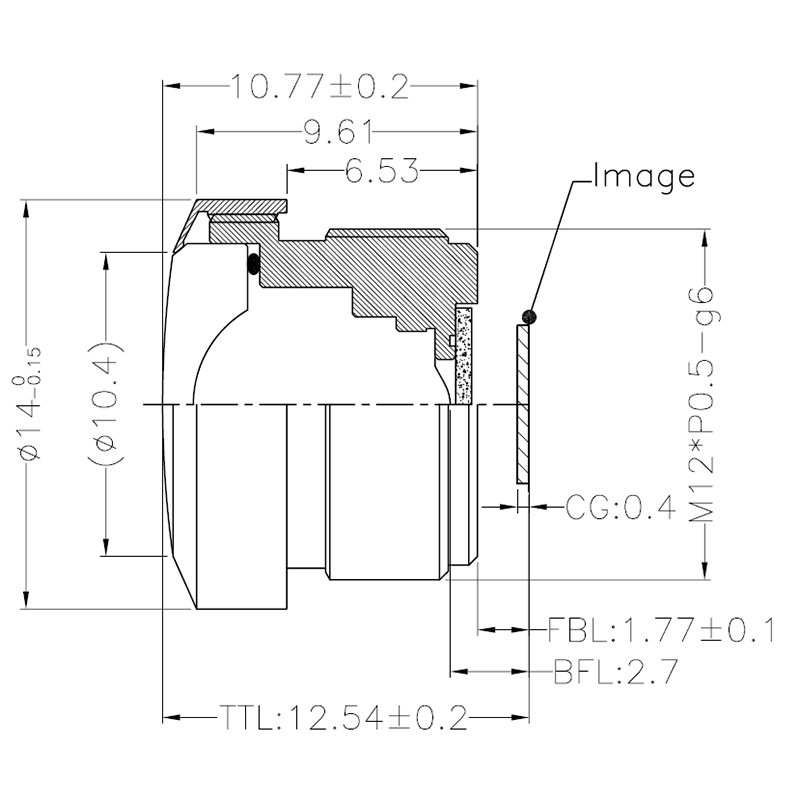
Wide Angle Lens – CCL14013MPF
1.3mm M12 wide angle lens with 144° FOV, < -8% TV distortion, F2.2 aperture and 0.2m M.O.D. for compact imaging systems.
CCL14013MPF is 1.3mm VGA resolution Low distortion lens, 1/4″ wide-angle lens with Built-In Filter, F2.2 High Magnification S-Mount Lens.
| IMAGE FORMAT | 1/4″ |
| FOCAL LENGTH | 1.3mm |
| F.O.V. | 144°(D) |
| 115°(H) | |
| 96°(V) | |
| TV DISTORTION | <-8% |
| RESOLUTION | VGA |
| APERTURE | F2.2 |
| MOUNT | M12X0.5 |
| IRIS | Fixed |
| FOCUS | Manual |
| ZOOM | Fixed |
| B.F.L. | 2.7mm |
| M.O.D. | 0.2m |
| CONSTRUCTION | 1G3P+IRF |
1.3mm M12 Low Distortion Wide Angle Lens
This 1.3mm M12 low distortion wide angle lens combines a 144° diagonal field of view with TV distortion below -8%, providing broad scene coverage while maintaining better geometric control than conventional ultra-wide optical designs. Its compact configuration is designed for embedded cameras and close-range imaging systems using 1/4″ sensors.
With an F2.2 aperture, M12×0.5 mount, 0.2m minimum object distance, and 1G3P+IRF optical construction, this fixed-focal lens offers a balanced solution for applications requiring both wide coverage and controlled image geometry.
M12 Wide Angle Lens Core Highlights
- 144° diagonal FOV provides broad coverage for compact close-range imaging systems.
- TV distortion below -8% offers improved geometric control for a wide-angle lens.
- 1.3mm focal length delivers an ultra-wide perspective while maintaining controlled distortion.
- 0.2m M.O.D. supports close-range monitoring and embedded imaging applications.
- 1G3P+IRF optical construction provides a compact optical configuration for M12 camera modules.
M12 Wide Angle Lens Applications
Core Application Scenes
This 1.3mm M12 low distortion lens is designed for applications where a wide field of view is required but excessive geometric distortion could reduce image usability. With a 144° diagonal FOV and TV distortion below -8%, it provides a practical balance between wide-area coverage and image geometry.
One suitable application is compact indoor monitoring and smart-device imaging. In small rooms, entrances, equipment areas, and retail fixtures, a wide-angle camera can cover a larger nearby area from a single installation point. The controlled distortion helps maintain a more usable image when straight-line structures or object shapes need to remain relatively consistent.
The lens is also suitable for compact embedded vision systems where both field coverage and optical compactness are important. Its M12×0.5 mount makes it appropriate for miniature camera modules, while the 0.2m M.O.D. allows the camera to operate effectively when positioned relatively close to the monitored object.
For robotic and mobile imaging devices, the combination of 115° horizontal and 96° vertical FOV can provide broad environmental visibility at close range. Compared with an extremely distorted fisheye configuration, the lower distortion specification makes this lens more suitable when the captured image needs to remain visually useful for monitoring or downstream image processing.
The lens can also be considered for wide-angle inspection and equipment observation, where a compact camera must capture a broad nearby area without introducing excessive barrel distortion.
Designed for low-distortion wide-angle monitoring, embedded vision, and close-range imaging applications.
Compatible Device List
- Compact Security Cameras: Suitable for small indoor cameras requiring broad coverage with controlled image distortion.
- Smart IoT Imaging Devices: Can be integrated into connected devices where wide scene coverage and compact optical dimensions are required.
- Embedded Vision Modules: Designed for 1/4″ sensor-based camera modules using an M12×0.5 lens interface.
- Robotic Camera Modules: Suitable for compact mobile robots requiring broad close-range environmental visibility.
- Equipment Monitoring Cameras: Useful for monitoring nearby equipment, machinery, or enclosed areas where geometric image quality matters.
- OEM Camera Systems: The fixed-focal optical configuration can be integrated into dedicated camera housings and customized imaging products.
For choosing the correct sensor and understanding sensor-to-lens compatibility, refer to the Sensor Guide. For additional lens selection considerations, see the Lens Selection Guide.
You can also compare this product with other M12 Lenses or explore TOWIN’s dedicated Low Distortion Lens range.
Frequently Asked Questions
Q: Is this M12 lens a fisheye lens?
A: No. Despite its very wide 144° diagonal FOV, this product is classified as a low distortion wide angle lens rather than a fisheye lens.
Q: How much distortion does this wide angle lens have?
A: The specified TV distortion is below -8%, providing controlled geometric distortion for a wide-angle optical configuration.
Q: What is the focal length and field of view?
A: The focal length is 1.3mm. The lens provides a 144° diagonal FOV, 115° horizontal FOV, and 96° vertical FOV.
Q: What sensor format is this lens designed for?
A: The specified image format is 1/4″, with VGA resolution.
Q: What is the minimum object distance?
A: The M.O.D. is 0.2m, making the lens suitable for close-range imaging applications.
Q: What mount does the lens use?
A: It uses an M12×0.5 mount, which is widely used for compact camera modules and embedded vision systems.
Q: Does this lens have adjustable iris or zoom?
A: The lens uses a fixed iris and fixed zoom configuration. Focus is manual for optical adjustment during camera integration.
Q: What does the 1G3P+IRF construction mean?
A: The optical construction consists of 1 glass element and 3 plastic elements, with an IRF optical component specified as part of the lens structure. IRF should not automatically be interpreted as an IR-corrected lens.
Related Products & Optical Resources
For applications where geometric control is particularly important, explore TOWIN’s Low Distortion Lens category. For a broader selection of compact optical solutions, visit the M12 Lenses product range.
Understanding distortion is especially important when using an ultra-wide lens for machine vision, monitoring, or image processing. TOWIN’s Distortion Guide explains how optical distortion affects captured images and lens selection.
For general optical fundamentals, the Lens Basics section provides additional information about focal length, FOV, and other lens parameters.
If you need to evaluate the expected scene coverage before selecting the lens, use the FOV Calculator. For application-specific requirements, explore TOWIN’s Smart Security and Robotics Vision solutions.
For OEM/ODM customization or technical support, contact TOWIN.
Online contact
| SENSOR | |
|---|---|
| E.F.L. | |
| H. F.O.V. | |
| RESOLUTION | |
| FNo. | |
| Max Dist. | |
| FEATURE | |
| MOUNT | |
| IRIS | |
| T.T.L.(mm) | |
| MARK |