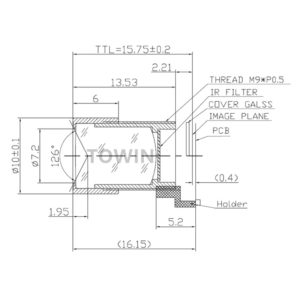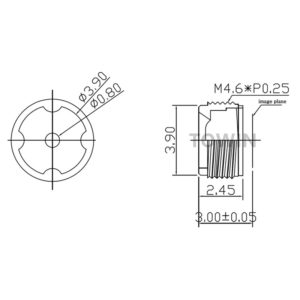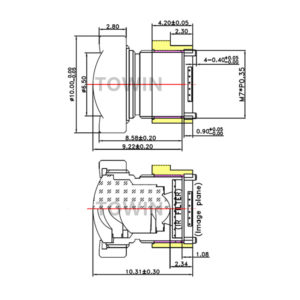



Low Distortion Lens – M702114008226
09/14/2025
Low Distortion Lens – M702514007240
09/14/2025
Fisheye Lens – M702513212020F
2.5mm M7 fisheye lens with 160° diagonal FOV, 120° horizontal FOV, F2.0 aperture and <-48% distortion for panoramic and compact camera applications.
M702513212020F is fisheye CCTV lens with Built-In IR Filter, 2.5mm focal length, 160° diagonal FOV, F2.0 aperture Suitable for security Surveillance.
| IMAGE FORMAT | 1/3″, 1/3.2″ |
| FOCAL LENGTH | 2.5mm |
| F.O.V.(AR0330) | 160°(D=5.82) |
| 120°(H=5.07) | |
| 60°(V=2.84) | |
| DISTORTION | <-48% |
| APERTURE | F2.0 |
| MOUNT | M7X0.35 |
| IRIS | Fixed |
| FOCUS | Manual |
| ZOOM | Fixed |
| B.F.L. | 2mm |
| M.O.D. | 0.2m |
| STRUCTURE | 5G+IRCF |
2.5mm M7 Fisheye Lens
This 2.5mm M7 fisheye lens is a compact ultra-wide-angle lens designed for miniature camera modules that require an exceptionally broad field of view. With up to 160° diagonal FOV on the AR0330 sensor, <-48% distortion, F2.0 aperture, and an M7 × 0.35 mount, it is well suited for panoramic, close-range, embedded, and space-constrained imaging applications.
Product Highlights at a Glance
- 160° diagonal FOV captures an exceptionally wide scene from a compact camera module.
- 120° horizontal FOV provides extensive lateral scene coverage for panoramic imaging.
- 2.5mm fisheye design delivers an ultra-wide perspective for space-constrained applications.
- F2.0 aperture provides efficient light collection for compact imaging systems.
- M7 × 0.35 mount and 2mm BFL support miniature camera module integration.
2.5mm M7 Fisheye Lens Applications
Core Application Scenes
This 2.5mm M7 fisheye lens is designed for applications where maximizing scene coverage is more important than maintaining rectilinear image geometry. Its 160° diagonal field of view and 120° horizontal FOV allow a single compact camera module to observe a very broad area, making it particularly useful for panoramic and situational-awareness imaging.
The fisheye optical design is suitable for compact panoramic cameras, embedded monitoring modules, robotics, indoor smart devices, action cameras, and short-range environmental observation systems. The 0.2m minimum object distance also makes it practical for applications where the camera needs to observe objects or activity relatively close to the lens.
The M7 × 0.35 mounting interface, 2mm back focal length, and compact optical configuration are well suited to camera assemblies where installation space is limited. The F2.0 aperture provides a useful balance between light collection and miniature optical construction, while the integrated IRCF configuration supports camera modules designed around visible-light imaging.
For applications requiring extremely broad scene coverage, the significant optical distortion is an intentional characteristic of the fisheye design rather than a defect. Engineers leverage this optical geometry for panoramic capture and apply software‑driven image correction whenever they need rectilinear output.
Designed for ultra-wide panoramic imaging, compact embedded cameras, and broad-area close-range observation.
Compatible Device List
- Panoramic Camera Modules: Suitable for compact cameras that require very broad scene coverage from a single imaging channel.
- Embedded Monitoring Devices: The M7 mounting format and ultra-wide FOV are suitable for compact smart monitoring equipment.
- Robotic Vision Modules: A broad FOV can help small robots maintain greater environmental awareness without requiring multiple cameras.
- Action & Compact Cameras: The 160° diagonal viewing angle is suitable for applications where capturing more of the surrounding scene is a priority.
- Smart IoT Vision Devices: The miniature form factor can be integrated into compact connected devices requiring wide-area visual sensing.
- Customized Camera Assemblies: The M7 × 0.35 interface, 2mm BFL, and manual focus configuration allow integration into application-specific camera housings.
For additional miniature optical solutions, explore Towin’s M8/M7/M6/M5/M3.5 Small Mount Lenses. For M12-based compact imaging systems, see the M12 Lenses product range.
When designing an ultra-wide camera system, sensor format and FOV should be evaluated together. Towin’s Sensor Guide provides guidance on sensor and lens compatibility, while the Lens Selection Guide can help engineers evaluate focal length, image format, FOV, and application requirements.
For applications involving panoramic or wide-angle image geometry, engineers can also refer to Towin’s Distortion Guide to understand how lens distortion affects image formation and correction.
Frequently Asked Questions
Q: Is this 2.5mm lens a fisheye lens?
A: Yes. With a 160° diagonal FOV, 120° horizontal FOV, and <-48% distortion, this lens is designed as a fisheye lens for ultra-wide scene capture.
Q: What sensor formats are supported by this lens?
A: The lens is specified for 1/3″ and 1/3.2″ image formats. The stated FOV is based on the AR0330 sensor.
Q: What is the field of view of this 2.5mm fisheye lens?
A: With the AR0330 sensor, the lens provides approximately 160° diagonal, 120° horizontal, and 60° vertical field of view.
Q: Why does this fisheye lens have such high distortion?
A: The <-48% distortion is an intentional characteristic of the fisheye optical design. Strong distortion allows the lens to achieve an exceptionally wide field of view within a compact optical system.
Q: Can the fisheye distortion be corrected?
A: Yes. Depending on the camera system, fisheye distortion can generally be corrected through image-processing algorithms or camera software. The appropriate correction method depends on the required output image geometry.
Q: What is the minimum object distance of this lens?
A: The specified M.O.D. is 0.2m, allowing the lens to capture relatively close subjects while maintaining its ultra-wide perspective.
Q: What does IRCF mean in this lens specification?
A: IRCF refers to an infrared cut filter configuration. It should not be confused with an IR-corrected lens, which is an optical design specifically optimized for multiple wavelength ranges.
Q: Can this M7 fisheye lens be customized for another camera module?
A: Custom optical and mechanical configurations can be evaluated according to sensor format, FOV, mounting thread, BFL, housing dimensions, and application requirements. For a specific camera project, engineers can contact Towin for customization support.
Online contact