


Fisheye Lens – CCL14014MP
09/28/2025
Fisheye Lens – M72921022F
09/28/2025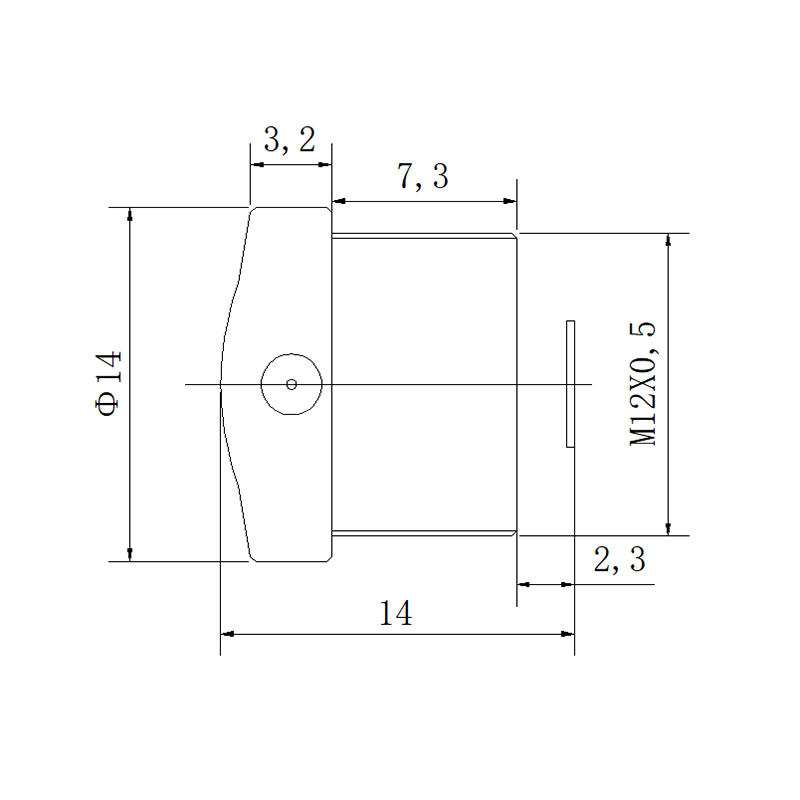
Fisheye Lens – CCL12301820MPF
1.8mm M12 5MP fisheye lens with 200° FOV, F2.0 aperture and M12 × 0.5 mount for panoramic, security, robotics and ultra-wide embedded vision.
CCL12301820MPF is Fisheye Lens for 1/2.3″ & 1/2.5″ Sensors, M12 Mount, 5-Megapixel, F2.0, 200° Field of View, Security Surveillance Application.
| IMAGE SIZE | Φ4.7, 1/2.3″, 1/2.5″ |
| FOCAL LENGTH | 1.8mm |
| F.O.V.@1/2.3″ | 200°(D) |
| 200°(H) | |
| 200°(V) | |
| F.O.V.@1/2.5″ | 200°(D) |
| 200°(H) | |
| 165°(V) | |
| RESOLUTION | 5 Megapixel |
| DISTORTION | <-119% |
| APERTURE | F2.0 |
| MOUNT | M12x0.5 |
| IRIS | Fixed |
| M.O.D. | 0.1m |
| T.T.L. | 14mm |
| B.F.L. | 3.5mm |
| STRUCTURE | 6G+IRCF |
1.8mm M12 5MP 200° Fisheye Lens
This 1.8mm M12 fisheye lens delivers an ultra-wide 200° field of view for 1/2.3″ sensors, providing exceptionally broad scene coverage in a compact optical package. With 5MP resolution, F2.0 aperture, M12 × 0.5 mounting, and a 14mm total optical length, it is designed for applications requiring extreme wide-angle imaging and maximum environmental visibility.
Its 200° FOV makes the lens suitable for wide-area security, panoramic imaging, robotics perception, embedded vision, and other systems where conventional lenses cannot provide sufficient angular coverage.
M12 Fisheye Lens Core Highlights
- Up to 200° ultra-wide FOV for extreme scene coverage
- 1.8mm fisheye focal length designed for panoramic and wide-area imaging
- 5MP resolution for detailed environmental and monitoring images
- F2.0 aperture provides efficient light transmission in a compact optical system
- M12 × 0.5 mount supports integration into compact camera modules
- 6G + IRCF optical structure supports specialized imaging configurations
- 0.1m M.O.D. enables relatively close-range wide-area imaging
1.8mm M12 5MP 200° Fisheye Lens Applications
Core Application Scenes
Ultra-Wide Security Monitoring
The 200° field of view allows a single camera to observe an exceptionally broad area. This can be useful for security systems installed in locations where minimizing blind spots is more important than maintaining conventional rectilinear image geometry.
Panoramic and Surround-View Imaging
With 200° coverage on a 1/2.3″ sensor, the lens can capture an extremely broad surrounding scene. It is suitable for panoramic camera modules, surround-view imaging, and compact wide-area observation systems.
Robotics Environmental Perception
A fisheye lens provides a large angular field for environmental awareness. The 200° horizontal FOV can help robotic systems observe objects and obstacles across a very broad angular range.
Compact Embedded Vision
The M12 × 0.5 mount makes the lens suitable for embedded camera modules requiring extreme wide-angle coverage. It can be integrated into OEM vision devices where the optical module must remain compact while covering a large scene.
Wide-Area Inspection
For inspection environments where the primary requirement is observing a large area rather than performing precision dimensional measurement, the extreme FOV can provide efficient scene coverage from a single camera position.
Designed for ultra-wide security monitoring, panoramic imaging, robotics perception, and embedded fisheye vision applications.
Compatible Device List
- M12 camera modules — M12 × 0.5 mounting supports compact optical integration.
- Fisheye security cameras — 200° FOV provides extremely broad monitoring coverage.
- Panoramic camera modules — Suitable for capturing large surrounding scenes.
- Robotics vision systems — Supports broad environmental perception.
- Embedded wide-angle cameras — Suitable for compact OEM camera designs.
- Wide-area observation devices — Useful where a large viewing angle is required from a single camera.
For compact M12 optical systems, explore TOWIN’s M12 Lens product range and M12 Lens solutions.
For security applications, the Smart Security solution provides additional information on integrating imaging optics into intelligent monitoring systems; For robotics applications, see Robotics Vision.
Engineers can also review TOWIN’s Fisheye Lens category when comparing other extreme wide-angle optical configurations.
Frequently Asked Questions
Q: What is the field of view of this 1.8mm M12 fisheye lens?
A: On a 1/2.3″ sensor, the specified FOV is 200° diagonal, 200° horizontal, and 200° vertical. On a 1/2.5″ sensor, it is 200° diagonal, 200° horizontal, and 165° vertical.
Q: Is this a fisheye lens?
A: Yes. The 1.8mm focal length combined with up to 200° FOV and distortion below -119% clearly indicates an extreme fisheye optical design.
Q: What sensor formats are supported?
A: The specified image sizes include Φ4.7, 1/2.3″, and 1/2.5″. The detailed FOV specifications are provided for 1/2.3″ and 1/2.5″ sensors.
Q: Why is the distortion specification below -119%?
A: The very large negative distortion value is associated with the extreme fisheye projection used to achieve a field of view of up to 200°. It should not be interpreted using the same criteria as conventional low-distortion machine vision lenses.
Q: Is this a low distortion lens?
A: No. This lens is designed to maximize angular coverage rather than minimize geometric distortion. It should therefore be classified as a fisheye and ultra-wide-angle lens rather than a low-distortion lens.
Q: What is the aperture of this fisheye lens?
A: The lens has a fixed F2.0 aperture, providing a consistent optical aperture for the intended imaging system.
Q: What is the minimum object distance?
A: The specified M.O.D. is 0.1m, or 100mm.
Q: Does the IRCF specification mean the lens is IR corrected?
A: Not necessarily. IRCF indicates an infrared-related optical component, but IR filtering and IR-corrected optical performance are different specifications. The lens should not be classified as an IR Corrected Lens without explicit IR-correction data.
Online contact