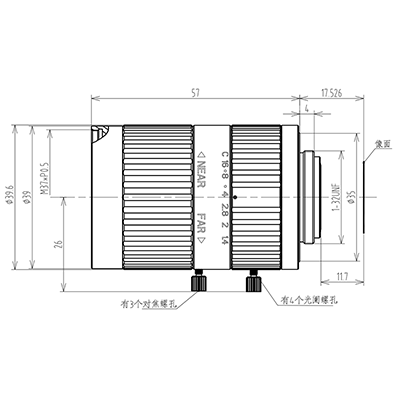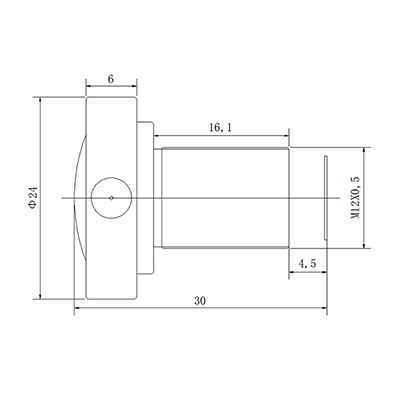



3.6mm HD M12 IR corrected CCTV lens
12/17/2025
6mm 3-Megapixel M12 CCTV lens
12/18/2025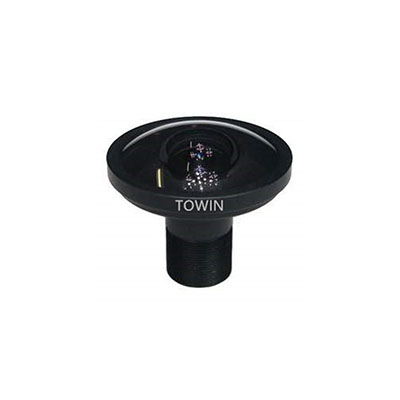
Industrial fisheye lenses provide an ultra-wide field of view for imaging systems that need to capture large surrounding areas with a compact optical design. An industrial fisheye lens, particularly an M12 fisheye lens, is widely used in panoramic monitoring, embedded vision, automotive imaging, robotics, and smart security applications.
Unlike conventional lenses designed to preserve straight-line geometry, fisheye lenses use specialized optical projection to capture a much wider scene on a limited image sensor. Selecting the right M12 fisheye lens requires evaluating field of view (FOV), sensor compatibility, resolution, optical distortion, focal length, and installation space.
TOWIN develops industrial optical lenses for machine vision and embedded imaging applications, offering different fisheye lens specifications and customization options for camera manufacturers and OEM customers.
Industrial Fisheye Lens: Key Features
- Ultra-wide field of view for panoramic imaging
- Compact M12 mounting options for embedded cameras
- Multiple focal lengths and sensor format options
- Different resolution and optical distortion specifications
- Options for IR-corrected and waterproof imaging applications
- OEM/ODM optical development and customization support
1. What Is an Industrial Fisheye Lens?
An industrial fisheye lens is a specialized wide-angle optical lens designed to capture an exceptionally large field of view within a compact imaging system. Many fisheye designs provide a field of view around or beyond 180 degrees, although the actual coverage depends on the optical projection, sensor format, and measurement direction.
Unlike conventional rectilinear lenses, which aim to reproduce straight lines as straight lines, fisheye lenses use different projection models to map a wide angular scene onto a flat image sensor. This allows a camera to capture more surrounding information within a single image.
Industrial fisheye lenses are particularly useful when camera size, installation space, and wide-area coverage are important design considerations.
Common applications include:
- Panoramic security cameras and surveillance systems.
- Automotive surround-view and vehicle monitoring cameras.
- Robotics and autonomous navigation systems.
- Embedded vision and compact AI cameras.
- Wide-area monitoring in industrial environments.
For compact camera modules, an M12 lens solution can provide a practical combination of small dimensions, flexible focal lengths, and wide-angle imaging capabilities.
2. How Does a Fisheye Lens Work?
A fisheye lens works by using a specialized optical projection system to capture light rays from a much wider angular range than conventional lenses. The optical elements direct these rays onto the camera sensor while controlling aberrations and maintaining usable image quality.
One of the most recognizable characteristics of fisheye imaging is barrel-like image distortion. Straight lines away from the image center may appear curved, depending on the projection model and lens design.
This behavior is not necessarily an optical defect. It is part of the way a fisheye lens maps a wide field of view onto a two-dimensional image plane.
Several projection models are used in fisheye optical designs, including:
- Equidistant projection: Image height is proportional to the incident angle.
- Equisolid-angle projection: Image area is proportional to the solid angle represented by the scene.
- Orthographic projection: Image height follows a sine-based angular relationship.
- Stereographic projection: Image height follows a tangent-based angular relationship.
The selected projection affects image geometry, peripheral representation, and the correction requirements of the camera system.
For industrial imaging, lens selection should therefore consider not only the advertised FOV but also the projection characteristics and the image-processing requirements of the final application.
3. Key Characteristics of Fisheye Lenses
Understanding the main fisheye lens characteristics helps engineers choose an optical solution that matches their camera system and imaging requirements.
3.1 Ultra-Wide Field of View
Field of view (FOV) describes the angular coverage captured by a camera. Fisheye lenses are designed to provide wider angular coverage than conventional wide-angle lenses, making them suitable for panoramic imaging and area monitoring.
FOV specifications should be checked in three directions:
- Diagonal FOV (DFOV): Angular coverage across the image diagonal.
- Horizontal FOV (HFOV): Angular coverage across the image width.
- Vertical FOV (VFOV): Angular coverage across the image height.
These values may differ significantly. Always compare the FOV specifications using the same sensor format and measurement direction.
3.2 Optical Distortion
Fisheye lenses naturally introduce strong geometric distortion to achieve their wide field of view. The amount and distribution of distortion depend on the optical projection and lens design.
For panoramic monitoring, this distortion may be acceptable or even useful. However, applications involving object measurement, accurate positioning, or machine vision inspection may require additional calibration and image correction.
It is important to distinguish between different distortion specifications, such as TV distortion and F-theta distortion. Their values should not be compared directly without understanding the measurement method.
Learn more about optical distortion in industrial imaging systems and how it affects camera calibration and image analysis.
3.3 Sensor Compatibility and Resolution
Sensor compatibility is another essential factor when selecting a fisheye lens. The lens image circle must adequately cover the active sensor area to avoid unwanted vignetting or loss of image information.
Resolution requirements should also be considered. A lens designed for a lower-resolution sensor may not provide sufficient optical performance for a higher-resolution camera.
Before selecting a lens, check:
- Sensor optical format and active dimensions.
- Pixel size and camera resolution.
- Lens image circle.
- FOV at the intended sensor format.
- Optical resolution and image quality across the field.
3.4 Compact Mechanical Design
Many industrial fisheye lenses use compact M12 × 0.5 mounting threads. This makes them suitable for board-level cameras and embedded vision modules where installation space is limited.
Mechanical compatibility also involves total track length (TTL), back focal length, mounting dimensions, and the camera housing design.
4. M12 Fisheye Lens: Features and Specifications
An M12 fisheye lens combines an ultra-wide optical design with a compact threaded mounting structure. It is frequently used in small camera modules that need to capture a large surrounding area without using a bulky optical assembly.
M12 fisheye lenses are particularly suitable for embedded vision, panoramic security cameras, automotive cameras, and compact monitoring systems.
When evaluating an M12 fisheye lens, consider the following specifications:
| Parameter | What to Check |
|---|---|
| Focal Length | Required scene coverage and optical configuration. |
| FOV | Horizontal, vertical, and diagonal coverage. |
| Sensor Format | Compatibility with the camera sensor. |
| Resolution | Required megapixel performance and image quality. |
| Distortion | Projection characteristics and correction requirements. |
| Aperture | Light transmission and low-light performance. |
| Mount | M12 × 0.5 thread and mechanical compatibility. |
Engineers can use the field of view calculator to evaluate camera coverage and compare lens configurations during the initial selection process. For fisheye projection systems, final FOV should always be confirmed against the manufacturer’s optical specifications rather than relying solely on a conventional rectilinear FOV formula.
For more information, see the industrial lens selection guide.
5. Industrial Applications of Fisheye Lenses
Industrial fisheye lenses are used in applications where a wide viewing angle and compact optical integration are important. The appropriate lens depends on the required coverage, image quality, environmental conditions, and camera configuration.
5.1 Smart Security and Panoramic Surveillance
Fisheye lenses are widely used in panoramic security cameras for monitoring indoor and outdoor environments. A single wide-angle camera can capture a large surrounding area, depending on the installation position and lens coverage.
Typical applications include:
- Warehouse and factory monitoring.
- Retail stores and commercial buildings.
- Parking areas and public spaces.
- Elevators and indoor monitoring systems.
IR-corrected fisheye lenses can also support day-and-night imaging systems that use infrared illumination.
Explore TOWIN’s smart security lens solutions for surveillance and AI imaging applications.
5.2 Automotive and Surround-View Imaging
Automotive imaging systems require compact lenses capable of capturing wide surrounding scenes. Fisheye lenses can be integrated into vehicle cameras for parking assistance, surround-view monitoring, and other wide-angle imaging applications.
Depending on the vehicle design, automotive lenses may also require environmental protection, stable optical performance, and compatibility with the camera sensor.
For demanding environments, selected TOWIN models offer IP69K protection. For example, the 1.4mm M12 200° IP69K fisheye lens combines a 3MP optical configuration, F2.0 aperture, and M12 × 0.5 mount.
Explore more automotive and ADAS imaging solutions.
5.3 Robotics and Embedded Vision
Robots and autonomous mobile systems need visual information about their surrounding environment. Wide-angle imaging can help cameras capture more environmental information, especially when the camera is installed in a compact or space-constrained position.
Fisheye lenses may be used for:
- Robot environment perception.
- Indoor panoramic monitoring.
- Compact navigation cameras.
- Embedded AI vision devices.
However, geometric distortion must be considered when the application involves precise positioning or visual measurement.
Discover TOWIN’s robotics vision lens solutions for AGV, AMR, and AI-enabled robotic systems.
5.4 Industrial Monitoring and Machine Vision
In industrial environments, fisheye lenses can be used for wide-area observation, equipment monitoring, and visual coverage of production areas.
They are particularly useful when the objective is to observe an entire working area rather than perform high-precision dimensional measurements.
For precision inspection, a conventional low-distortion or telecentric lens may be more appropriate than a fisheye lens. The correct optical solution depends on the inspection method and measurement accuracy requirements.
Learn more about machine vision lens solutions for industrial automation and inspection systems.
6. How to Choose the Right Fisheye Lens
Choosing the right fisheye lens requires more than comparing the maximum advertised field of view. Engineers should evaluate the entire optical and mechanical configuration to ensure compatibility with the final camera system.
6.1 Define the Required Field of View
Start by identifying the area that needs to be captured. Determine whether the application requires 180°, 200°, or a wider field of view, and clarify whether the specification refers to horizontal, vertical, or diagonal coverage.
The installation height, camera orientation, and working distance also influence the usable scene coverage.
6.2 Match the Lens to the Image Sensor
Check the sensor format and active imaging dimensions before selecting the lens. A mismatch between the lens image circle and sensor area can cause vignetting or incomplete image coverage.
6.3 Evaluate Resolution and Image Quality
Consider the camera’s megapixel requirements, pixel size, edge sharpness, and optical performance. A lens should be selected according to the imaging system’s actual resolution requirements rather than megapixel ratings alone.
6.4 Check Distortion and Image Correction
For panoramic surveillance, strong fisheye distortion may be acceptable. For object recognition, measurement, or navigation, the camera system may need calibrated distortion correction.
Confirm that the lens projection characteristics are compatible with the image-processing software.
6.5 Consider Environmental and Mechanical Requirements
Evaluate the mounting interface, total track length, aperture, operating temperature, and protection requirements. Automotive and outdoor systems may require additional environmental protection and specialized optical configurations.
6.6 Evaluate Customization Requirements
If standard products do not meet the camera system’s requirements, consider customized optical development. Important customization parameters may include focal length, FOV, image circle, distortion, resolution, mechanical dimensions, and environmental protection.
Working with an experienced industrial lens manufacturer can help camera developers evaluate optical feasibility and mechanical integration requirements.
7. TOWIN Industrial Fisheye Lens Solutions
TOWIN provides a range of industrial fisheye lenses for compact imaging systems, panoramic monitoring, automotive cameras, and other wide-angle applications.
Different models offer different combinations of focal length, field of view, sensor compatibility, resolution, aperture, and environmental protection.
1.17mm M12 Fisheye Lens
Model: CCL1320117MP
- 220° FOV
- 8MP resolution
- F2.2 aperture
- M12 × 0.5 mount
- IR corrected
Suitable for panoramic security and day-and-night imaging.
1.4mm M12 Automotive Fisheye Lens
Model: S01412420020F69
- 200° diagonal FOV
- 3MP resolution
- F2.0 aperture
- M12 × 0.5 mount
- IP69K protection
Suitable for automotive and demanding outdoor imaging systems.
1.6mm M12 Fisheye Lens
Model: S4121020F-1
- 209° diagonal FOV
- 5MP resolution
- F2.0 aperture
- M12 × 0.5 mount
- IR-cut filter structure
Suitable for panoramic CCTV and security monitoring.
These products demonstrate how different optical configurations can address different imaging requirements. The best model depends on the sensor, desired field of view, working distance, and environmental conditions.
Explore the complete TOWIN fisheye lens product range to compare available specifications.
For camera manufacturers and OEM customers, TOWIN also supports optical customization and lens development according to specific project requirements.
8. Frequently Asked Questions About Fisheye Lenses
Q: What is the difference between a fisheye lens and a wide-angle lens?
A: A fisheye lens uses a specialized projection design to capture an extremely wide field of view, often around or beyond 180 degrees. A conventional wide-angle lens generally aims to maintain more natural straight-line geometry. Fisheye lenses are often preferred for panoramic coverage, while conventional wide-angle lenses are suitable when geometric representation is more important.
Q: What is an M12 fisheye lens used for?
A: An M12 fisheye lens is commonly used in compact camera modules for panoramic surveillance, automotive imaging, embedded vision, robotics, and wide-area monitoring. Its small mounting structure makes it suitable for space-constrained camera systems.
Q: Do all fisheye lenses have a 180-degree field of view?
A: No. The field of view depends on the optical design, sensor format, and measurement direction. Some fisheye lenses provide less than 180 degrees, while others exceed 200 degrees. Always check the horizontal, vertical, and diagonal FOV specifications.
Q: Can fisheye lens distortion be corrected?
A: Yes. Camera calibration and image-processing algorithms can compensate for much of the geometric distortion. However, correction may reduce the usable image area and cannot fully restore optical information lost through poor edge imaging. The lens and correction algorithm should be selected together.
Q: How do I choose the right M12 fisheye lens?
A: Consider the required FOV, sensor format, resolution, focal length, image circle, optical distortion, aperture, and mechanical dimensions. Environmental conditions and image-processing requirements should also be considered before final selection.
Q: Are fisheye lenses suitable for machine vision applications?
A: Yes, fisheye lenses can be used for wide-area observation, environmental perception, and panoramic monitoring in machine vision systems. However, applications requiring precise dimensional measurement may benefit more from low-distortion or telecentric lenses.
Q: Can TOWIN customize an industrial fisheye lens?
A: TOWIN supports OEM/ODM optical development. Customization requirements can include focal length, FOV, sensor compatibility, optical distortion, mechanical dimensions, and environmental protection. Contact the engineering team to discuss the technical feasibility of your project.
Conclusion: Choosing the Right Industrial Fisheye Lens
An industrial fisheye lens is an effective optical solution for imaging systems that require wide-angle coverage, compact integration, and panoramic scene capture. From M12 fisheye lenses to specialized automotive and security imaging optics, selecting the right lens requires careful consideration of FOV, sensor compatibility, resolution, distortion, and mechanical requirements.
For engineers and camera manufacturers developing embedded vision, machine vision, robotics, and surveillance systems, the right optical configuration can significantly influence overall imaging performance.
TOWIN provides industrial fisheye lenses and customized optical development support for different camera applications. If you are looking for an M12 fisheye lens or a customized wide-angle optical solution, contact TOWIN to discuss your project requirements.
Looking for an Industrial Fisheye Lens?
Tell us your sensor format, required FOV, resolution, and application. Our team can help you evaluate a suitable optical solution.