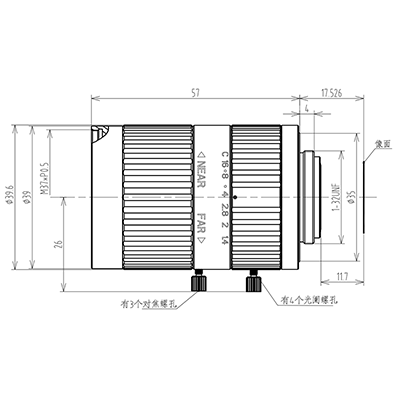



High-Contrast Wide Angle Lens
08/22/2025
Astronomy pinhole lens
08/22/2025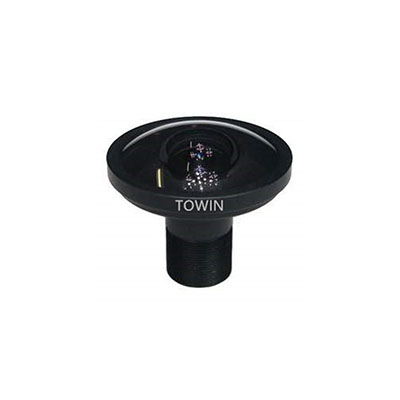
Fisheye lens focal length is one of the key factors that determines how a wide-angle scene is projected onto a camera sensor. However, unlike conventional rectilinear lenses, fisheye lenses use non-rectilinear projection models. This means that focal length alone cannot fully describe the resulting field of view.
For industrial camera systems, engineers need to consider focal length together with sensor dimensions, image circle, projection model, resolution, and the required image coverage. Understanding these relationships helps avoid incorrect lens selection and improves the performance of machine vision, robotics, automotive, and panoramic imaging systems.
A fisheye lens does not follow the same field-of-view relationship as a conventional rectilinear lens. Its projection model determines how incident angles are mapped to image positions, so focal length, sensor size, and projection must be evaluated together.
1. How Does a Fisheye Lens Work?
A fisheye lens is an ultra-wide-angle optical system that captures a large angular field of view. Instead of preserving straight lines in the same way as a rectilinear lens, it maps incoming light rays onto the image sensor using a non-rectilinear projection.
This mapping allows a very wide scene to fit within a compact image area. As a result, straight lines that do not pass through the image center may appear curved. The amount and pattern of image deformation depend on the optical design and projection model.
Fisheye lenses are used when wide-area coverage is a priority. Examples include vehicle surround-view cameras, panoramic imaging, mobile robotics, security monitoring, and compact embedded vision systems.
If you need to compare the main image formats before selecting a lens, see our guide to the main types of fisheye lenses, including circular and diagonal designs.
2. How Fisheye Lens Focal Length Affects Field of View
Focal length describes the optical system’s image scale. In general, a shorter focal length captures a wider angular scene than a longer focal length when the sensor and projection design are otherwise comparable.
However, the field of view of a fisheye lens cannot be accurately determined by applying a conventional rectilinear formula without considering the lens projection. Different fisheye designs map the same incident angle to different image heights.
2.1 Rectilinear Lens FOV Formula
For a conventional rectilinear lens, the field of view can be estimated using:
FOV = 2 × arctan ( d / 2f )
d = sensor dimension; f = focal length
This formula is useful for estimating the horizontal, vertical, or diagonal field of view of a rectilinear lens, provided the corresponding sensor dimension is used.
It should not be treated as a universal fisheye FOV formula. Fisheye lenses use different projection relationships, so the actual field of view should be taken from the optical design or manufacturer’s verified specifications.
2.2 Fisheye Projection and Image Height
A simplified way to describe a fisheye projection is to relate the image height to the incident angle:
r = f × g(θ)
r = image height; f = projection scale; θ = incident angle; g(θ) = projection function
The function g(θ) depends on the projection model. This is why two fisheye lenses with the same nominal focal length may not produce identical image coverage.
3. Common Fisheye Projection Models
Projection describes how the angle of an incoming light ray is converted into a position on the image plane. Different projection models distribute image information differently from the center to the edge.
3.1 Equidistant Projection
In an ideal equidistant projection, image height is proportional to the incident angle:
r = fθ
This relationship means equal increments in incident angle correspond to equal increments in image height. Equidistant projection is a useful reference model when analyzing angular image distribution.
3.2 Equisolid-Angle Projection
An ideal equisolid-angle projection follows:
r = 2f sin(θ/2)
This projection is designed so that equal solid angles are represented by equal image areas under the ideal model. It can be relevant when angular scene distribution and image-area relationships are important.
3.3 Stereographic Projection
An ideal stereographic projection can be expressed as:
r = 2f tan(θ/2)
Stereographic projection has distinctive geometric properties and can preserve local angular relationships in ways that are useful for certain imaging applications. Its image scale increases toward the edge of the field.
3.4 Orthographic Projection
An ideal orthographic projection follows:
r = f sin(θ)
This model maps the sine of the incident angle to image height. It has a different image-area distribution from equidistant, equisolid-angle, and stereographic projection.
These equations describe idealized projection models. Actual commercial fisheye lenses may use modified or hybrid optical mappings, so engineers should confirm the projection behavior from measured optical data or manufacturer documentation rather than assuming that every lens follows one ideal equation exactly.
4. How Sensor Size Affects Fisheye Lens FOV
Sensor size is another major factor in fisheye lens selection. Even when the lens design remains unchanged, a different sensor dimension can capture a different portion of the projected image.
A larger sensor may capture a wider portion of the image circle, provided the lens image circle is large enough to cover it. A smaller sensor uses a smaller part of the projected image and may therefore produce a narrower recorded field of view.
4.1 Sensor Format and Image Circle
The image circle is the circular area over which the lens is designed to form an image. For a camera system to use the sensor correctly, the lens image circle must cover the required sensor area.
If the image circle is too small, the corners or edges of the sensor may show darkening or vignetting. For a circular fisheye design, the intended circular image may occupy only part of the rectangular sensor. For a diagonal fisheye design, the image coverage is intended to extend across the sensor diagonal.
Before choosing a lens, compare the actual sensor dimensions with the lens’s specified image circle and image format. Do not rely only on a nominal sensor-inch designation.
4.2 Sensor Resolution and Pixel Size
Sensor resolution and pixel size affect the level of detail captured by the imaging system. A high-megapixel sensor does not automatically guarantee high image quality if the lens cannot resolve the required detail.
For industrial applications, evaluate lens resolution together with sensor pixel size, image quality across the field, focus performance, and the actual inspection target. Edge performance can be particularly important for wide-angle and fisheye systems because the image covers a large angular range.
5. Fisheye Lens vs. Rectilinear Wide-Angle Lens
Fisheye lenses and rectilinear wide-angle lenses both capture a broad scene, but they map the surrounding environment onto the sensor in different ways.
| Feature | Fisheye Lens | Rectilinear Wide-Angle Lens |
|---|---|---|
| Projection | Non-rectilinear | Rectilinear |
| Straight lines | May appear curved away from the center | Designed to keep straight lines straight |
| Scene coverage | Very wide angular coverage | Wide coverage with rectilinear mapping |
| Typical use | Panoramic, surround-view, wide-area monitoring | Inspection and imaging where straight-line geometry matters |
| Image processing | May require dewarping or application-specific correction | May still require distortion calibration |
A fisheye lens is not simply a wide-angle lens with excessive distortion. Its projection is an intentional optical design choice. If the application requires a very wide scene, a fisheye may be appropriate. If geometric measurement and straight-line representation are priorities, a rectilinear or low-distortion lens may be more suitable.
6. How to Select a Fisheye Lens for Industrial Cameras
Selecting an industrial fisheye lens requires evaluating the optical, sensor, mechanical, and application requirements together. The following factors should be considered before finalizing a lens model.
6.1 Define the Required Field of View
Determine the horizontal, vertical, and diagonal coverage required by the application. Also identify whether the system needs a circular image or a rectangular full-frame image. The required field of view should be based on the actual installation geometry, not only on a product headline specification.
6.2 Match the Lens to the Sensor
Confirm the sensor format, active dimensions, resolution, and pixel size. Then check the lens image circle and specified sensor compatibility. This helps prevent vignetting and incomplete image coverage.
6.3 Evaluate Optical Resolution
The lens must provide suitable image quality for the sensor and application. Consider resolution across the image field, not just at the center. For inspection or recognition tasks, the required detail at the edge of the image may be a critical selection factor.
6.4 Consider Aperture and Lighting
Aperture affects the amount of light reaching the sensor and can influence depth of field and image quality. The appropriate aperture depends on illumination, exposure time, motion, working distance, and the required image performance.
6.5 Check Distortion and Image Correction
Fisheye projection is inherently non-rectilinear. If the application requires a corrected or geometrically interpreted image, confirm that the camera and software pipeline support the required calibration or dewarping process.
6.6 Confirm the Mechanical Interface
Check the mount type, lens dimensions, back focal distance, and available installation space. For compact embedded systems, mechanical constraints may determine which optical designs are practical.
7. Industrial Applications of Fisheye Lenses
7.1 Automotive Imaging
Fisheye lenses can provide wide scene coverage for vehicle camera systems, including surround-view and monitoring applications. Selection should consider the sensor, required viewing area, mounting location, environmental conditions, and image correction requirements.
7.2 Robotics and Autonomous Systems
Mobile robots may use fisheye cameras to observe a broad surrounding area. Wide-angle coverage can support navigation, obstacle awareness, and environmental monitoring when integrated with suitable image processing.
7.3 Smart Security
Fisheye cameras can monitor large indoor or outdoor areas from a single location. The lens and camera system should be selected according to the installation height, target coverage, lighting, and image-processing method.
7.4 Drone and Panoramic Imaging
Compact fisheye optics can be used in aerial and panoramic imaging systems where wide coverage and compact dimensions are important. Weight, sensor matching, exposure conditions, and edge image quality should be evaluated.
8. Frequently Asked Questions
Q1: How does focal length affect a fisheye lens field of view?
For otherwise comparable optical designs and sensor formats, a shorter focal length generally provides a wider field of view. However, the actual relationship depends on the fisheye projection model and the sensor dimensions.
Q2: Can I use the standard FOV formula for a fisheye lens?
The standard rectilinear formula is not a universal fisheye calculation method. Fisheye lenses rely on non-rectilinear projection models, so you use the manufacturer’s optical data or a suitable projection-specific calculation.
Q3: What is equidistant projection in a fisheye lens?
Equidistant projection is an idealized model in which image height is proportional to the incident angle, expressed as r = fθ. Actual lenses may deviate from this ideal relationship.
Q4: Does sensor size affect fisheye lens FOV?
Yes. Sensor dimensions determine how much of the projected image is recorded. A larger sensor can capture a wider portion of the image circle when the lens provides sufficient image coverage.
Q5: What is the difference between fisheye and rectilinear lenses?
A fisheye lens uses non-rectilinear projection to capture a very wide scene, while a rectilinear lens is designed to preserve straight-line geometry. The choice depends on whether wide angular coverage or geometric representation is more important.
Q6: Do fisheye lenses require image correction?
Not always. Some applications can use the original fisheye image directly. Others require calibration, dewarping, or projection conversion to support measurement, display, or downstream computer vision tasks.
Q7: What should I provide when requesting an industrial fisheye lens?
Provide the camera sensor model, sensor dimensions, required field of view, working distance, target resolution, image format, lens mount, installation space, and operating environment. These details help evaluate whether an existing lens or a customized optical design is suitable.
9. Find an Industrial Fisheye Lens for Your Camera
Choosing the right fisheye lens requires more than selecting a focal length. Projection model, sensor size, image circle, resolution, aperture, and mechanical compatibility all influence the final imaging result.
TOWIN offers industrial lens solutions for compact camera systems. Review the TOWIN fisheye lens category to explore available options for your application.
For a complete selection process, first identify whether your system requires a circular or diagonal image format. Our guide to the main types of fisheye lenses explains the differences between these two designs.