


Wide Angle Lens – CCL1401655MP
07/25/2025
Wide Angle Lens – CCL1402124MPF
07/25/2025
Fisheye Lens – CCL1401820MP
1.8mm 5MP M12 ultra-wide fisheye lens with up to 200° FOV, F2.0 aperture, 0.1m M.O.D., 14mm T.T.L., and M12x0.5 mount for compact wide-area imaging.
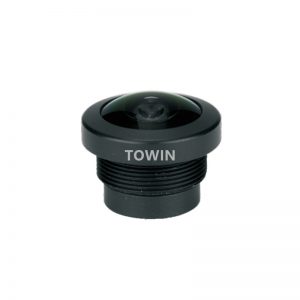
CCL1401820MP is 1.8mm Compact Fisheye Lens with T.T.L. 14mm, 5-megapixel resolution F2.0 aperture Low F-number M12/S-Mount Lens(Fast Lenses).
| IMAGE FORMAT | Φ4.7mm |
| FOCAL LENGTH | 1.8mm |
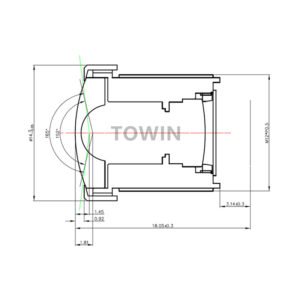
| F.O.V.@4.7mm | 200° |
| F.O.V.@4.6mm | 185° |
| F.O.V.@3.84mm | 136° |
| F.O.V.@3.4mm | 110° |
| RESOLUTION | 5 Megapixel |
| OPTICAL DISTORTION | <-122% |
| APERTURE | F2.0 |
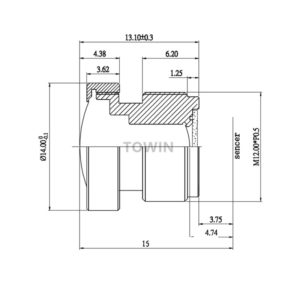
| MOUNT | M12x0.5 |
| IRIS | Fixed |
| M.O.D. | 0.1m |
| T.T.L. | 14mm |
| B.F.L. | 3.46mm |
| COMPONENT | 6G |
1.8mm 5MP M12 200° Ultra Wide Angle Fisheye Lens
The 1.8mm M12 fisheye lens is designed for imaging systems that require an exceptionally wide field of view from a compact optical assembly. With a maximum 200° diagonal FOV, 185° FOV at 4.6mm image height, and 5MP resolution, this lens provides extremely broad scene coverage for embedded vision and wide-area imaging applications. Its M12x0.5 mount, F2.0 aperture, 0.1m M.O.D., and 6G optical construction support compact camera integration.
M12 200° Fisheye Lens Core Product Highlights
- Up to 200° Ultra-Wide FOV: Provides exceptionally broad scene coverage for applications requiring visibility across a very large viewing area.
- Multiple FOV Configurations: The optical design provides 200°, 185°, 136°, and 110° FOV values at different specified image heights, offering broad coverage across the image format.
- 5MP Resolution: Supports detailed image acquisition for compact embedded vision and wide-area imaging systems.
- F2.0 Aperture: Provides a relatively bright fixed aperture for stable image capture in suitable lighting environments.
- Compact M12x0.5 Mount: Integrates easily into miniature camera modules and space-constrained optical assemblies.
- 6G Optical Construction: Uses a 6G optical configuration within a compact 14mm T.T.L. design.
M12 200° Fisheye Lens Applications
Core Application Scenes
The defining characteristic of this lens is its extremely wide field of view. With a maximum specified diagonal FOV of 200°, it is designed for applications where maximizing scene coverage is more important than maintaining conventional rectilinear image geometry.
The lens is suitable for applications such as:
- Ultra-wide embedded vision
- Panoramic imaging systems
- Wide-area object detection
- Compact monitoring modules
- Robotics perception
- Embedded vision cameras
- Surround-view imaging concepts
- Short-distance wide-area imaging
- Space-constrained optical modules
Because the specified optical distortion is <-122%, this lens should not be treated as a conventional low-distortion wide-angle lens. The strong optical projection is an important part of achieving its exceptionally wide field of view.
Designed for ultra-wide-angle and fisheye imaging applications where maximum scene coverage is the primary optical requirement.
Compatible Devices
The M12x0.5 mount makes this lens suitable for compact camera assemblies where a small mechanical interface is required.
Potential compatible devices include:
- M12 camera modules
- Embedded vision cameras
- Compact industrial cameras
- Miniature robotic vision modules
- Wide-area monitoring cameras
- OEM imaging modules
- Compact panoramic camera systems
- Space-constrained embedded cameras
The specified image format is Φ4.7mm, so the optical image coverage and sensor active area should be checked carefully before integration.
TOWIN’s Sensor Guide can help engineers evaluate sensor and lens compatibility during the camera design process.
200° Ultra-Wide Field of View
The most important feature of this lens is its extremely broad viewing angle.
The specified FOV values are:
- 200° at 4.7mm
- 185° at 4.6mm
- 136° at 3.84mm
- 110° at 3.4mm
These values demonstrate how the lens is designed to capture a very large angular range within a compact imaging system.
This makes the lens particularly useful when the camera cannot be positioned far enough from the target to achieve broad scene coverage with a conventional lens.
Engineers should distinguish between fisheye FOV and rectilinear FOV when evaluating system performance. A fisheye optical design intentionally uses a different image projection to achieve much wider angular coverage.
For general field-of-view planning, TOWIN’s FOV Calculator can be used as part of the lens selection process.
Fisheye Projection and Distortion
The specified optical distortion of <-122% is a fundamental characteristic of this ultra-wide-angle design rather than a defect that should be compared directly with low-distortion machine vision lenses.
For applications such as panoramic perception, wide-area detection, and environmental awareness, the ability to capture a very large angular range can be more important than preserving straight-line geometry.
However, if the application requires accurate dimensional measurement or conventional geometric reconstruction, engineers should evaluate whether a lower-distortion optical design would be more appropriate.
TOWIN’s Distortion Guide provides additional information for comparing optical distortion characteristics.
Compact M12 Optical Integration
The M12x0.5 mount, 14mm T.T.L., and 3.46mm B.F.L. make the lens suitable for compact optical integration.
When integrating the lens into a camera housing, engineers should verify:
- M12x0.5 mechanical compatibility
- Sensor active area and image coverage
- B.F.L. and sensor positioning
- Housing clearance
- Optical alignment
- Image-processing requirements for fisheye distortion
For additional optical integration considerations, see TOWIN’s Optical Design resources.
Lens Selection Considerations
When selecting an ultra-wide-angle M12 lens, engineers should evaluate the entire optical system rather than focusing only on focal length.
Important parameters include:
- Image Format: Φ4.7mm
- Focal Length: 1.8mm
- Maximum FOV: 200°
- Resolution: 5 Megapixel
- Optical Distortion: <-122%
- Aperture: F2.0
- Minimum Object Distance: 0.1m
- Mount: M12x0.5
- T.T.L.: 14mm
- B.F.L.: 3.46mm
For this particular lens, the most important selection question is whether the application prioritizes maximum angular coverage or low geometric distortion.
If maximum scene coverage is the priority, the 200° FOV provides a major advantage. If image geometry and measurement accuracy are more important, engineers should instead evaluate TOWIN’s Low Distortion Lens options.
For a broader lens-selection workflow, see the Lens Selection Guide.
Frequently Asked Questions
Q1: What is the maximum field of view of this M12 fisheye lens?
A: The specified maximum field of view is 200° at an image height of 4.7mm. Additional specified FOV values are 185° at 4.6mm, 136° at 3.84mm, and 110° at 3.4mm.
Q2: Is this an ultra-wide-angle or fisheye lens?
A: It is best categorized as an ultra-wide-angle fisheye lens. The 200° maximum FOV and <-122% optical distortion are characteristic of a fisheye-type optical design.
Q3: Is this a low-distortion M12 lens?
A: No. The specified optical distortion is <-122%. This lens prioritizes extremely wide angular coverage rather than low geometric distortion.
Q4: What sensor or image format is this lens designed for?
A: The specified image format is Φ4.7mm. The camera sensor and active imaging area should be checked against this optical image coverage before integration.
Q5: What is the minimum object distance?
A: The specified M.O.D. is 0.1m, or 100mm, making the lens suitable for relatively close-range wide-area imaging.
Q6: What mount does this fisheye lens use?
A: The lens uses an M12x0.5 mount, making it suitable for compact M12 camera modules and embedded optical systems.
Q7: Is the 1.8mm M12 lens suitable for machine vision?
A: It can be suitable for machine vision applications that require extremely wide scene coverage, such as environmental perception, wide-area detection, and compact embedded vision. Applications requiring precision measurement should carefully evaluate the specified optical distortion.
Q8: What is the advantage of a 200° fisheye lens?
A: A 200° field of view allows the camera to capture an exceptionally large angular area from a single compact optical position. This can reduce blind spots in applications where broad environmental visibility is more important than conventional image geometry.
Online contact