


Low Distortion Lens – CCL140265MP
07/25/2025
Fisheye Lens – CCL1401820MP
07/25/2025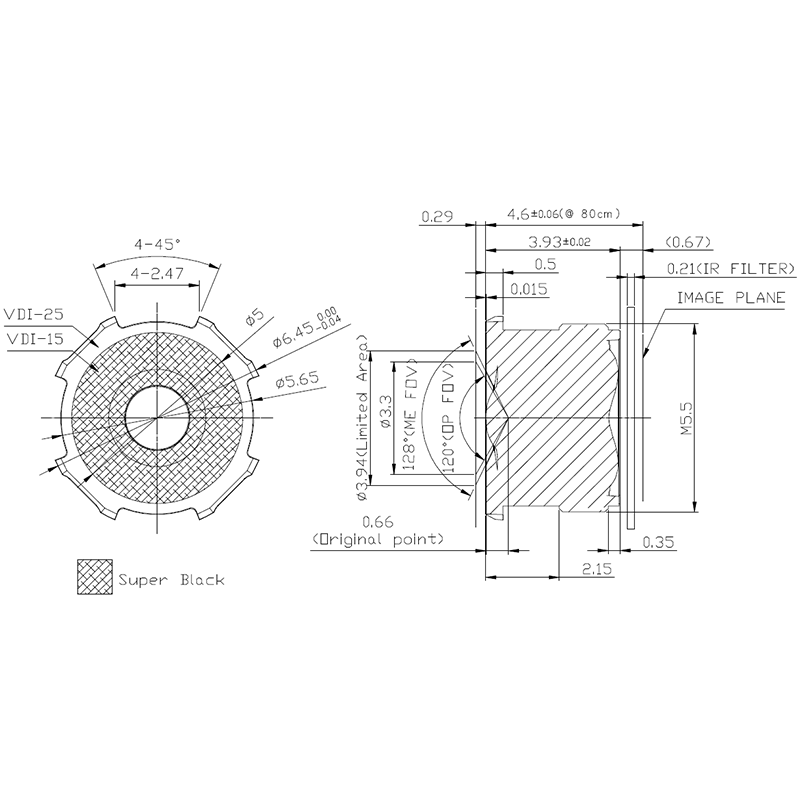
Wide Angle Lens – CCL1401655MP
1.6mm M5.5 ultra-wide-angle miniature lens for 1/4″ sensors, featuring 120° D.FOV, 105° H.FOV, 83° V.FOV, F2.4 aperture, and 0.1m M.O.D.
CCL1401655MP is 1.6mm wide angle lens with Low Chromatic Aberration, F2.4 aperture M5.5X0.35 mount lens, 1/4″ 120° Megapixel CCTV HD lens.
| IMAGE SIZE | 1/4″ |
| FOCAL LENGTH | 1.6mm |
| F.O.V. | 120°(D) |
| 105°(H) | |
| 83°(V) | |
| RESOLUTION | Megapixel |
| DISTORTION | <-16% |
| APERTURE | F2.4 |
| MOUNT | M5.5X0.35 |
| IRIS | Fixed |
| FOCUS | Manual |
| ZOOM | Fixed |
| B.F.L. | 0.8mm |
| M.O.D. | 0.1m |
| CONSTRUCTION | 6P |
1.6mm Megapixel M5.5 Ultra Wide Angle Miniature Lens
The 1.6mm M5.5 miniature lens is designed for compact imaging systems requiring an extremely wide field of view. With 120° diagonal, 105° horizontal, and 83° vertical FOV, this fixed focal lens provides broad scene coverage from a very small optical package. Its 1/4″ image format, F2.4 aperture, 0.1m M.O.D., and M5.5X0.35 mount make it suitable for compact embedded vision and wide-area imaging applications.
M5.5 Wide Angle Lens Core Product Highlights
- 1.6mm Ultra-Short Focal Length: Provides an extremely wide viewing angle for applications requiring broad scene coverage from a compact camera position.
- 120° Diagonal FOV: The 120° diagonal, 105° horizontal, and 83° vertical FOV enable wide-area image capture.
- Compact M5.5X0.35 Mount: Designed for miniature camera assemblies and space-constrained embedded optical systems.
- Close-Range Imaging: With a specified 0.1m M.O.D., the lens can be used in compact imaging configurations with short object distances.
- 6P Optical Construction: The 6P construction provides a compact optical architecture for miniature wide-angle imaging applications.
M5.5 Wide Angle Lens Applications
Core Application Scenes
The primary advantage of this 1.6mm lens is its very wide field of view. With a 105° horizontal FOV, the lens can capture a broad scene even when the available camera-to-object distance is limited.
Unlike a low-distortion wide-angle lens, this design has a specified distortion below -16%, so it should be selected when wide scene coverage is more important than maintaining straight-line geometry.
Typical applications include:
- Ultra-wide embedded imaging
- Compact vision modules
- Wide-area object detection
- Short-distance monitoring
- Compact robotic vision modules
- Embedded industrial cameras
- Space-constrained inspection equipment
- Wide-angle sensing and imaging systems
For applications where image geometry is critical, engineers should evaluate the effect of the specified distortion during system design. TOWIN’s Distortion Guide provides useful background when comparing wide-angle and low-distortion optical designs.
Designed for ultra-wide-angle embedded imaging applications requiring maximum scene coverage from a compact optical module.
Compatible Devices
The M5.5X0.35 mount makes this lens particularly relevant to miniature camera modules where conventional M12, C-mount, or CS-mount lenses may be too large.
Potential compatible device configurations include:
- 1/4″ compact camera modules
- Miniature embedded cameras
- Small industrial vision modules
- Compact robotic cameras
- Embedded monitoring devices
- OEM optical modules
- Space-constrained imaging assemblies
Before integration, the sensor size and optical image coverage should be verified. The specified image format is 1/4″, while the actual field of view depends on the sensor dimensions used with the lens.
Engineers can use TOWIN’s Sensor Guide to understand the relationship between sensor format and lens selection.
Ultra-Wide Field of View
The 1.6mm focal length provides a 120° diagonal FOV, together with 105° horizontal and 83° vertical coverage. This makes the lens suitable for applications where the camera needs to see a large area without moving farther away from the target.
For example, when the available installation space is restricted, a shorter focal length can help increase scene coverage. However, the resulting optical distortion should be considered when the application involves dimensional measurement or geometric analysis.
The FOV Calculator can help engineers evaluate field-of-view requirements when selecting a lens for a specific camera and installation geometry.
Distortion Characteristics
The specified distortion is <-16%, which is significantly different from a low-distortion machine vision lens. This characteristic is consistent with an ultra-wide-angle optical design where maximizing field coverage is a higher priority than maintaining straight-line geometry.
This lens is therefore better suited to applications such as broad-area viewing, detection, monitoring, and embedded perception than precision measurement tasks where very low distortion is required.
For applications requiring controlled geometric accuracy, engineers should consider TOWIN’s Low Distortion Lens category instead.
Compact Optical Integration
The M5.5X0.35 mount, 0.8mm B.F.L., and compact 6P construction are important specifications for miniature optical integration.
Mechanical designers should verify:
- Mount compatibility
- Sensor position
- Back focal distance
- Housing clearance
- Optical alignment
- Available installation space
For more information about optical integration and lens architecture, see TOWIN’s Optical Design resources.
Lens Selection Considerations
When selecting this 1.6mm ultra-wide-angle lens, engineers should evaluate the following parameters together:
- Image Format: The specified image size is 1/4″.
- Focal Length: 1.6mm provides an extremely wide viewing angle.
- Field of View: 120° diagonal, 105° horizontal, and 83° vertical.
- Distortion: <-16%, which should be considered when image geometry matters.
- Aperture: Fixed F2.4 aperture.
- Working Distance: 0.1m M.O.D. for close-range imaging configurations.
- Mount: M5.5X0.35 for miniature optical assemblies.
- Focus: Manual focus for optical adjustment during integration.
TOWIN’s Lens Selection Guide can help engineers compare focal length, sensor format, field of view, distortion, and mechanical requirements before choosing a lens.
Frequently Asked Questions
Q1: What is the field of view of this 1.6mm lens?
A: The lens provides a 120° diagonal field of view, 105° horizontal field of view, and 83° vertical field of view based on the specified optical configuration.
Q2: Is this lens a low distortion lens?
A: No. The specified distortion is <-16%. This lens is designed primarily for very wide scene coverage rather than low-distortion imaging.
Q3: Is the 1.6mm lens suitable for wide-angle imaging?
A: Yes. Its 120° diagonal FOV and 105° horizontal FOV make it suitable for applications requiring very broad image coverage from a compact camera position.
Q4: What sensor size is this lens designed for?
A: The specified image size is 1/4″. The actual camera sensor should be checked for compatibility before system integration.
Q5: What is the minimum object distance?
A: The specified M.O.D. is 0.1m, or 100mm, making the lens suitable for relatively close-range imaging configurations.
Q6: What mount does this lens use?
A: The lens uses an M5.5X0.35 mount, which is intended for miniature camera and embedded optical assemblies.
Q7: Is this lens suitable for precision measurement?
A: The specified distortion is <-16%, so the lens is generally better suited to wide-area viewing, detection, and embedded imaging than precision measurement applications requiring very low geometric distortion.
Q8: What is the difference between this lens and a low-distortion wide-angle lens?
A: This 1.6mm lens prioritizes an extremely wide field of view, reaching 120° diagonally, while a low-distortion lens prioritizes maintaining image geometry. The appropriate choice depends on whether scene coverage or geometric accuracy is the main system requirement.
Online contact