


CCTV IR corrected 1/3″ 185° M12 Fisheye lens
12/30/2025
3.7mm 1/3″ HD CCTV M12 Pinhole lens
12/31/2025
Choosing the right industrial fisheye lenses requires more than simply selecting the widest field of view. Engineers and camera manufacturers must consider sensor compatibility, optical resolution, distortion characteristics, mounting dimensions, and environmental requirements.
For machine vision, robotics, security surveillance, and embedded imaging systems, a fisheye lens can capture a broad scene from a compact camera module. However, different optical designs serve different imaging requirements. A lens suitable for panoramic monitoring may not be the best choice for precision inspection or measurement.
In this guide, we compare five TOWIN fisheye lens models and explain their key specifications, potential applications, and selection considerations. Whether you are developing an M12 camera module, an industrial monitoring system, or a wide-angle imaging device, this comparison will help you identify a suitable optical configuration.
Quick Overview
- Ultra-wide 245° fisheye imaging: CCL123010MPF
- Waterproof 8MP imaging: S01512323020
- Compact 210° panoramic imaging: CCL1301020MP
- Flexible image-format coverage: S02106819024
- Harsh-environment automotive imaging: S01014019520F
Product suitability should always be confirmed against the actual camera sensor, mechanical interface, working distance, and operating environment.
1. What Is an Industrial Fisheye Lenses?
An industrial fisheye lens is an ultra-wide-angle optical lens designed to capture a large viewing area within a single image. Compared with conventional wide-angle lenses, fisheye designs can provide a much wider field of view, making them useful for applications where scene coverage and reduced blind spots are important.
These lenses are commonly used in compact surveillance cameras, embedded vision devices, robotics, vehicle imaging, and panoramic camera systems.
Most compact fisheye camera modules use an M12 lens mount, also known as an S-Mount. Its compact threaded interface makes it suitable for space-constrained camera housings and embedded imaging equipment.
How Does a Fisheye Lenses Differ from a Standard Wide-Angle Lens?
A standard wide-angle lens is generally designed to maintain relatively natural geometric proportions, while a fisheye lens uses a specialized projection to capture an extremely wide viewing angle. Depending on its optical design, a fisheye lens may produce strong barrel-type image deformation or a circular image.
In industrial applications, this distortion is not necessarily a disadvantage. For monitoring and panoramic imaging, wide scene coverage may be more important than maintaining straight lines. For precision measurement, however, optical distortion and calibration requirements must be evaluated carefully.
2. Key Factors When Choosing an Industrial Fisheye Lenses
Before selecting a fisheye camera lens, engineers should evaluate several optical and mechanical parameters. A wide FOV alone does not guarantee good imaging performance.
2.1 Field of View (FOV)
Field of view determines how much of a scene a camera can capture. Fisheye lenses are often selected for applications requiring very wide coverage, including panoramic surveillance, robotics, and compact embedded cameras.
When comparing lens specifications, distinguish between diagonal FOV (DFOV), horizontal FOV (HFOV), and vertical FOV (VFOV). These values are not interchangeable. Always check the manufacturer’s optical specification for the intended sensor format.
Use the industrial lens FOV calculator to estimate imaging coverage based on sensor size, focal length, and working distance.
2.2 Sensor Size and Image Circle
Sensor compatibility is essential when choosing an M12 fisheye lens. The lens image circle must cover the active area of the image sensor. A mismatch may result in vignetting, dark corners, or incomplete image coverage.
Common sensor formats include 1/4″, 1/3″, 1/2.3″, and 1/2″. However, the nominal sensor format alone does not guarantee compatibility. Engineers should also check the actual active sensor dimensions and image circle.
Read the industrial camera sensor size guide to understand sensor formats and lens matching requirements.
2.3 Optical Resolution
Lens resolution should be evaluated against the image sensor’s pixel requirements. An 8MP or 10MP lens specification indicates a stated resolution capability, but actual system image quality also depends on sensor pixel size, optical performance, focus, illumination, and image processing.
For applications requiring detailed image capture, evaluate the lens’s MTF performance and edge sharpness rather than relying only on the megapixel label.
2.4 Optical Distortion
Fisheye lenses are designed for extremely wide coverage, so geometric distortion is an important consideration. Different optical designs may use different distortion definitions and measurement methods.
For general surveillance and panoramic monitoring, software-based dewarping may help transform a fisheye image into a more conventional view. For precision measurement, distortion calibration and residual error should be evaluated as part of the complete imaging system.
Learn more about optical distortion in machine vision lenses.
2.5 Mounting and Environmental Requirements
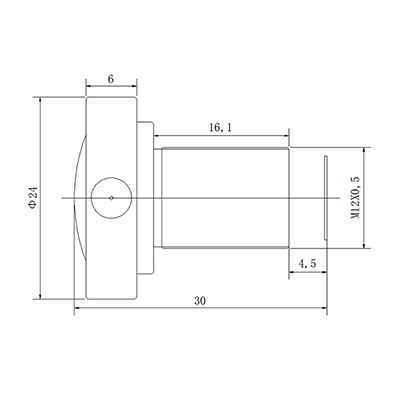
M12x0.5 is a common threaded interface for compact board lenses. However, selecting the correct thread is only one part of mechanical compatibility. Total track length (TTL), back focal length (BFL), housing clearance, focus adjustment, and sensor positioning must also be considered.
For outdoor or automotive imaging, check the specified waterproof rating and operating temperature range. These specifications should be verified for the complete camera assembly rather than assumed from the lens alone.
3. Top 5 Industrial Fisheye Lenses Options from TOWIN
The following five TOWIN models offer different combinations of viewing angle, sensor compatibility, resolution, and environmental protection. They are intended for different imaging requirements rather than being a universal ranking from best to worst.
| Model | Focal Length | Image Format | Resolution | FOV | Aperture | Key Feature |
|---|---|---|---|---|---|---|
| CCL123010MPF | 1.0mm | 1/2.3″ | 10MP | 245° | F2.8 | Ultra-wide imaging |
| S01512323020 | 1.5mm | 1/2.3″ | 8MP | 230° | F2.0 | IP68 waterproof |
| CCL1301020MP | 1.0mm | 1/3″ | 8MP | 210° | F2.0 | Compact panoramic imaging |
| S02106819024 | 2.1mm | Φ6.8mm max | 8MP | 190° at Φ6.8mm | F2.4 | Multi-format FOV options |
| S01014019520F | 1.0mm | 1/4″ | 1.3MP | 200° diagonal | F2.0 | IP69K protection |
Note: The FOV figures above follow the published product specifications. The exact image coverage depends on the sensor format and configuration. Distortion values from different optical designs should not be compared without confirming their definitions and test conditions.
3.1 CCL123010MPF – 10MP Ultra-Wide M12 Fisheye Lens
The CCL123010MPF 10MP M12 fisheye lens is designed for imaging systems requiring extremely wide scene coverage and a compact optical interface.
With a 1.0mm focal length, 1/2.3-inch image format, 10MP resolution, and a published 245° FOV, this model is an option for panoramic monitoring, compact camera modules, and wide-area imaging systems.
- Focal length: 1.0mm
- Image format: Φ4.4mm / 1/2.3″
- Resolution: 10MP
- Published FOV: 245° (D/H/V)
- Aperture: F2.8
- Mount: M12x0.5
- F-Theta distortion: below -1.6% as specified by the manufacturer
- Total track length: 36.9mm
Potential Applications: Panoramic imaging, robotics, UAV imaging, and wide-area security monitoring, subject to system-level optical validation.
View CCL123010MPF product specifications →
3.2 S01512323020 – 8MP IP68 Waterproof M12 Fisheye Lens
The S01512323020 waterproof fisheye lens combines an 8MP optical specification with a wide viewing angle and IP68 protection.
Its 1.5mm focal length, 1/2.3-inch image format, and F2.0 aperture make it a candidate for outdoor imaging and compact camera systems where environmental protection is an important design requirement.
- Focal length: 1.5mm
- Image format: Φ4.7mm / 1/2.3″
- Resolution: 8MP
- Published FOV: 230° (D/H/V)
- Aperture: F2.0
- Mount: M12x0.5
- Distortion: below -25% as specified by the manufacturer
- Waterproof rating: IP68
- Total track length: 14.8mm
Potential Applications: Outdoor security cameras, vehicle imaging modules, and weather-exposed camera systems. Final suitability depends on the complete enclosure and environmental qualification.
View S01512323020 product specifications →
3.3 CCL1301020MP – 8MP 210° Compact M12 Fisheye Lens
The CCL1301020MP M12 fisheye lens is designed for compact panoramic imaging systems that require a very wide field of view.
Featuring a 1.0mm focal length, 1/3-inch image format, 8MP resolution, and F2.0 aperture, this lens can be considered for embedded camera modules and wide-angle monitoring devices.
- Focal length: 1.0mm
- Image format: Φ3.0mm / 1/3″
- Resolution: 8MP
- Published FOV: 210° (D/H/V)
- Aperture: F2.0
- Mount: M12x0.5
- Optical distortion: below -99% as specified by the manufacturer
- Minimum object distance: 0.1m
- Total track length: 14.84mm
Potential Applications: Panoramic cameras, embedded imaging devices, compact security cameras, and selected robotics imaging systems.
Because this model has a specialized fisheye distortion profile, system developers should evaluate image dewarping and calibration requirements before using it in measurement applications.
View CCL1301020MP product specifications →
3.4 S02106819024 – 8MP Fisheye Lenses with Multiple Image-Format Options
The S02106819024 fisheye lens provides different viewing-angle specifications according to the image format used.
Its 2.1mm focal length and 8MP resolution make it an option for imaging systems that require a balance between broad scene coverage and sensor-format flexibility.
- Focal length: 2.1mm
- Maximum image format: Φ6.8mm
- Resolution: 8MP
- FOV at Φ6.8mm: 190°
- FOV at Φ6.3mm: 180°
- FOV at Φ3.57mm: 95°
- Aperture: F2.4
- Mount: M12x0.5
- F-Theta distortion: below -10% as specified by the manufacturer
- Total track length: 16.64mm
Potential Applications: Security monitoring, wide-angle embedded cameras, and imaging devices that require evaluation across different active image formats.
Before selecting this model, confirm the active sensor area and the corresponding FOV. The published 190°, 180°, and 95° values represent different image-format conditions, not three interchangeable specifications for the same configuration.
View S02106819024 product specifications →
3.5 S01014019520F – IP69K Industrial and Automotive Fisheye Lens
The S01014019520F automotive fisheye lens is designed for wide-angle imaging in demanding environments.
Its IP69K protection, compact 12.88mm total track length, and operating temperature specification make it relevant to selected vehicle camera and industrial monitoring designs.
- Focal length: 1.0mm
- Image format: 1/4″ / Φ4.1mm
- Resolution: 1.3MP
- FOV: 200° diagonal / 195° horizontal / 151° vertical
- Aperture: F2.0
- Mount: M12x0.5
- Waterproof rating: IP69K
- Operating temperature: -40°C to +85°C
- Total track length: 12.88mm
Potential Applications: Automotive camera modules, exterior vehicle monitoring, and industrial equipment surveillance where environmental protection is required.
Its 1.3MP specification should be considered when evaluating the required image detail. For high-resolution inspection, compare the sensor and optical requirements carefully before selecting this model.
View S01014019520F product specifications →
4. Industrial Applications of Fisheye Lenses
Industrial fisheye lenses are useful in imaging systems where a broad viewing angle, compact optical structure, or reduced camera blind spots are required. The appropriate lens depends on the target scene, sensor, image processing requirements, and installation conditions.
4.1 Machine Vision and Automated Inspection
In selected machine vision applications, a fisheye lens can capture a wide inspection area from a compact camera position. This can be useful for equipment monitoring, scene observation, and applications where broad visual coverage is more important than precise dimensional measurement.
For high-accuracy inspection, engineers should carefully evaluate distortion, edge resolution, calibration, and working distance. A conventional low-distortion machine vision lens may be more suitable when dimensional accuracy is the priority.
Explore TOWIN’s machine vision lens solutions for industrial imaging and inspection systems.
4.2 Robotics and Autonomous Systems
Robotic systems may require wide-angle cameras for environmental awareness, navigation, and obstacle observation. A compact M12 fisheye lens can provide broad visual coverage where camera installation space is limited.
However, the lens must be matched to the camera sensor, mounting position, processing algorithm, and required detection range.
Learn more about robotics vision lens solutions.
4.3 Security and Panoramic Surveillance
Fisheye lenses are widely relevant to surveillance systems that need to observe large indoor or outdoor areas. Their broad viewing angle can reduce blind spots and support panoramic monitoring from a single camera location.
Image dewarping software can help transform the captured fisheye image into more familiar viewing formats. The final image quality depends on lens design, sensor performance, illumination, and image processing.
Explore TOWIN’s smart security imaging solutions.
4.4 Drone and UAV Imaging
Compact fisheye lenses can be considered for UAV imaging systems that require a broad field of view and lightweight optical integration. They may support situational awareness, equipment monitoring, and panoramic imaging.
For drone applications, engineers should also evaluate lens weight, vibration resistance, image stabilization requirements, focus stability, and the effect of distortion correction on the final image.
Discover TOWIN’s drone imaging lens solutions.
5. How to Select the Right Fisheye Lenses for Your Project
Selecting an industrial fisheye lens should begin with the camera system’s actual imaging requirements rather than choosing a product based only on its maximum FOV.
Step 1: Define the Required Field of View
Determine the horizontal, vertical, and diagonal coverage needed for the application. Consider the camera’s installation position and working distance.
Step 2: Confirm Sensor Compatibility
Check the sensor’s active dimensions and ensure that the lens image circle provides sufficient coverage.
Step 3: Evaluate Resolution and Image Quality
Match the optical resolution to the sensor pixel requirements. Review MTF performance, edge sharpness, illumination, and focus stability.
Step 4: Check Mechanical Integration
Verify M12 thread compatibility, TTL, BFL, housing clearance, and sensor positioning.
Step 5: Evaluate Environmental Conditions
For outdoor or automotive systems, confirm waterproof protection, temperature requirements, vibration conditions, and the complete camera enclosure design.
Step 6: Validate the Complete Camera System
Test the lens with the actual sensor and housing. Evaluate FOV, distortion, image sharpness, illumination, and application-specific performance before mass production.
For additional engineering guidance, visit the M12 lens selection and integration guide.
6. Custom Industrial Fisheye Lenses Solutions from TOWIN
Standard fisheye lenses may not meet every camera development requirement. Different projects can require specific focal lengths, fields of view, sensor formats, optical resolutions, mechanical dimensions, or environmental protection levels.
TOWIN provides industrial lens products and OEM/ODM support for customers developing embedded cameras, security systems, robotics equipment, and other imaging devices.
Depending on project requirements, customization discussions may cover:
- Focal length and field-of-view requirements
- Sensor format and image circle compatibility
- Optical resolution and distortion characteristics
- M12x0.5 mounting and mechanical dimensions
- Waterproof structure and environmental requirements
- IR filter and optical configuration requirements
- Prototype evaluation and mass-production planning
For projects requiring a customized optical design, TOWIN can evaluate the camera’s mechanical drawings, sensor specifications, working distance, and target imaging performance before recommending a suitable lens configuration.
Looking for a Custom Industrial Fisheye Lens?
Share your sensor size, required FOV, focal length, resolution, and mechanical requirements with our team. We can help evaluate suitable standard products or discuss a customized optical solution.
TOWIN Industrial Lens Manufacturer | OEM / ODM Support
7. Frequently Asked Questions About Industrial Fisheye Lenses
Q1: What is an industrial fisheye lens used for?
A: An industrial fisheye lens is used in imaging systems that require an extremely wide field of view. Typical applications include panoramic surveillance, robotics, embedded cameras, vehicle imaging, and selected machine vision systems.
Q2: What is the difference between an M12 fisheye lens and a standard M12 wide-angle lens?
A: An M12 fisheye lens uses a specialized ultra-wide optical design to capture a broader scene, often with more pronounced geometric distortion. A standard M12 wide-angle lens generally provides a more conventional perspective with less extreme distortion. The choice depends on scene coverage and image geometry requirements.
Q3: How do I choose the correct sensor size for a fisheye lens?
A: Check the lens’s specified image circle and the camera sensor’s actual active dimensions. The image circle must cover the sensor area to avoid vignetting and incomplete image coverage. Always confirm compatibility with the specific camera module.
Q4: Can a fisheye lens be used for machine vision inspection?
A: Yes, for applications requiring broad scene observation, equipment monitoring, or wide-area coverage. However, high-precision measurement and dimensional inspection may require a low-distortion or telecentric lens instead. The correct choice depends on the required measurement accuracy and calibration process.
Q5: Can fisheye lens distortion be corrected by software?
A: Yes. Image processing algorithms can perform fisheye dewarping using an appropriate camera calibration model. However, software correction cannot restore optical detail that was not captured by the lens, and it may reduce the usable image area or resolution near the edges.
Q6: Are M12 fisheye lenses suitable for outdoor cameras?
A: Some M12 fisheye lenses are designed for outdoor imaging and offer specified waterproof protection, such as IP68 or IP69K. Engineers should verify the individual lens specifications and the protection level of the complete camera assembly.
Q7: Does TOWIN provide OEM/ODM fisheye lens customization?
A: TOWIN supports OEM/ODM lens development discussions based on project requirements, including focal length, FOV, sensor compatibility, optical performance, and mechanical integration. Contact the team with your camera specifications to evaluate a suitable solution.
Conclusion: Choose an Industrial Fisheye Lens Based on Your Imaging Requirements
Selecting the right industrial fisheye lens involves balancing field of view, sensor compatibility, resolution, distortion, mechanical integration, and environmental requirements.
The five TOWIN models introduced in this guide offer different optical configurations for panoramic imaging, outdoor monitoring, embedded cameras, and automotive applications. Rather than choosing a lens based only on its maximum viewing angle or megapixel rating, engineers should evaluate the complete camera system and validate actual imaging performance.
Whether you need a standard M12 fisheye lens or a customized optical solution for an industrial imaging project, TOWIN can help you evaluate suitable lens options.
Contact TOWIN to discuss your industrial fisheye lens requirements →