


What Is a Fixed Iris Lens?
06/16/2025
What Size Sensor is an M12 Lens?
06/16/2025
Choosing between a 2.8mm vs 4mm CCTV lens is an important decision when designing a security camera system. Although the difference in focal length is only 1.2mm, these two lenses can produce noticeably different fields of view, image coverage, and subject magnification. Selecting the wrong focal length may result in blind spots or insufficient image detail at the required monitoring distance.
In general, a 2.8mm CCTV lens is better when you need wider coverage of a nearby area, while a 4mm CCTV lens is more suitable when you want a narrower view and greater subject magnification at the same camera position. However, the actual viewing angle also depends on the camera sensor size and optical design.
In this guide, we compare 2.8mm vs 4mm CCTV lenses in terms of field of view, viewing distance, image coverage, sensor compatibility, and practical security applications. You will also learn how to choose the right focal length for your surveillance system.
1. 2.8mm vs 4mm CCTV Lens: Key Differences
The main difference between a 2.8mm and a 4mm CCTV lens is the field of view. A shorter focal length generally captures a wider scene, while a longer focal length provides a narrower view with greater image magnification at the same distance.
Both focal lengths are commonly used in CCTV and IP camera systems, but they are designed for different surveillance requirements.
| Comparison | 2.8mm CCTV Lens | 4mm CCTV Lens |
|---|---|---|
| Focal Length | 2.8mm | 4mm |
| Field of View | Wider | Narrower |
| Image Magnification | Lower | Higher |
| Scene Coverage | Larger area at the same distance | More concentrated coverage |
| Subject Detail | Suitable for general scene monitoring | More pixels across a subject at the same distance, under otherwise equal conditions |
| Typical Applications | Rooms, corridors, entrances, and wide-area surveillance | Specific entrances, counters, and focused monitoring areas |
| Installation Consideration | Useful when minimizing blind spots is important | Useful when a more focused viewing area is required |
Which one should you choose?
- Choose a 2.8mm lens if you need to monitor a wider area, such as a small office, hallway, or room.
- Choose a 4mm lens if you want to concentrate on a particular area or capture more subject detail at the same camera distance.
Neither focal length is universally better. The right choice depends on the required coverage, camera position, sensor size, and identification requirements.
2. 2.8mm vs 4mm Field of View Comparison
Field of view (FOV) describes how much of a scene a camera can capture through its lens. It is one of the most important parameters when comparing 2.8mm vs 4mm CCTV lenses.
With the same image sensor and camera position, a 2.8mm lens generally provides a wider horizontal and vertical field of view than a 4mm lens.
How Does Focal Length Affect Field of View?
The relationship between focal length and field of view can be explained using the following formula for an ideal rectilinear lens:
Horizontal FOV = 2 × arctan (Sensor Width / (2 × Focal Length))
Where:
- Sensor Width: The active horizontal dimension of the camera sensor.
- Focal Length: The optical focal length of the lens.
- Horizontal FOV: The horizontal viewing angle.
For example, consider a camera with an active sensor width of 5.6mm. The following values are theoretical estimates based on ideal rectilinear projection.
| Parameter | 2.8mm Lens | 4mm Lens |
|---|---|---|
| Sensor Width | 5.6mm | 5.6mm |
| Focal Length | 2.8mm | 4mm |
| Horizontal FOV | 90° | 70° |
| Relative Coverage | Wider | Narrower |
This example demonstrates why a shorter focal length generally captures a wider scene. Actual field of view may vary because of optical distortion, lens design, sensor dimensions, and image cropping.
How Does Viewing Distance Affect Coverage?
Field of view also determines how much physical space a camera can capture at a given working distance.
For an ideal rectilinear imaging system, approximate horizontal scene coverage can be calculated as:
Coverage Width = 2 × Working Distance × tan (Horizontal FOV / 2)
For example, at a working distance of 5 meters:
- A 2.8mm lens with a 90° horizontal FOV theoretically covers approximately 10 meters horizontally.
- A 4mm lens with a 70° horizontal FOV theoretically covers approximately 7 meters horizontally.
These are illustrative calculations rather than universal CCTV specifications. The actual coverage must be calculated using the real sensor width and lens parameters.
For a more accurate result, use the TOWIN FOV Calculator to calculate horizontal, vertical, and diagonal field of view based on your camera sensor and focal length.
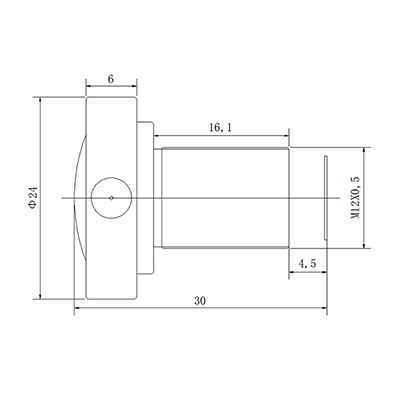
4.4mm M12 CCTV Lens
3. What Is the Angle of View of a 4mm CCTV Lens?
The 4mm lens angle of view is an important consideration when selecting a CCTV camera for entrances, counters, hallways, and other specific monitoring areas.
A 4mm lens generally produces a narrower viewing angle than a 2.8mm lens when both are used with the same sensor. However, there is no single universal angle of view for every 4mm CCTV lens.
Does Sensor Size Affect the 4mm Lens Angle of View?
Yes. The camera sensor size directly affects the field of view produced by a 4mm lens.
For the same focal length, a larger active sensor width generally captures a wider horizontal field of view than a smaller sensor width.
For example, consider a 4mm lens used with three different active sensor widths:
| Active Sensor Width | 4mm Lens Horizontal FOV |
|---|---|
| 4.8mm | Approximately 62° |
| 5.6mm | Approximately 70° |
| 7.2mm | Approximately 84° |
These figures are theoretical estimates using the rectilinear FOV formula. They represent active sensor widths, not guaranteed dimensions for every sensor format.
When selecting a CCTV lens, always check the actual sensor dimensions and the manufacturer’s specified horizontal FOV rather than relying only on the nominal sensor format.
4mm Lens Horizontal Field of View
The horizontal field of view is particularly important in surveillance applications because it determines the width of the area captured by the camera.
A 4mm lens may be appropriate when:
- You need to monitor a specific entrance or doorway.
- You want a more focused view of a particular area.
- You need greater subject magnification than a shorter focal length provides at the same distance.
- You want to reduce unnecessary background coverage.
For longer monitoring distances, a 4mm lens may still be insufficient. In these cases, consider a longer focal length or a varifocal lens based on the required target detail and installation geometry.
4. 2.8mm vs 4mm CCTV Lens: Which Is Better for Different Applications?
The best CCTV lens depends on the surveillance environment, camera installation position, and the level of detail required. The following examples can help you make a practical decision.
2.8mm Lens Applications
A 2.8mm CCTV lens is generally suitable for applications that require wide-angle coverage over a relatively short monitoring distance.
- Small Offices: Captures a wider view of desks, entrances, and shared working areas.
- Residential Security: Provides broad coverage of living spaces, garages, and nearby entrances.
- Hallways: Helps monitor a wider portion of a corridor, depending on the camera position.
- Retail Stores: Captures a larger portion of the shop floor.
- Elevators: Can provide a wide view of a relatively confined space.
4mm Lens Applications
A 4mm CCTV lens is more suitable when the camera needs a more concentrated view of a particular monitoring area.
- Store Entrances: Focuses on a specific entrance area when a wider view is unnecessary.
- Reception Counters: Helps concentrate the image on a defined working area.
- Parking Entrances: Can provide a more focused view of vehicles approaching a specific point.
- Office Access Points: Monitors a particular doorway or access control area.
- Specific Monitoring Zones: Useful when the camera needs to capture a smaller area with greater subject magnification.
Application Comparison
| Application | Suggested Starting Point | Reason |
|---|---|---|
| Small Office | 2.8mm | Wider scene coverage |
| Residential Room | 2.8mm | Captures more of the room |
| Corridor | 2.8mm | Useful for wider corridor coverage |
| Store Entrance | 2.8mm or 4mm | Depends on required coverage |
| Reception Counter | 4mm | More focused monitoring |
| Parking Entrance | 4mm or longer | Depends on vehicle distance and detail requirements |
| License Plate Recognition | Application-specific longer focal length | Requires sufficient pixel density and target detail |
For license plate recognition, face identification, or other demanding applications, choosing between 2.8mm and 4mm alone is not sufficient. You must also consider resolution, target distance, shutter speed, illumination, and the required pixels across the target.
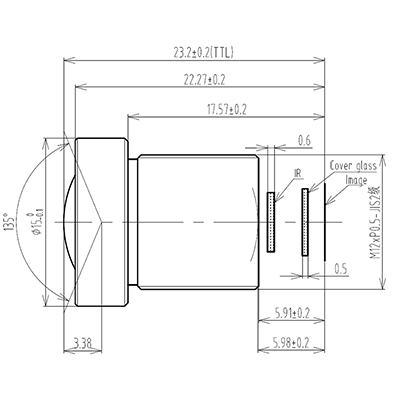
2.8mm wide angle CCTV lens
5. How to Choose the Right CCTV Lens Focal Length
When selecting between a 2.8mm and 4mm CCTV lens, consider the following technical factors before making a final decision.
1. Camera Sensor Size
Sensor size directly influences the field of view. A 2.8mm lens on a smaller sensor may not provide the same viewing angle as a 2.8mm lens on a larger sensor.
Always confirm sensor compatibility and image circle coverage before selecting a lens.
2. Working Distance
Working distance is the distance between the camera lens and the target area.
If the camera is installed close to the monitored area and needs to capture a wide scene, a 2.8mm lens may be a better starting point. If the camera is positioned farther away and needs to concentrate on a specific target area, a 4mm lens or a longer focal length may be more suitable.
3. Required Image Detail
A longer focal length generally produces greater image magnification at the same camera distance. This means a 4mm lens can place more pixels across a subject than a 2.8mm lens when the sensor resolution and other conditions are the same.
However, image detail also depends on the optical resolution of the lens, sensor pixel size, focus accuracy, lighting, and image processing.
4. Aperture and Low-Light Performance
Focal length is not the only factor affecting CCTV image quality. Aperture also determines how much light reaches the camera sensor.
A lens with a larger maximum aperture can generally transmit more light, helping the camera operate in low-light environments. However, actual performance depends on optical transmission, sensor sensitivity, exposure settings, and lens design.
5. Lens Mount and Mechanical Compatibility
Before purchasing a CCTV lens, check whether the camera requires an M12/S-Mount, CS-Mount, or another mounting interface.
- M12/S-Mount: Commonly used in compact board cameras and miniature CCTV modules.
- CS-Mount: Commonly used in network cameras and CCTV systems with interchangeable lenses.
- C-Mount: Used in a variety of industrial imaging and machine vision applications.
Mount compatibility, flange focal distance, image circle, and mechanical dimensions should all be verified before installation.
6. M12 vs CS-Mount CCTV Lenses: Which Should You Choose?
Besides focal length, the mounting interface is another important factor when selecting a CCTV lens.
M12/S-Mount CCTV Lenses
M12 lenses, also known as S-Mount or board lenses, typically use an M12 × 0.5 thread. Their compact dimensions make them suitable for small camera modules, embedded vision systems, and space-constrained surveillance devices.
TOWIN offers a range of M12/S-Mount lenses for different imaging requirements, including wide-angle, low-distortion, low-light-sensitive, and automotive lens designs.
CS-Mount CCTV Lenses
CS-Mount lenses are commonly used in CCTV cameras, network cameras, and IP surveillance systems. The CS-Mount standard has a flange focal distance of 12.526mm.
Compared with compact board lenses, CS-Mount systems provide different mechanical and optical configuration options, including fixed-focal-length and varifocal lenses.
Explore TOWIN’s CS-Mount CCTV lenses for fixed-focal-length, manual iris, DC auto iris, and P-Iris configurations.
7. How to Calculate the Correct CCTV Lens Focal Length
If you are unsure whether a 2.8mm or 4mm lens is suitable for your camera, calculating the field of view before installation can help prevent coverage problems.
The calculation requires three main parameters:
- Camera sensor width.
- Required horizontal field of view or scene coverage.
- Working distance between the camera and target.
For an ideal rectilinear lens, focal length can be estimated from sensor width and horizontal field of view using:
Focal Length = Sensor Width / [2 × tan (Horizontal FOV / 2)]
Alternatively, if working distance and required coverage width are known:
Focal Length ≈ (Sensor Width × Working Distance) / Coverage Width
These equations provide a theoretical starting point. Actual lens selection should also account for optical distortion, image circle, lens design, and mechanical tolerances.
Use the following TOWIN tools to assist with lens selection:
- FOV Calculator – Calculate horizontal, vertical, and diagonal field of view using sensor size and focal length.
- Focal Length Calculator – Estimate the required focal length based on sensor dimensions, working distance, and required coverage.
8. TOWIN CCTV and Security Lens Solutions
Choosing the right focal length is only one part of designing a reliable surveillance system. Lens resolution, distortion, aperture, sensor compatibility, optical coating, and environmental requirements also affect overall imaging performance.
TOWIN provides M12/S-Mount and CS-Mount optical lens solutions for CCTV cameras, network cameras, and smart security applications.
Our lens portfolio supports different focal lengths, sensor formats, resolutions, and optical configurations to meet the needs of camera manufacturers and OEM customers.
Explore our Smart Security Lens Solutions to learn more about optical solutions for CCTV surveillance, facial recognition, smart city monitoring, and other security imaging applications.
For camera manufacturers requiring specific focal lengths, sensor compatibility, field of view, or mechanical configurations, selecting the correct optical design is essential. TOWIN can support lens selection and customized optical development according to project requirements.
9. Frequently Asked Questions About 2.8mm vs 4mm CCTV Lenses
Q1: What is the difference between a 2.8mm and 4mm CCTV lens?
A: The main difference is the field of view. A 2.8mm CCTV lens generally captures a wider scene, while a 4mm lens provides a narrower view and greater image magnification at the same camera distance. The actual viewing angle depends on the sensor size and optical design.
Q2: Is a 2.8mm or 4mm lens better for home security?
A: A 2.8mm lens is often a good choice for general home surveillance because it can capture a wider area, such as a living room, garage, or entrance. A 4mm lens may be more suitable when you want to focus on a specific doorway or monitoring area. The best option depends on the camera position and required coverage.
Q3: Does a 4mm CCTV lens have a narrower field of view?
A: Yes. When used with the same sensor, a 4mm lens generally has a narrower field of view than a 2.8mm lens. It captures a smaller scene but provides greater subject magnification at the same distance.
Q4: How far can a 4mm CCTV lens see?
A: There is no fixed maximum viewing distance for a 4mm CCTV lens. Its ability to capture recognizable details depends on the sensor resolution, pixel density, target size, illumination, optical quality, and required identification standard. A 4mm lens may capture a recognizable scene at a distance, but that does not guarantee reliable identification of small details.
Q5: What is the angle of view of a 4mm lens?
A: The angle of view depends on the active sensor dimensions. For example, a 4mm lens with a 5.6mm active sensor width has a theoretical horizontal field of view of approximately 70 degrees. A different sensor width will produce a different viewing angle.
Q6: Is a 2.8mm lens better for wide-angle surveillance?
A: Generally, yes. A 2.8mm CCTV lens provides a wider field of view than a 4mm lens when both use the same sensor. It is commonly used for monitoring rooms, corridors, entrances, and other areas where broad scene coverage is important.
Q7: Which CCTV lens is better for identifying distant objects?
A: A 4mm lens generally provides greater image magnification than a 2.8mm lens at the same camera distance. However, identification performance also depends on resolution, sensor size, optical quality, lighting, and the distance to the target. For long-distance identification, a longer focal length may be necessary.
10. Conclusion: 2.8mm vs 4mm CCTV Lens
When comparing a 2.8mm vs 4mm CCTV lens, the best choice depends on your surveillance coverage and image detail requirements.
- 2.8mm CCTV lens: Better suited to wider scene coverage and general surveillance in relatively confined spaces.
- 4mm CCTV lens: Better suited to more focused monitoring and greater subject magnification at the same camera distance.
Before making a decision, always consider sensor size, horizontal field of view, working distance, image resolution, aperture, and lens mount compatibility.
For camera manufacturers and security system developers, selecting the correct lens requires balancing optical performance with the camera’s mechanical and imaging requirements. TOWIN provides M12/S-Mount and CS-Mount lens solutions to support different CCTV and security imaging applications.
Whether you need a 2.8mm wide-angle lens, a 4mm fixed-focus lens, or a customized optical solution, choosing the right specifications is the first step toward achieving reliable surveillance performance.