


Telecentric CS-Mount lenses for measurement
11/21/2025
M12 Lenses with Raspberry Pi Camera Modules
11/21/2025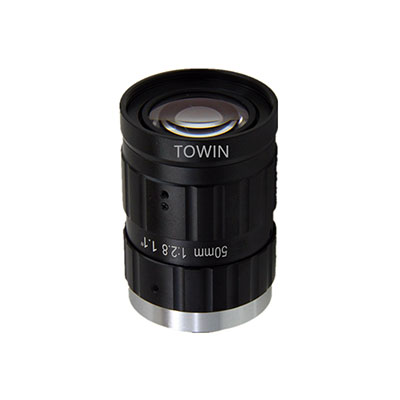
Advantages of C-Mount lenses make them an established choice for industrial machine vision, factory automation, and precision imaging systems. Their standardized threaded interface, broad range of focal lengths, and availability of different optical configurations give engineers flexibility when designing industrial camera systems.
For machine vision applications, however, choosing a C-Mount lens involves more than selecting a compatible mount. Sensor size, resolution, field of view (FOV), working distance, distortion, and aperture all influence the final imaging performance.
As an industrial optical lens manufacturer, TOWIN provides a range of C-Mount industrial lenses for machine vision, factory automation, inspection, and traffic imaging. This guide explains the main advantages of C-Mount lenses, their practical applications, and the factors engineers should consider when selecting the right optical solution.
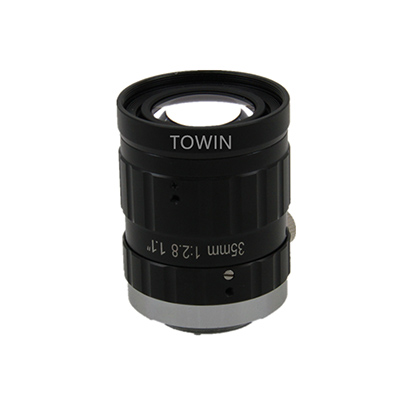
20-35mm-20MP-C-mount-low distortion FA lens
What Is a C-Mount Lens?
A C-Mount lens is an optical lens that uses a standardized threaded mounting interface commonly found in industrial cameras, machine vision systems, scientific imaging equipment, and some surveillance cameras.
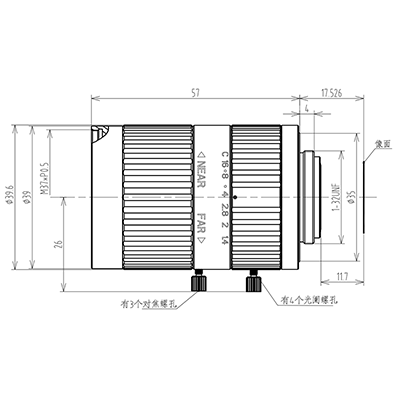
The C-Mount standard uses a 1-inch diameter, 32-threads-per-inch (1″-32 UN) thread and a flange focal distance of 17.526 mm. This standardized mechanical interface allows compatible lenses and cameras from different manufacturers to be integrated, provided their optical and mechanical specifications match.
One important distinction is that the C-Mount standard defines the mechanical connection, not the optical performance of the lens. Resolution, image circle, distortion, aperture, and field of view depend on the individual optical design.
C-Mount lenses are available in different focal lengths, sensor formats, resolutions, and aperture configurations. This flexibility makes them useful for a wide range of industrial imaging tasks.
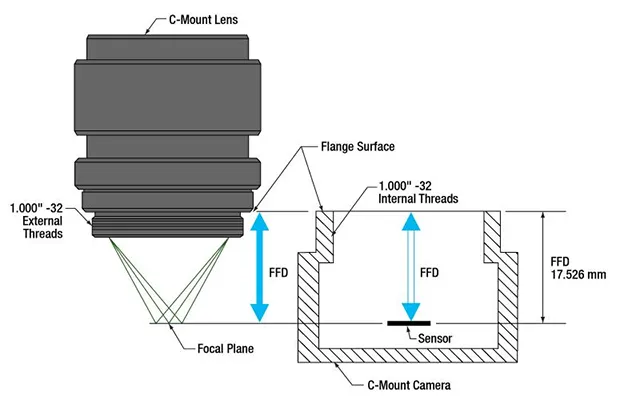
C-Mount Configuration and Flange Focal Distance
7 Key Advantages of C-Mount Lenses for Machine Vision
The main advantages of C-Mount lenses come from their standardized interface and the wide selection of optical designs available for industrial imaging. The following characteristics explain why they remain widely used in machine vision and industrial camera systems.
1. Standardized Mechanical Interface
One major advantage of C-Mount lenses is their standardized threaded connection. The 1″-32 UN interface provides a widely adopted mechanical mounting solution for compatible industrial cameras.
For machine vision engineers and system integrators, this standardization can simplify lens replacement, system upgrades, and equipment integration. It also gives users access to lens options from multiple manufacturers without being restricted to a proprietary mounting system.
However, mechanical compatibility does not automatically guarantee optical compatibility. Engineers should also verify flange focal distance, sensor coverage, image circle, and camera clearance before installation.
2. Wide Range of Focal Length Options
C-Mount lenses are available in various focal lengths to support different fields of view, working distances, and object sizes.
Shorter focal lengths generally provide a wider field of view, while longer focal lengths provide a narrower field of view for applications requiring more detailed observation of distant or smaller objects.
This range of options is useful in applications such as automated inspection, barcode reading, component recognition, and industrial measurement.
When selecting a focal length, engineers should consider the camera sensor dimensions, object size, working distance, and required field of view together rather than choosing a lens based on focal length alone.
For an initial calculation, use TOWIN’s field of view calculator to estimate the required imaging coverage.
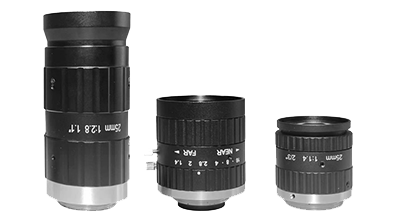
C-Mount Machine Vision Lens
3. Flexible Sensor Format Compatibility
Another important advantage of C-Mount lenses is the availability of optical designs for different image sensor formats.
Industrial cameras use a variety of sensor sizes, including 1/2″, 2/3″, 1″, 1.1″, and larger formats. The selected lens must provide an image circle large enough to cover the active sensor area.
If the image circle is too small, dark corners or vignetting may appear. If the lens is designed for a larger sensor, it may cover a smaller sensor, although the resulting field of view and effective image usage will differ.
TOWIN offers C-Mount lens options for different sensor formats and industrial imaging requirements. For applications requiring larger image coverage, engineers can explore the 1.1-inch 20MP machine vision lens series.
Always check the specified image circle and sensor compatibility of the individual lens model before finalizing a camera system.
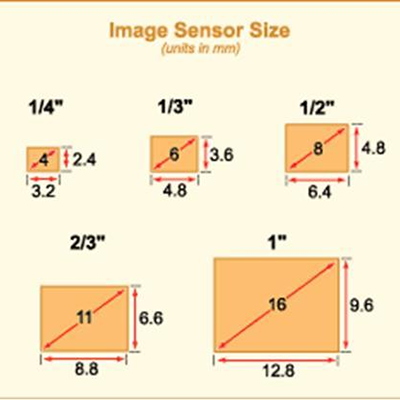
CMOS Sensor Size
4. Availability of High-Resolution Optical Designs
Industrial inspection and machine vision applications increasingly require cameras with higher pixel counts to detect small defects, identify fine features, and capture detailed product information.
C-Mount lenses are available in a range of optical designs developed for different sensor resolutions. Depending on the lens model, options may support megapixel, 5MP, 10MP, 20MP, and other high-resolution imaging requirements.
However, using a high-resolution camera does not automatically guarantee high-resolution images. The lens must provide sufficient optical resolving power across the sensor area to match the camera’s pixel size and imaging requirements.
Engineers should evaluate optical resolution, MTF performance, image circle, contrast, and edge sharpness when selecting a high-resolution C-Mount lens.
For applications involving fine-detail inspection, explore TOWIN’s high-resolution C-Mount machine vision lenses and compare the specifications of individual models.
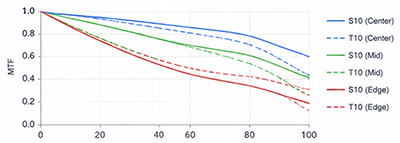
MTF vs Spatial Frequency
5. Flexible Optical Configurations
C-Mount lenses are available in different optical configurations to meet varying industrial imaging requirements.
Depending on the application, engineers can select different combinations of focal length, aperture, focus adjustment, iris configuration, and optical correction.
For example, a wide-aperture lens may be useful when a machine vision system operates under limited lighting conditions. A low-distortion design may be more appropriate for dimensional measurement, while a lens with a suitable image circle is essential for larger camera sensors.
These optical options allow system designers to select a lens according to the actual imaging task rather than relying on a single general-purpose specification.
For measurement applications, see TOWIN’s industrial lens distortion guide to understand how optical distortion can influence image measurement and geometric accuracy.
6. Integration Flexibility for Industrial Imaging Systems
The standardized C-Mount interface and broad product selection make C-Mount lenses practical for many industrial camera integration projects.
Machine vision engineers can choose lenses with different focal lengths, sensor coverage, and optical characteristics to suit specific inspection equipment and automation systems.
This flexibility can simplify the development of new imaging systems and the modification of existing inspection equipment. It can also help system integrators standardize lens mounting arrangements across compatible camera platforms.
For projects with specific optical or mechanical requirements, the selected lens may need additional evaluation or customization. Camera dimensions, available installation space, working distance, lighting conditions, and environmental requirements should all be considered during system integration.
7. Suitable for a Wide Range of Industrial Applications
Because C-Mount lenses are available in different optical configurations, they can support various industrial and professional imaging applications.
Typical applications include:
- Automated Optical Inspection (AOI): Capturing detailed images for electronic component and product inspection.
- Factory Automation: Supporting object detection, positioning, sorting, and production-line monitoring.
- Precision Measurement: Capturing images for dimensional inspection when the lens meets the required resolution and distortion specifications.
- Barcode and OCR Recognition: Providing suitable image detail and contrast for reading printed codes and text.
- Traffic Monitoring: Supporting road monitoring and intelligent transportation systems with appropriate focal lengths and aperture configurations.
For more information about industrial imaging applications, explore TOWIN’s machine vision lens solutions.

Machine Vision
Common Industrial Applications of C-Mount Lenses
The advantages of C-Mount lenses become more meaningful when they are matched to specific imaging requirements. Different industrial applications require different combinations of sensor coverage, resolution, focal length, distortion, and aperture.
Machine Vision Inspection
Machine vision inspection systems use industrial cameras and lenses to identify product defects, verify component positions, and inspect manufacturing quality. C-Mount lenses provide a flexible mounting platform with a wide range of optical options for different inspection tasks.
For applications involving small components or fine surface details, engineers should prioritize optical resolution, sensor compatibility, and working distance.
Factory Automation and Robotics
In factory automation, cameras help identify objects, verify assembly positions, and support automated handling systems. A suitable C-Mount lens can provide the required field of view and image detail for these tasks.
The lens should be selected according to the camera specifications, installation space, object distance, and required detection accuracy.
Precision Measurement and Optical Inspection
Optical measurement systems rely on accurate image information to inspect dimensions, edges, and geometric features. In these applications, lens distortion and image sharpness can directly influence measurement results.
Low-distortion C-Mount lens designs may be suitable for applications where geometric accuracy is important. For particularly demanding measurement tasks, a telecentric lens may be a more appropriate choice, depending on the required accuracy and object geometry.
ITS and Traffic Monitoring
Intelligent transportation systems require optical solutions that can capture useful image details under different lighting conditions and at varying distances.
C-Mount traffic lenses with suitable focal lengths and aperture configurations can be used in traffic monitoring and road imaging systems. The final selection should consider the camera sensor, field of view, installation distance, and lighting environment.
How to Choose the Right C-Mount Lens
Although C-Mount lenses offer many advantages, selecting the correct model is essential for achieving the required imaging performance. Before purchasing an industrial C-Mount lens, engineers should evaluate the following parameters.
1. Camera Sensor Size
Check the camera sensor format and make sure the lens image circle covers the active sensor area. A mismatch can result in vignetting or unused image coverage.
2. Resolution Requirements
Match the optical resolving capability of the lens to the camera resolution and pixel size. High-megapixel cameras require lenses with suitable optical performance.
3. Focal Length and Field of View
Determine the object size, working distance, and required field of view before choosing the focal length. These parameters work together to determine how much of the target area the camera can capture.
4. Optical Distortion
For applications involving measurement, positioning, or geometric inspection, evaluate the maximum distortion specified for the lens. Lower distortion may improve measurement consistency, although calibration and the complete imaging system also affect accuracy.
5. Aperture and Lighting Conditions
Consider the available light, exposure time, required depth of field, and operating conditions. A larger maximum aperture can improve light collection, but the final image quality also depends on the optical design and operating aperture.
6. Camera Mount Compatibility
Confirm that the camera supports a C-Mount interface and that the mechanical dimensions and flange focal distance are suitable. Do not assume that C-Mount and CS-Mount lenses are directly interchangeable without considering the required spacing or adapter.
For a more detailed selection process, read TOWIN’s M12, CS, and C-Mount lens selection guide.
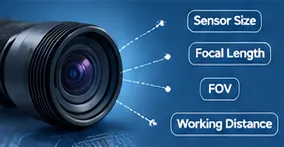
Lens Selection Guide
C-Mount vs. CS-Mount: What Is the Difference?
C-Mount and CS-Mount lenses share a similar 1-inch threaded interface, but they have different flange focal distances.
The standard flange focal distance is:
- C-Mount: 17.526 mm
- CS-Mount: 12.526 mm
The approximately 5 mm difference affects the optical distance between the lens and the camera sensor. Therefore, physical thread compatibility does not mean that both lens types can be used interchangeably without checking the optical arrangement.
For compatible systems, a C-Mount lens can generally be used on a CS-Mount camera with a suitable 5 mm spacer. Using a CS-Mount lens on a C-Mount camera requires a different optical compatibility solution and should not be treated as a simple spacer installation.
The best choice depends on the camera interface, optical requirements, sensor size, and application.
Read our detailed guide to C-Mount vs. CS-Mount differences and compatibility for a more complete explanation.
Engineers working with CS-Mount cameras can also explore TOWIN’s CS-Mount lens range.
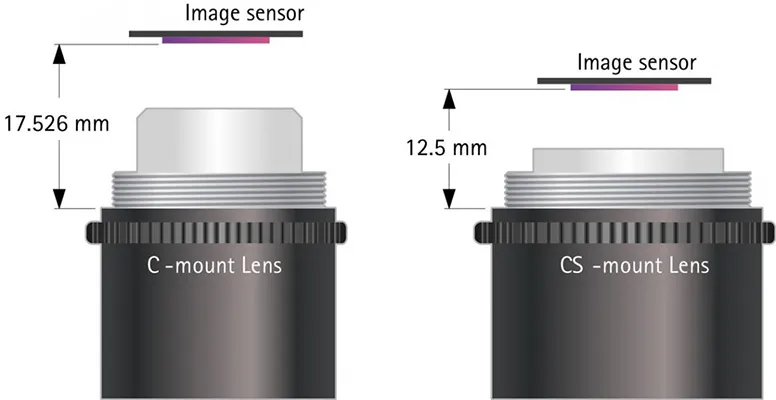
C-Mount VS CS-Mount Technical Diagram
Explore TOWIN C-Mount Industrial Lenses
TOWIN develops and supplies industrial optical lenses for machine vision, factory automation, intelligent transportation, and other imaging applications.
Our C-Mount lens range covers different sensor formats, focal lengths, resolutions, and optical configurations to support a variety of industrial camera requirements.
Depending on the application, available product categories include:
- 2/3-inch 5–10MP FA lenses: For industrial inspection and factory automation systems.
- 1-inch 10MP scan lenses: For industrial imaging applications requiring suitable sensor coverage and resolution.
- 4/3-inch 10MP industrial lenses: For camera systems requiring larger image coverage.
- 1.1-inch 20MP machine vision lenses: For high-resolution imaging applications.
- F1.4 traffic monitoring lenses: For suitable traffic and road monitoring applications.
- F1.2 ITS lenses: For imaging systems requiring large-aperture optical configurations.
- Vari-focal CCTV lenses: For applications requiring adjustable focal length and field of view.
Specific specifications and availability vary by model. Please review the individual product parameters to confirm sensor coverage, resolution, focal length, distortion, and aperture.
C-Mount Machine Vision Lens
Looking for the Right C-Mount Lens for Your Project?
Explore TOWIN’s C-Mount industrial lens portfolio to compare available models and optical specifications. If your project has specific sensor, focal length, resolution, or mechanical requirements, our team can help evaluate a suitable lens solution.
Frequently Asked Questions About C-Mount Lenses
1. What are the main advantages of C-Mount lenses?
The main advantages of C-Mount lenses include a standardized threaded interface, a wide range of focal lengths, flexible sensor format options, and the availability of different optical configurations. These characteristics make them suitable for many industrial camera and machine vision applications.
2. Are C-Mount lenses suitable for machine vision?
Yes. C-Mount lenses are widely used in industrial machine vision systems because they are available in different focal lengths, sensor formats, and optical specifications. The correct lens should be selected according to camera resolution, sensor size, working distance, field of view, and application requirements.
3. What is the flange focal distance of a C-Mount lens?
The standard flange focal distance of a C-Mount lens is 17.526 mm. This is the specified distance from the mounting flange to the image plane and is an important parameter for camera and lens compatibility.
4. What is the difference between C-Mount and CS-Mount lenses?
The main difference is their flange focal distance. C-Mount uses 17.526 mm, while CS-Mount uses 12.526 mm. Both use a similar 1-inch threaded interface, but their optical mounting distances differ. Compatibility should be checked before installation.
5. How do I choose the right C-Mount lens for an industrial camera?
Start by checking the camera sensor size and mount type. Then evaluate resolution, focal length, field of view, working distance, distortion, and aperture. The selected lens should meet both the mechanical and optical requirements of the imaging system.
6. Are all C-Mount lenses high-resolution and low-distortion?
No. C-Mount describes the mechanical mounting interface rather than a guaranteed level of optical performance. Resolution and distortion vary by lens model. Always check the manufacturer’s specifications and test the lens under the intended imaging conditions.
7. Can TOWIN provide customized C-Mount lens solutions?
TOWIN provides industrial lens products and supports project-specific optical requirements. For customization inquiries, provide your camera sensor size, resolution, focal length, field of view, working distance, and application details so the team can evaluate a suitable solution.
Conclusion: Why Choose C-Mount Lenses for Industrial Imaging?
The advantages of C-Mount lenses include their standardized mechanical interface, wide focal length selection, flexible sensor compatibility, and availability of optical designs for different industrial imaging requirements.
For machine vision engineers and system integrators, the key is to match the lens to the camera and application rather than selecting a C-Mount lens based on its mounting type alone. Sensor size, resolution, focal length, field of view, distortion, and aperture should all be considered during the selection process.
TOWIN offers a range of C-Mount industrial lenses for machine vision, factory automation, inspection, and traffic imaging. Explore the product range or contact TOWIN to discuss your industrial optical requirements.