


Low Distortion Lens – S09211804628F
08/25/2025
Low Distortion Lens – S11011803640
08/25/2025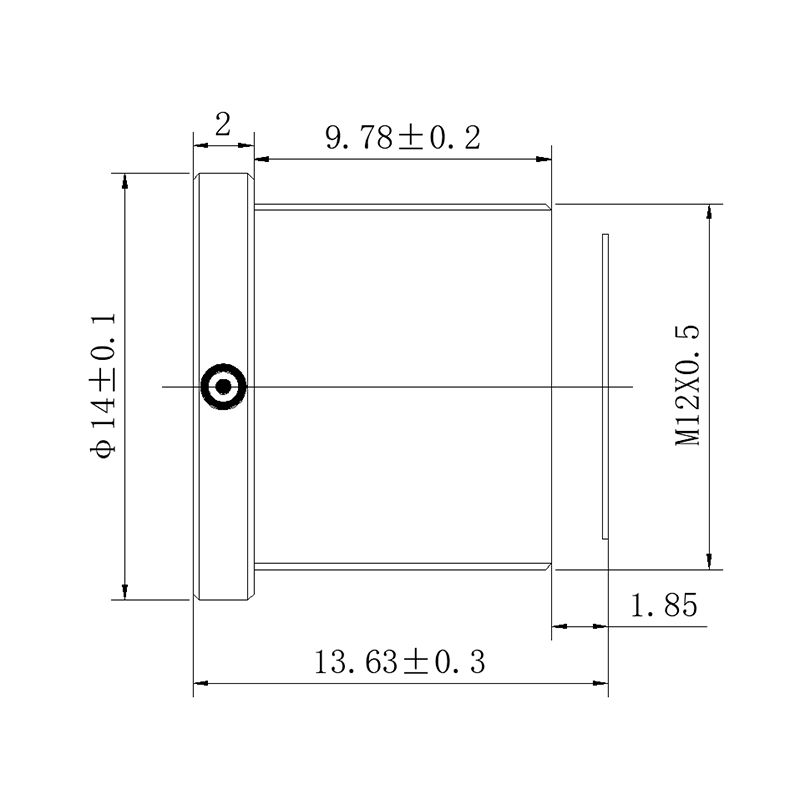
Low Distortion Lens – S09911804230F
9.9mm 6MP M12 fixed focal lens for 1/1.8″ sensors with <0.2% distortion, F3.0 aperture and 47.5° diagonal FOV for precision machine vision.
S09911804230F is Low distortion lens for machine vision with Built-In IR Filter, F3.0 6-Megapixel 1/1.8″ M12-mount CCTV lens, Suitable for security Surveillance.
| IMAGE FORMAT | 1/1.8″ |
| FOCAL LENGTH | 9.9mm |
| F.O.V. | 47.5°(D=8.81) |
| 42°(H=7.68) | |
| 24°(V=4.32) | |
| RESOLUTION | 6MP |
| TV DISTORTION | <0.2% |
| APERTURE | F3.0 |
| MOUNT | M12x0.5 |
| IRIS | Fixed |
| M.O.D. | 0.2m |
| T.T.L. | 13.63mm |
| STRUCTURE | With IRCF |
9.9mm M12 Low Distortion Lens
This 9.9mm M12 fixed focal lens is designed for 1/1.8″ image sensors and 6MP imaging applications where geometric accuracy is important. With an exceptionally low TV distortion of <0.2%, the lens delivers a controlled 47.5° diagonal field of view while maintaining accurate object shapes across the image.
The F3.0 aperture, fixed iris, 0.2m minimum object distance, and compact M12x0.5 mount make this lens a practical optical solution for embedded machine vision cameras and space-constrained inspection systems.
Product Core Highlights
- <0.2% TV distortion for highly accurate image geometry.
- 6MP resolution supports detailed imaging with 1/1.8″ sensors.
- 9.9mm focal length provides a controlled moderate field of view.
- M12x0.5 mount enables compact camera and embedded vision integration.
- Fixed F3.0 iris provides a simple and consistent optical configuration.
9.9mm M12 Low Distortion Lens Applications
Core Application Scenes
The key advantage of this lens is its extremely low <0.2% TV distortion, making it particularly suitable for machine vision tasks where the shape and relative position of objects need to be preserved with minimal geometric deformation. Compared with conventional wide-angle optics, its 47.5° diagonal field of view provides more controlled image coverage for defined inspection areas.
The 9.9mm focal length is suitable for applications such as component inspection, dimensional verification, package inspection, barcode or label imaging, and localized object detection. The 0.2m M.O.D. allows the camera to be positioned relatively close to the inspection target while maintaining the specified optical configuration.
Its compact M12x0.5 interface makes it well suited to embedded camera modules where installation space is limited. The combination of 6MP resolution and very low distortion can also benefit AI vision systems that use image geometry as part of object analysis or measurement workflows.
For engineers selecting a focal length according to sensor size, working distance, and target coverage, the Lens Selection Guide provides additional guidance on matching optical parameters to a machine vision system.
Compatible Device List
- Machine Vision Cameras: Compact 1/1.8″ 6MP cameras for automated inspection.
- Dimensional Inspection Systems: Vision modules requiring low geometric distortion.
- Barcode & Label Inspection: Fixed-view imaging where object shape and position need to remain stable.
- Embedded AI Cameras: Compact vision modules used for object detection and image analysis.
- Robotics Vision: Close-range cameras for localized inspection and object recognition.
- OEM Imaging Equipment: Customized camera systems requiring a compact M12x0.5 optical interface.
Designed for precision machine vision application where extremely low distortion and consistent image geometry are important.
When the required field of view is determined by the target dimensions and camera distance, the FOV Calculator can help estimate the appropriate optical coverage.
Frequently Asked Questions
Q: What makes this 9.9mm M12 lens different from a standard M12 lens?
A: Its main optical characteristic is the exceptionally low TV distortion of <0.2%, making it particularly suitable for applications where image geometry needs to remain highly accurate.
Q: What sensor size is compatible with this lens?
A: The lens is designed for a 1/1.8″ image format and supports 6MP resolution.
Q: What is the field of view of the 9.9mm lens?
A: It provides a 47.5° diagonal, 42° horizontal, and 24° vertical field of view.
Q: Is this lens suitable for dimensional inspection?
A: Yes. The <0.2% TV distortion helps minimize geometric deformation, which can be beneficial for dimensional inspection and other vision tasks requiring consistent object representation.
Q: Is the 9.9mm lens a wide-angle or fisheye lens?
A: No. Its 47.5° diagonal field of view is a moderate viewing angle, and the lens is not designed as a fisheye optic.
Q: What is the minimum object distance?
A: The specified M.O.D. is 0.2m, allowing the lens to be used for relatively close-range imaging applications.
Q: What type of iris does this lens use?
A: It uses a fixed F3.0 iris, providing a simple optical configuration for fixed imaging environments.
Q: Does “With IRCF” mean this is an IR corrected lens?
A: Not necessarily. IRCF indicates an IR-cut filter configuration, but this specification alone does not establish that the lens is an IR-corrected optical design.
Online contact