


Low Distortion Lens – S07912304525F-IMX477
08/24/2025
Low Distortion Lens – S08011804780F
08/25/2025
Low Distortion Lens – S08011804756
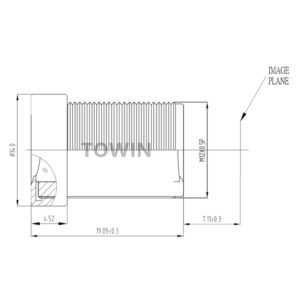
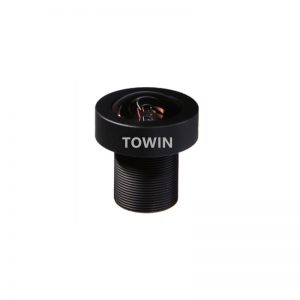
8mm 8MP M12 low distortion fixed focal lens for 1/1.8″ sensors, featuring <0.3% distortion, 47° horizontal FOV, F5.6 aperture, and compact 25mm TTL.
S08011804756 is Low distortion M12-mount 8-Megapixel CCTV lens with Built-In IR Filter, 57° diagonal F.O.V. (1/1.8″), 8mm F5.6, for security or industrial applications.
| IMAGE FORMAT | Max Φ11mm |
| FOCAL LENGTH | 8mm |
| F.O.V.(1/1.8″) | 57°(D=9.0) |
| 47°(H=7.2) | |
| 36°(V=5.3) | |
| RESOLUTION | 8MP |
| TV DISTORTION | <0.3% |
| APERTURE | F5.6 |
| MOUNT | M12x0.5 |
| IRIS | Fixed |
| M.O.D. | 0.12m |
| T.T.L. | 25mm |
| CONSTRUCTION | 7G+IRCF |
8mm 8MP M12 Low Distortion Fixed Focal Lens
This 8mm M12 low distortion lens is designed for compact imaging systems that require high resolution and accurate image geometry. With support for 1/1.8″ sensors, 8MP resolution, and TV distortion below 0.3%, it provides clear and geometrically controlled imaging for inspection, recognition, measurement, and other precision imaging applications.
The lens delivers a 57° diagonal, 47° horizontal, and 36° vertical FOV on a 1/1.8″ sensor. Its fixed F5.6 aperture, 0.12m minimum object distance, and 25mm total track length make it suitable for space-constrained camera modules and embedded vision equipment. The 7G optical construction with IRCF further supports stable visible-light imaging in applications where an IR-cut filter is required.
M12 Low Distortion Lens Core Highlights
- 8MP optical performance for detailed imaging with 1/1.8″ sensors.
- Ultra-low TV distortion below 0.3% for accurate geometric representation.
- 8mm fixed focal length with a balanced 47° horizontal FOV.
- Compact M12 × 0.5 mount for embedded and space-constrained camera designs.
- 7G + IRCF configuration for controlled visible-light imaging and compact optical integration.
8mm M12 Low Distortion Lens Applications
Precision Inspection and Measurement
The combination of 8MP resolution and <0.3% distortion makes this lens suitable for inspection systems where image geometry needs to remain highly consistent across the field of view. The relatively moderate 8mm focal length provides a practical balance between scene coverage and image detail, making it useful for component inspection, dimensional checking, surface inspection, and visual quality control.
For systems requiring accurate field-of-view planning, users can also use the FOV Calculator to estimate coverage based on sensor and working-distance requirements.
Compact Machine Vision Systems
As an M12 fixed focal lens, this model can be integrated into compact machine vision cameras and embedded imaging modules where a C-Mount assembly may be too large. The 25mm TTL and 0.12m M.O.D. allow it to be considered for relatively short working-distance applications while maintaining an 8MP imaging capability.
For more information about choosing an appropriate sensor and lens combination, see the Sensor Guide and Lens Selection Guide.
Recognition and Inspection Cameras
The low distortion design is also useful for visual recognition systems that process object shapes, edges, patterns, or positional information. Keeping geometric distortion below 0.3% can help reduce image deformation when the captured scene is used for feature comparison or measurement-oriented image processing.
Designed for precision inspection, compact machine vision, visual recognition, and embedded imaging applications.
Compatible Device Types
- Compact machine vision cameras
- Embedded vision camera modules
- Industrial inspection cameras
- Fixed-camera recognition systems
- Compact measurement imaging systems
- Automated optical inspection equipment
Frequently Asked Questions
Q: What sensor size is this 8mm M12 lens designed for?
A: The lens is specified for a 1/1.8″ image sensor and provides a 57° diagonal, 47° horizontal, and 36° vertical FOV on this format.
Q: How low is the distortion of this M12 lens?
A: The specified TV distortion is below 0.3%, making this a low distortion lens for applications where image geometry and object shape need to be preserved.
Q: Is this an 8MP machine vision lens?
A: Yes. The lens is specified for 8MP resolution, making it suitable for compact machine vision and industrial imaging systems that use compatible 1/1.8″ sensors.
Q: Is the 8mm lens considered a wide-angle lens?
A: This model should not be classified as a typical wide-angle or fisheye lens. Its 47° horizontal FOV on a 1/1.8″ sensor provides moderate scene coverage while prioritizing controlled geometry and image detail.
Q: What does IRCF mean in this lens specification?
A: IRCF refers to an IR-cut filter configuration. It filters infrared wavelengths from the imaging path and should not be confused with an IR-corrected optical design, which is intended to maintain focus across different wavelength ranges.
Q: What is the minimum object distance of this M12 lens?
A: The specified M.O.D. is 0.12m, or 120mm. Actual usable performance at a particular working distance should be evaluated together with the camera sensor, target size, and required image quality.
Q: How can I calculate the field of view for this lens?
A: You can use the FOV Calculator to estimate image coverage based on sensor format, focal length, and working distance. For selecting the appropriate focal length, the Focal Length Calculator can also be used.
Online contact