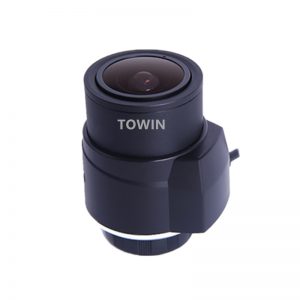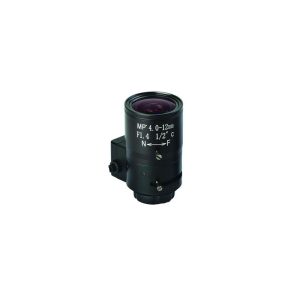



CCTV Lens – CS271212714A3
07/31/2025
CCTV lens – CS281212718A4
07/31/2025
CCTV Lens – CS281212714A3
2.8–12mm CS-mount IR corrected CCTV lens for 1/2.7″ cameras, offering 150°–39° diagonal FOV, 3MP resolution, F1.4 aperture and DC auto iris.
CS281212714A3 is CCTV lens 1/2.7″ 2.8-12mm manual zoom and focus lens, 3-Megapixel F1.4-C aperture CS mount lens, DC auto iris, IR corrected.
| IMAGE FORMAT | 1/2.7″ |
| FOCAL LENGTH | 2.8-12mm |
| F.O.V. | 150°~39°(D) |
| 106°~32°(H) | |
| 76°~24°(V) | |
| RESOLUTION | 3 MegaPixel |
| DISTORTION | -69%~-4% |
| APERTURE | F1.4-C |
| MOUNT | CS |
| IRIS | DC Auto |
| FOCUS | Manual |
| ZOOM | Manual |
| M.O.D. | 0.2m |
| IR | Corrected |
2.8–12mm CS-Mount IR Corrected CCTV Lens
This 2.8–12mm CS-mount CCTV lens is designed for 1/2.7″ cameras and delivers a 150° to 39° diagonal field of view with 3MP resolution. With F1.4-C aperture, DC auto iris, manual focus and manual zoom, it provides flexible framing for wide-area and adjustable CCTV surveillance.
CS-Mount CCTV Lens Core Highlights
- 2.8–12mm manual varifocal range allows flexible adjustment from wide-area coverage to narrower viewing.
- 106°–32° horizontal FOV provides broad scene coverage while retaining focal-length adjustment.
- 150°–39° diagonal FOV supports wide-angle surveillance applications.
- F1.4–C aperture with DC auto iris adapts the optical system to changing illumination.
- IR corrected optical design supports day/night CCTV systems using infrared illumination.
CS-Mount CCTV Lens Applications
Core Application Scenes
The 2.8–12mm focal-length range gives this lens a broad operating window for CCTV installations where the required framing may vary between locations.
At the 2.8mm wide end, the lens provides a 106° horizontal field of view and 76° vertical field of view, making it suitable for capturing large indoor areas such as entrances, corridors, retail spaces, reception areas and general monitoring zones.
At the 12mm end, the horizontal field of view narrows to approximately 32°, allowing the installer to concentrate the image on a more specific area or subject. This makes the lens practical when one camera needs some flexibility during installation and commissioning.
The F1.4–C aperture provides a relatively wide maximum aperture, while the DC auto iris can adjust the aperture according to changing lighting conditions. Combined with IR correction, the lens is suitable for surveillance systems operating across different lighting conditions, including day/night configurations.
The 0.2m minimum object distance also provides flexibility for relatively close surveillance scenes.
Designed for wide-angle CCTV surveillance and day/night security applications where adjustable framing and IR compatibility are important.
Compatible Device List
- 1/2.7″ security cameras
- CS-mount CCTV cameras
- Day/night surveillance cameras
- Indoor security camera systems
- Commercial surveillance cameras
- Retail monitoring cameras
- Entrance and access monitoring systems
- General-purpose video surveillance equipment
For additional CS-interface options, TOWIN’s CS-Mount Lenses collection includes different focal lengths and optical configurations for security imaging.
Focal Length and Field of View Selection
The variable focal length allows installers to adjust the camera framing according to the actual installation scene.
| Focal Length | Field-of-View Characteristic | Typical Use |
|---|---|---|
| 2.8mm | Very wide coverage | Entrances, rooms, corridors |
| 4–6mm | Wide to medium coverage | General surveillance |
| 6–9mm | Medium coverage | Defined monitoring areas |
| 9–12mm | Narrower coverage | Specific subjects or longer viewing distances |
The wide end is particularly useful when the installation requires broad scene coverage, while the telephoto end can be used when a more concentrated image is required.
Before installation, the required viewing area can be estimated using TOWIN’s FOV Calculator. For projects where the required focal length is determined from working distance and target dimensions, the Focal Length Calculator can also be used.
IR Corrected Design for Day/Night Surveillance
An important feature of this lens is its IR corrected optical design. In day/night CCTV systems, the imaging wavelength can change when infrared illumination is introduced. An IR corrected lens is designed to provide better focus consistency across the relevant wavelength range.
This makes the lens suitable for surveillance systems that combine visible-light imaging with infrared-assisted night monitoring.
The combination of IR correction, DC auto iris and F1.4 maximum aperture makes this configuration particularly suitable for applications where lighting conditions are not constant.
Wide-Angle Imaging and Distortion Considerations
The lens provides a very wide 150° diagonal FOV at the wide end, while the specified distortion range is -69% to -4%.
This specification indicates that the lens prioritizes broad scene coverage rather than precision geometric imaging. For conventional CCTV applications, where capturing a large area is more important than maintaining highly accurate straight-line geometry, this characteristic can be acceptable.
For measurement, inspection or other applications where image geometry is critical, distortion should be evaluated together with the camera sensor, working distance and required accuracy. TOWIN’s Distortion Guide provides additional information about how lens distortion affects imaging.
Frequently Asked Questions
Q: What sensor format is this 2.8–12mm lens designed for?
A: This lens is specified for a 1/2.7″ image format and uses a CS mount. The camera should be compatible with both the sensor coverage and CS mechanical interface.
Q: Is this a fixed focal length lens?
A: No. It is a manual varifocal zoom lens with a focal-length range of 2.8–12mm. The zoom position can be adjusted manually during installation.
Q: What is the horizontal field of view?
A: The horizontal field of view ranges from approximately 106° at the wide end to 32° at the telephoto end.
Q: What is the diagonal field of view?
A: The specified diagonal FOV ranges from 150° to 39%, with the wide end providing very broad scene coverage.
Q: What does IR corrected mean?
A: IR correction is designed to improve focus consistency when the lens operates across visible and infrared wavelengths, making the lens suitable for day/night surveillance systems.
Q: Does the lens have an automatic iris?
A: Yes. It uses a DC auto iris, allowing the aperture to respond to changing illumination when used with a compatible camera and control system.
Q: What is the minimum object distance?
A: The specified M.O.D. is 0.2m, allowing the lens to focus on relatively close subjects when properly adjusted.
Q: Is this lens suitable for precision machine vision?
A: The lens can be considered for general imaging or monitoring, but its specified -69% to -4% distortion means it is not primarily intended for precision geometric measurement. Applications requiring controlled distortion should use an optical configuration specifically designed for machine vision.
Online contact