


Automotive grade lenses for ADAS cameras
03/06/2026
M12 S-mount 6mm CCTV lens
03/08/2026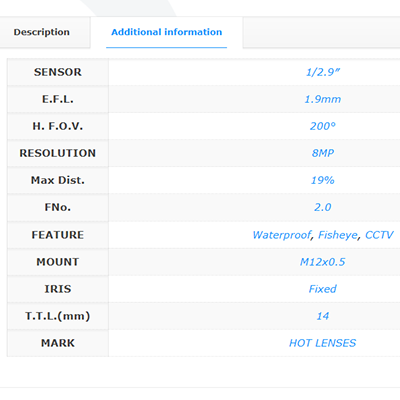
Table of Contents
Introduction
If you’re sourcing optical lenses for industrial vision, surveillance, automotive, or consumer electronics applications—whether you’re a design engineer, procurement specialist, or product developer—decoding a lens datasheet is a critical skill. A lens datasheet contains vital technical details, yet without proper knowledge, key specs can be overlooked or misread.
At TOWIN, a professional optical lens supplier in China with a full range of M12/S-mount, C-mount, CS-mount, and custom lenses, we work with clients daily to help them navigate datasheets and select the perfect lens for their needs. This guide dissects every key aspect of lens datasheets, from basics to nuances, for expert-level reading.
The Basic Framework of a Lens Datasheet
First, get familiar with the core structure of a standard lens datasheet—most follow a consistent layout, and understanding this framework lets you quickly locate critical info. TOWIN’s lens datasheets, like pro optics docs, logically organize specs for real-world performance and use.
Bullet points of key standard sections:
- General Specifications: Quick overview (mount type, resolution, sensor size compatibility)
- Optical Parameters: Focal length, aperture, distortion, field of view (FOV)
- Mechanical Parameters: Dimensions, thread size, flange focal distance, mounting specs
- Environmental Ratings: Operating temperature, humidity, shock/vibration resistance
- Application Notes: Recommended use cases (e.g., machine vision, traffic monitoring, CCTV)
- Part Number Coding: Unique alphanumeric codes for quick product identification (e.g., TOWIN’s S3421020, A5120020F69)
Pro Tip: Always start with the part number and mount type—this eliminates lenses that don’t fit your hardware before you dive into detailed specs.
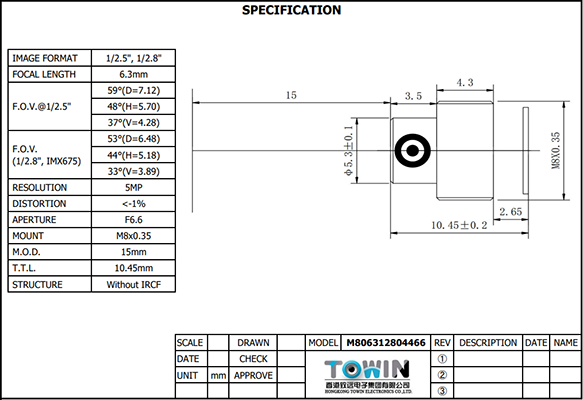
Lens Datasheet
Deep Dive into Focal Length Parameters
Focal length (measured in millimeters, mm) is the most fundamental lens spec, defining how much a lens magnifies a scene and its field of view. Datasheets list focal length in nominal values (e.g., 8mm, 16mm) and may include a tolerance range (e.g., 8.2±0.2mm)—a critical detail for precision applications like machine vision.
Key Focal Length Details to Note
- Fixed vs. Vari-Focal: Fixed focal length (e.g., 12mm) is static for consistent framing; vari-focal (e.g., 4-16mm) lets you adjust FOV without changing the lens.
- Tolerance: A small tolerance (±0.1mm/±0.2mm) means higher manufacturing precision—essential for industrial and automotive lenses where alignment is critical.
- Effective Focal Length (EFL): The actual focal length in use (differs from nominal in some optical designs) for accurate FOV calculations.
Focal Length vs. Field of View (FOV) Quick Reference (1/2″ Sensor)
| Focal Length (mm) | Horizontal FOV (°) | Typical Application |
| 2.8 | 90+ (Wide Angle) | CCTV/Surveillance |
| 8 | 45 | Machine Vision |
| 16 | 25 | Long-Range Monitoring |
| 35 | 10 (Telephoto) | Traffic ITS Lenses |
TOWIN Note: Our M12/S-mount lenses offer a wide focal length range (2.1mm to 35mm+) with tight tolerances (e.g., 14±0.2mm, 13.56±0.2mm) for diverse compact camera applications.
Aperture Parameter Explained
Aperture (denoted as f-number/f-stop, e.g., F2, F1.4) measures the lens’s ability to gather light—the lower the f-number, the more light the lens lets in. Datasheets list the maximum aperture (the widest the lens can open) and may note minimum aperture for light control. Aperture directly impacts low-light performance and depth of field (DoF)—two make-or-break specs for night vision, surveillance, and machine vision.
Critical Aperture Specs on a Datasheet
- Maximum Aperture (e.g., F2, F1.8): Non-negotiable for low-light applications (e.g., TOWIN’s 1/2″ 5MP F2 lens for low-light sensitive camera modules).
- Iris Type: Manual Iris (adjust by hand), DC Auto Iris (electronic light adjustment), or P-Iris (precision iris for industrial FOV consistency)—listed in CS-mount/C-mount datasheets for surveillance/industrial lenses.
- Aperture Tolerance: Ensures consistent light gathering across lens batches—vital for mass production of camera systems.
Pro Tip: For day/night security cameras, pair a low f-number (F2 or lower) with IR-corrected multi-coating (a TOWIN core feature for CS-mount lenses) to eliminate light distortion in infrared mode.
Lens Mount & Sensor Format Compatibility
One of the most common sourcing mistakes is ignoring mount type and sensor format compatibility—even a perfect lens will fail if it doesn’t fit your camera’s mount or match its sensor size. Datasheets clearly list mount type and compatible sensor sizes (e.g., 1/2″, 2/3″, 3/4″), and TOWIN’s datasheets go a step further by linking mount types to specific application use cases (our core product lines: M12/S-mount, C-mount, CS-mount).
TOWIN’s Core Lens Mounts: Key Specs & Compatibility
| Mount Type | Thread Standard | Flange Focal Distance | Sensor Size Compatibility | Primary Applications |
| M12/S-mount | M12X0.5 | Custom (compact) | 1/4″ to 1/2″ | CCTV, consumer electronics, automotive, miniature cameras |
| C-mount | Standard C | 17.526mm | 1/2″ to 2/3″ | Machine Vision (MV/FA), ITS Traffic Lenses, 3D GigE cameras |
| CS-mount | Standard CS | 12.526mm | 1/3″ to 1/2″ | CCTV/IP/Network cameras, video surveillance, day/night security |
Key Note: C-mount lenses can fit CS-mount cameras with a 5mm adapter ring (the 5mm difference in flange focal distance), but CS-mount lenses cannot fit C-mount cameras—this is a common datasheet misread!
Optical Structure Parameters
Optical structure specs reveal how the lens is designed and its performance limits—these are the “behind-the-scenes” numbers that separate a basic lens from a high-precision professional one. TOWIN’s datasheets list these specs prominently for industrial/automotive clients who require uncompromising optical performance.
Must-Know Optical Structure Parameters
- Distortion: % of geometric distortion (e.g., barrel/pincushion)—low distortion (<1%) is critical for machine vision and measurement cameras (TOWIN offers dedicated Low Distortion M12 lenses).
- Resolution (Megapixels/MP): Max sensor resolution the lens supports (e.g., 5MP, 8MP)—a 5MP lens will underperform on an 8MP sensor (blurry images).
- Image Plane: Distance to the sensor (CG/Optical/Mech values, e.g., 0.40(CG), 0.697(Optical))—ensures precise lens-to-sensor alignment for sharp images.
- Coating Technology: Multi-coating (anti-reflective) or IR correction—listed for day/night lenses to reduce glare and improve light transmission.
- Back Focal Length (BFL): Distance from the lens’s rear element to the image plane—critical for compact camera module design.
How to Judge Lens Application Scenarios from a Datasheet
The ultimate goal of reading a datasheet is to confirm a lens is a match for your specific application—and every spec ties back to real-world use. TOWIN tailors lenses for specific uses; our datasheets note compatibility. Use this checklist to match specs to needs.
Spec-to-Application Matching Checklist
- Surveillance/CCTV: Wide angle (2.8-8mm), low f-number (F2/F1.8), IR-corrected, CS-mount/M12-mount, 2-5MP resolution.
- Machine Vision (MV/FA): Fixed focal length (8-35mm), low distortion, C-mount, 5+MP resolution, P-Iris (precision light control).
- Traffic ITS: Telephoto (16-35mm), high resolution, C-mount, wide temperature range (for outdoor use), anti-shock/vibration.
- Automotive/Miniature Cameras: M12/S-mount, compact dimensions, low light sensitivity, shock/vibration resistance, small sensor compatibility (1/4″-1/2″).
- Consumer Electronics: M12-mount, ultra-compact, fixed focal length, cost-effective, 2-5MP resolution.
TOWIN Example: Our S6822023F – IMX335 lens (1/2″ sensor, 5MP, tight focal length tolerance) is optimized for high-precision machine vision and industrial IP cameras—all clear from its datasheet specs.
Hidden Traps & Misinterpretation Mistakes in Datasheets
Even experienced professionals fall for common datasheet pitfalls—these hidden traps often lead to wrong lens selection, delayed projects, and extra costs. Avoid these mistakes with TOWIN’s expert tips:
- Ignoring Tolerance Ranges: A lens listed as 14mm focal length with ±0.5mm tolerance may perform very differently than one with ±0.2mm—always check tolerance for precision applications.
- Confusing Nominal vs. Effective Focal Length: Nominal is the “listed” length; effective is the actual performance—use EFL for FOV/calculations, not nominal.
- Overlooking Environmental Ratings: A lens rated for 0-40°C will fail in outdoor automotive/traffic applications (need -40 to 85°C)—always check operating temp/humidity.
- Misreading Mount Compatibility: As noted earlier, C-mount → CS-mount (adapter OK), CS-mount → C-mount (no fit)—never skip flange focal distance specs.
- Disregarding Part Number Coding: TOWIN’s part numbers (e.g., S3421020, M806312804466) include mount, focal length, and resolution info—learn the coding to quickly filter lenses.
- Forgetting Sensor Aspect Ratio: A lens for a 4:3 sensor will have a different FOV on a 16:9 sensor—datasheets list compatible aspect ratios, so don’t miss this!
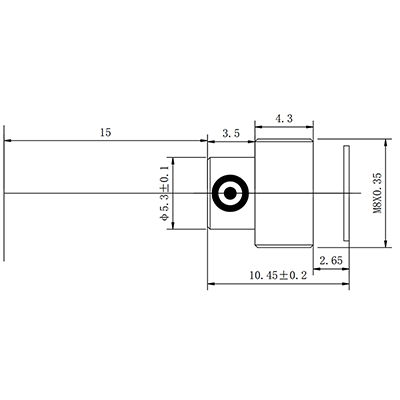
5-Megapixel Low-distortion lens
FAQs
Q1: What’s the first spec I should check when sourcing a lens for a pre-built camera module?
A1: Mount type and sensor size—these are hard compatibility limits; all other specs are secondary if the lens doesn’t fit the camera’s hardware. For TOWIN’s M12-mount camera modules, start with M12X0.5 thread compatibility.
Q2: How do I calculate field of view (FOV) from a datasheet’s focal length and sensor size?
A2: Use the FOV formula (FOV = 2 × arctan(sensor dimension / (2 × focal length))) or reference the FOV chart in the focal length section of this guide. TOWIN’s technical team also provides free FOV calculations for clients.
Q3: What does “IR corrected” mean on a CS-mount lens datasheet, and do I need it?
A3: IR corrected means the lens is designed to reduce light distortion in infrared mode—essential for day/night security cameras. If your application only uses visible light, IR correction is optional.
Q4: Why do some datasheets list both “optical” and “mechanical” image plane values?
A4: Optical image plane is the ideal sensor position for sharp images; mechanical image plane is the physical mounting position for the sensor. This dual listing lets camera designers align hardware with optical performance—critical for custom camera module design (a TOWIN specialty).
Q5: How do I know if a lens is suitable for mass production?
A5: Check for tight tolerance ranges, consistent part number coding, and batch test data (listed in TOWIN’s datasheets). TOWIN provides custom lens manufacturing with scalable mass production; “FAST” shipping ensures timely large order delivery.
Conclusion
Reading a lens datasheet like a pro isn’t about memorizing every number—it’s about knowing which specs matter for your application and how to connect technical details to real-world performance. Whether you’re sourcing M12-mount miniature lenses for consumer electronics, C-mount industrial lenses for machine vision, or CS-mount lenses for surveillance, the core principles in this guide apply to every lens datasheet.