


Trusted Automotive Lens Supplier for ADAS & Autonomous Driving
05/14/2026
Miniature Pinhole Lens Supplier: How to Choose the Right Compact Camera Lens
05/16/2026
Key Takeaways
As a professional IR-Corrected Lens Supplier, TOWIN provides optical solutions designed to maintain sharp image quality in both daytime and nighttime environments for surveillance, automotive, and machine vision applications.
- An IR-corrected lens minimizes focus shift between visible light and infrared light.
- These lenses are essential for day/night cameras using IR LEDs.
- IR correction improves image clarity during nighttime monitoring.
- Key parameters include focal length, aperture, sensor size, IR wavelength, and MTF performance.
- IR-corrected lenses are widely used in CCTV, smart traffic, automotive vision, robotics, and industrial inspection.
- Choosing the right lens supplier helps ensure stable imaging quality and long-term system reliability.
- Common IR wavelengths include 850nm and 940nm.
- Large-aperture IR lenses perform better in low-light environments.
- High-resolution IR lenses improve AI recognition accuracy.
- Custom optical solutions are important for specialized imaging systems.
Introduction
An experienced IR-Corrected Lens Supplier plays a critical role in modern day and night imaging systems. As surveillance technology, automotive vision, AI recognition, and smart city infrastructure continue to develop rapidly, imaging systems are increasingly required to operate reliably under both visible light and infrared illumination.
Traditional optical lenses often experience focus shift when switching from daytime visible light to nighttime infrared lighting. This problem becomes especially noticeable in cameras equipped with IR LEDs, where nighttime images may appear blurred even though daytime images remain clear. For security monitoring, machine vision, and intelligent transportation systems, unstable focus can significantly reduce recognition accuracy and overall system performance.
IR-corrected lenses are specifically designed to solve this issue. By optimizing optical structures and compensating for wavelength differences between visible and infrared light, these lenses maintain sharp focus consistency during day/night switching.
In this article, we will explore:
- What an IR-corrected lens is
- How IR correction works
- Why day/night systems require IR optimization
- Key optical parameters to consider
- How to select the right lens for your application
- Why choosing a reliable supplier matters
Whether you are a CCTV manufacturer, system integrator, automotive developer, or industrial imaging engineer, understanding IR-corrected optics can help improve imaging performance and long-term product reliability.
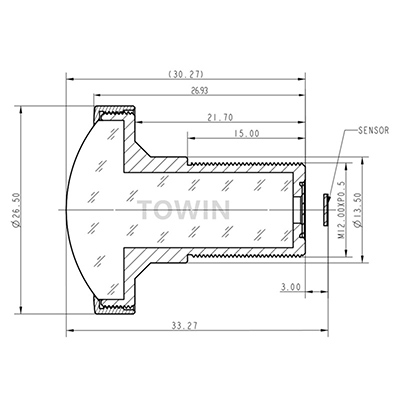
IR-corrected Fisheye lens
What Is an IR-Corrected Lens?
Understanding IR Correction
An IR-corrected lens is an optical lens specially engineered to maintain accurate focus under both visible light and near-infrared light conditions.
Visible light and infrared light have different wavelengths, which means they refract differently when passing through ordinary optical glass. Standard lenses are typically optimized only for visible light, causing infrared light to focus at a different point on the image sensor.
This optical mismatch creates:
- Blurry nighttime images
- Focus drift during IR switching
- Reduced AI detection accuracy
- Lower surveillance reliability
IR-corrected lenses compensate for these wavelength differences through advanced optical design.
Visible Light vs Infrared Light
| Light Type | Wavelength Range | Typical Usage |
|---|---|---|
| Visible Light | 400–700nm | Daytime imaging |
| Near Infrared (NIR) | 700–1000nm | Night vision systems |
| 850nm IR | Common IR LED wavelength | Surveillance cameras |
| 940nm IR | Invisible IR illumination | Covert monitoring |
How IR-Corrected Lenses Work
IR-corrected optics use:
- Specialized glass materials
- Multi-element optical compensation
- Advanced coating technologies
- Precise focal calibration
These design methods help visible and infrared light converge more closely onto the same image plane.
As a result:
- Daytime images remain sharp
- Nighttime focus remains stable
- IR switching becomes smoother
- Image quality improves significantly
Standard Lens vs IR-Corrected Lens
| Feature | Standard Lens | IR-Corrected Lens |
|---|---|---|
| Daytime image quality | Good | Good |
| Night vision clarity | Often blurry | Sharp |
| Focus stability | Unstable | Stable |
| IR LED compatibility | Limited | Optimized |
| AI recognition performance | Lower | Higher |
| Day/night switching | Focus drift | Minimal shift |
Why Day and Night Vision Systems Need IR-Corrected Lenses
The Problem of Focus Shift
One of the biggest challenges in day/night imaging systems is focus inconsistency.
When IR LEDs activate at night:
- Infrared wavelengths enter the optical system
- Ordinary lenses refract IR light differently
- The focal point shifts away from the sensor
- Images lose sharpness
This issue becomes more severe in:
- High-resolution cameras
- Long-distance monitoring
- AI recognition systems
- Large-aperture lenses
Impact on AI Imaging Accuracy
Modern AI systems depend heavily on image clarity.
Blurred nighttime images may reduce:
- Facial recognition accuracy
- License plate detection
- Motion analysis precision
- Object classification reliability
IR-corrected lenses help maintain image consistency for AI-based imaging systems operating 24/7.
Benefits of IR-Corrected Optics
Key Advantages
- Stable focus during day/night switching
- Improved nighttime image sharpness
- Better low-light imaging performance
- Higher AI recognition reliability
- Reduced maintenance and recalibration
- Improved customer satisfaction
IR-Corrected Lens Supplier: Common Applications of IR-Corrected Lenses
Security and Surveillance
IR-corrected lenses are widely used in:
- CCTV cameras
- Smart home security
- Outdoor surveillance
- PTZ monitoring systems
- Traffic monitoring systems
Why IR Correction Matters
- Clear nighttime monitoring
- Better evidence recording
- Reduced focus drift
- Enhanced 24/7 reliability
Automotive Vision Systems
Automotive imaging systems often operate under challenging lighting conditions.
Applications include:
- ADAS systems
- Rear-view cameras
- Driver monitoring systems
- Night driving assistance
- Intelligent transportation systems
Automotive Requirements
| Requirement | Importance |
|---|---|
| Low-light imaging | Critical |
| Vibration resistance | High |
| Temperature stability | Essential |
| High resolution | Necessary |
| IR compatibility | Important |
Machine Vision and Industrial Inspection
Industrial imaging systems require highly stable optical performance.
Typical applications:
- Robotics
- Automated inspection
- Barcode reading
- Precision measurement
- AI manufacturing systems
Key Optical Requirements
- Low distortion
- High MTF performance
- Stable focus
- Accurate imaging
- Consistent edge sharpness
Key Parameters When Choosing an IR-Corrected Lens
1. Focal Length
F.l. determines viewing angle and monitoring distance.
| Focal Length | Viewing Angle | Typical Application |
|---|---|---|
| 2.8mm | Wide-angle | Indoor surveillance |
| 4mm | Standard view | General CCTV |
| 6mm | Medium range | Entrance monitoring |
| 8mm | Narrower angle | Traffic systems |
| 12mm+ | Long distance | License plate recognition |
Selection Tips
- Wide-angle lenses cover larger areas
- Longer focal lengths provide better detail at distance
- Match focal length with installation environment
2. Aperture (F-Number)
Aperture affects light intake.
Lower F-number Advantages
- Better low-light performance
- Improved nighttime brightness
- Reduced image noise
- Better IR imaging quality
| Aperture | Performance |
|---|---|
| F1.0–F1.4 | Excellent low-light imaging |
| F1.6–F2.0 | Balanced performance |
| F2.4+ | Suitable for brighter environments |
3. Sensor Compatibility
The lens must match the camera sensor size.
Common sensor formats include:
- 1/1.8″
- 1/2″
- 1/2.8″
- 1/3″
Improper matching may cause:
- Vignetting
- Image dark corners
- Reduced resolution
4. IR Wavelength Compatibility
Different systems use different IR illumination wavelengths.
| IR Wavelength | Characteristics | Applications |
|---|---|---|
| 850nm | Strong illumination | Standard surveillance |
| 940nm | Invisible glow | Covert security |
Selection Considerations
- 850nm provides brighter imaging
- 940nm offers more discreet monitoring
- Lens optimization should match LED wavelength
5. MTF Performance
MTF (Modulation Transfer Function) measures optical sharpness.
High MTF performance improves:
- Edge clarity
- AI analysis
- Image detail
- Recognition accuracy
This is especially important for:
- 4K cameras
- AI surveillance
- Machine vision systems
6. Distortion Control
Low distortion is essential for precision imaging.
Applications Requiring Low Distortion
- Traffic monitoring
- Industrial measurement
- Robotics
- Automated inspection
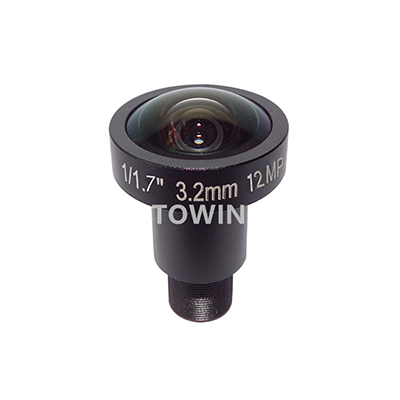
M12-wide-angle-CCTVlens-IR-corrected
How to Choose the Right IR-Corrected Lens
Choose Based on Application
For CCTV Surveillance
Recommended features:
- Large aperture
- Stable IR correction
- Weather resistance
- Cost-effective design
For Automotive Cameras
Focus on:
- Vibration durability
- HDR compatibility
- Temperature stability
- Long-term reliability
For Machine Vision
Important requirements:
- Low distortion
- High resolution
- Precision imaging
- Stable optical consistency
Application-Based Selection Guide
| Application | Recommended Lens Features |
|---|---|
| CCTV | IR correction + large aperture |
| Smart traffic | High resolution + low distortion |
| License plate recognition | Long focal length + high MTF |
| Robotics | Compact structure + stable optics |
| Industrial inspection | Precision imaging + low distortion |
Why Choose TOWIN as Your IR-Corrected Lens Supplier
TOWIN specializes in optical lens development for industrial imaging, surveillance, automotive, and machine vision applications.
Advantages of TOWIN
Professional Optical Design Capability
- Advanced optical engineering
- IR correction optimization
- High-resolution lens development
- Customized optical solutions
Stable Manufacturing Quality
TOWIN emphasizes:
- Strict quality control
- Stable mass production
- Consistent optical performance
- Long-term reliability
OEM and ODM Support
Customization options include:
- Focal length adjustment
- Sensor adaptation
- Mount customization
- IR wavelength optimization
- Mechanical structure design
Wide Industry Experience
TOWIN products are suitable for:
- CCTV surveillance
- Automotive imaging
- Smart traffic systems
- Industrial automation
- AI vision devices
FAQs
Q: What is the difference between a standard lens and an IR-corrected lens?
A standard lens is optimized mainly for visible light, while an IR-corrected lens maintains focus consistency between visible and infrared wavelengths.
Q: Why do night images become blurry without IR correction?
Infrared light focuses differently than visible light. Without compensation, the focal point shifts during nighttime IR illumination.
Q: Which is better: 850nm or 940nm?
- 850nm provides stronger illumination and brighter images
- 940nm is nearly invisible and better for covert monitoring
The best choice depends on the application.
Q: Are IR-corrected lenses necessary for AI cameras?
Yes. AI systems rely heavily on image clarity and stable focus, especially during nighttime operation.
Q: Can IR-corrected lenses work during daytime?
Yes. IR-corrected lenses are designed for both daytime visible light and nighttime infrared imaging.
Q: Does TOWIN support customized IR lens solutions?
Yes. TOWIN provides OEM and ODM optical customization services for various industrial and commercial imaging applications.
Conclusion
As imaging systems continue evolving toward AI intelligence and 24/7 operation, IR correction has become increasingly important for maintaining stable image quality in both visible and infrared environments.
Choosing the right lens involves careful consideration of focal length, aperture, sensor compatibility, IR wavelength optimization, MTF performance, and application requirements. A properly designed IR-corrected lens can significantly improve nighttime clarity, AI recognition accuracy, and overall system reliability.
As a trusted IR-Corrected Lens Supplier, TOWIN provides professional optical solutions for surveillance, automotive, machine vision, and industrial imaging applications worldwide.
📧: info@towin-elec.com