


Automotive camera lens manufacturer
04/09/2026
Night vision CCTV lens: Selection Guide
04/11/2026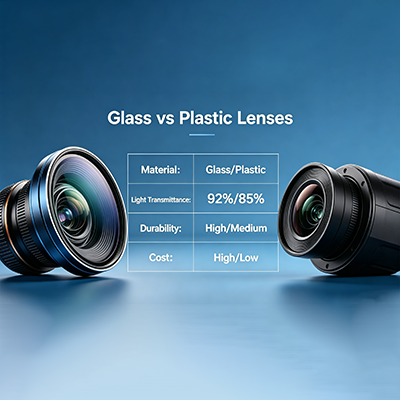
Glass vs. plastic automotive camera lenses is an important consideration when developing reliable vehicle imaging systems. From ADAS and surround-view cameras to driver monitoring systems (DMS) and rear-view cameras, lens material can influence optical performance, dimensional stability, surface durability, weight and manufacturing cost.
Glass optics are widely considered for automotive imaging systems that require precise optical correction, good surface hardness and stable performance under demanding environmental conditions. Optical plastics, however, can offer advantages in weight, impact resistance, design flexibility and high-volume manufacturing. Neither material is automatically the best choice for every automotive camera.
The correct selection depends on the optical material grade, wavelength, operating temperature, camera position, sensor requirements and mechanical design of the complete camera module. This guide explains the differences between glass vs. plastic automotive camera lenses, compares their practical characteristics and provides a selection framework for ADAS and other automotive imaging applications.
Key Takeaways: Glass vs. Plastic Automotive Camera Lenses
- Glass optics: Offer a wide range of refractive indices and dispersion properties, together with generally good surface hardness and optical design flexibility.
- Plastic optics: Can reduce weight, support complex molded geometries and provide good impact resistance, depending on the polymer grade and design.
- Thermal stability: Depends on the material, optical prescription, mechanical structure and temperature range of the complete camera assembly.
- Optical transmission: Must be evaluated at the actual operating wavelength, including visible and near-infrared bands.
- ADAS applications: Require appropriate field of view, resolution, distortion control, image quality and environmental performance.
- Automotive lens selection: Should be based on application requirements rather than assuming that all glass or plastic lenses perform identically.
Table of Contents
- Why Material Selection Matters in Automotive Cameras
- Glass vs. Plastic Automotive Camera Lenses
- Thermal Stability and Environmental Reliability
- Optical Transmission, IR and Image Quality
- Material Selection for ADAS and Automotive Applications
- How to Choose an Automotive Camera Lens
- TOWIN Automotive Camera Lens Solutions
- Frequently Asked Questions
1. Why Material Selection Matters in Automotive Cameras
Automotive cameras operate in environments that can differ significantly from those of indoor industrial cameras. Depending on their installation position, they may experience temperature changes, vibration, humidity, UV exposure, road debris and repeated thermal cycling.
The optical lens is a critical part of the camera module because it determines how light reaches the image sensor. Changes in optical properties, element dimensions or lens alignment can affect image sharpness, focus position and geometric accuracy.
When evaluating glass vs. plastic automotive camera lenses, engineers should consider several factors together.
1.1 Operating Temperature
Temperature changes can influence the refractive index and dimensions of optical materials. They can also affect lens spacing, barrel dimensions, adhesives and mechanical alignment.
Glass materials generally have lower thermal expansion than many common optical polymers, although the actual values vary by material grade. Certain engineering polymers are also designed for improved dimensional and thermal performance.
For automotive camera systems, the important question is not simply whether a lens is made of glass or plastic. Engineers should evaluate focus shift, optical performance and mechanical stability across the specified operating temperature range of the complete assembly.
1.2 Vibration and Mechanical Stress
Vehicle cameras can be exposed to vibration and mechanical shock during normal operation. Lens elements must remain properly positioned within the optical assembly.
Glass has relatively high surface hardness but is generally more brittle than many optical polymers. Some plastics provide better resistance to impact-related fracture, although their stiffness and dimensional behavior must also be considered.
Mechanical retention, lens barrel design, bonding methods and assembly tolerances are important regardless of the selected material.
1.3 UV Exposure and Environmental Protection
Automotive cameras installed near the exterior of a vehicle may experience sunlight, moisture, dust and chemical exposure.
UV resistance and weathering behavior vary between glass types and polymer formulations. Some optical plastics require additional surface protection or stabilization, while selected optical-grade polymers are designed for demanding applications.
Environmental protection also depends on the camera housing, optical window, sealing structure, coatings and assembly design. The lens material alone does not determine the environmental protection level of the complete camera.
2. Glass vs. Plastic Automotive Camera Lenses: Main Differences
Glass and plastic optical materials have different physical and optical characteristics. The following comparison provides a general selection framework rather than a universal performance ranking.
2.1 Automotive Lens Material Comparison Table
| Comparison Factor | Glass Optical Elements | Plastic Optical Elements |
|---|---|---|
| Refractive index | Wide selection across different optical glass families | Depends on polymer chemistry and optical grade |
| Light transmission | Depends on glass composition, wavelength, thickness and coatings | Depends on polymer grade, wavelength, thickness and coatings |
| Surface hardness | Generally higher than common optical plastics | Generally lower; hard coatings may improve abrasion resistance |
| Impact resistance | Relatively brittle and susceptible to fracture | Many optical polymers provide better impact resistance |
| Thermal expansion | Varies by glass composition; many grades have relatively low expansion | Generally higher, but varies significantly by polymer grade |
| Weight | Generally heavier | Generally lighter |
| Manufacturing | Grinding, polishing, precision molding and finishing | Precision injection molding, machining and finishing |
| Design flexibility | Wide range of optical properties and precision finishing options | Complex molded geometries and integration possibilities |
| Production economics | Depends on material, geometry, precision and processing | Can be attractive for suitable high-volume molded designs |
2.2 Advantages of Glass Optical Elements
Optical glass provides designers with a broad selection of refractive indices and dispersion characteristics. Different glass types can be combined to control chromatic aberration and optimize multi-element lens systems.
Common advantages include:
- Generally higher surface hardness than common optical plastics.
- A wide range of refractive indices and dispersion properties.
- Good dimensional stability for many optical glass compositions.
- Availability of materials designed for specific visible, UV and infrared wavelength ranges.
- Compatibility with established precision grinding, polishing and optical coating processes.
These characteristics can make glass suitable for precision imaging systems, particularly when surface durability and specific optical correction requirements are important.
However, glass is not automatically more reliable in every automotive camera. Brittleness, element weight, mounting stress and the thermal behavior of the complete assembly must also be evaluated.
2.3 Advantages of Plastic Optical Elements
Optical plastics offer different advantages, particularly for compact camera modules and applications where weight and manufacturing flexibility are important.
Potential advantages include:
- Lower weight than many conventional optical glass elements.
- Good impact resistance for selected polymer grades.
- Precision molding of complex optical surfaces.
- Potentially efficient high-volume manufacturing.
- Design flexibility for compact embedded camera modules.
However, plastic optics require attention to thermal expansion, molding stress, birefringence, moisture absorption, chemical compatibility and surface abrasion.
Material selection should be based on optical-grade polymer specifications rather than assuming that all transparent plastics have the same properties.
2.4 Can Glass and Plastic Be Combined?
Yes. Some optical systems use hybrid designs that combine glass and plastic elements.
A hybrid optical assembly can balance optical correction, weight, mechanical requirements and manufacturing cost. The appropriate element distribution depends on the optical prescription and the performance targets of the camera system.
Hybrid designs should be evaluated individually. An M12 or other automotive lens should not be assumed to contain a particular glass-plastic structure unless its product specifications confirm the actual construction.
3. Thermal Stability and Environmental Reliability
Automotive reliability involves more than the choice of optical material. The lens, barrel, housing, adhesives, coatings and mounting structure all contribute to the performance of the final camera assembly.
3.1 Thermal Expansion and Focus Stability
When temperature changes, optical elements and mechanical components can expand or contract at different rates.
This can affect:
- Element spacing and alignment.
- Effective focal length and optical power.
- Back focal distance and focus position.
- Lens barrel dimensions.
- Overall image quality across the field of view.
Many optical glass materials have relatively low coefficients of thermal expansion. Optical polymers often have higher expansion, although specialized grades can offer useful thermal properties.
For automotive applications, the correct approach is to evaluate thermal focus shift and optical performance across the actual project temperature range.
3.2 UV Resistance and Material Aging
UV exposure can influence the long-term optical properties of certain polymers. Depending on the material formulation and exposure conditions, degradation may affect color, transparency or mechanical characteristics.
Optical glass generally provides good resistance to many forms of environmental aging, but its actual spectral transmission and coating durability still depend on the glass composition and surface treatment.
For plastic optics, suitable UV-stabilized materials and protective coatings may improve performance. However, coatings cannot compensate for every limitation of an unsuitable substrate.
3.3 Scratch Resistance and Impact Performance
Glass generally has greater surface hardness than common optical polymers. This can be advantageous when exposed optical surfaces need to withstand repeated cleaning or abrasion.
Many plastics provide better resistance to impact-related fracture. This can be beneficial in designs where mechanical shock and lightweight construction are important.
These properties should not be confused. Surface hardness does not directly measure impact resistance, and impact resistance does not guarantee good scratch resistance.
3.4 Environmental Testing of Automotive Camera Modules
Automotive camera reliability should be verified through tests defined by the system manufacturer and applicable project requirements.
Depending on the camera installation and application, evaluation may include:
- High- and low-temperature exposure.
- Temperature cycling and thermal shock.
- Mechanical vibration and shock.
- Humidity and moisture exposure.
- Dust and water ingress protection.
- UV and weathering evaluation.
- Optical performance before and after environmental testing.
Component-level and system-level qualifications are not interchangeable. AEC-Q100, for example, is a qualification framework for integrated circuits, not a general optical lens certification.
For this reason, engineers should confirm the applicable test methods and acceptance criteria for each camera module rather than treating a material label as proof of automotive qualification.
4. Optical Transmission, IR Compatibility and Image Quality
Automotive camera systems may use visible light, near-infrared illumination or a combination of different spectral bands. The optical material and coating design must match the intended wavelength range.
4.1 Visible Light Transmission
Visible-light transmission affects the amount of light reaching the camera sensor. However, transmission is influenced by more than the base material.
Important factors include:
- Material composition and optical grade.
- Wavelength and spectral transmission characteristics.
- Element thickness.
- Surface reflection losses.
- Anti-reflection coating design.
- Number of optical surfaces in the assembly.
A material should therefore be compared using spectral transmission data under consistent measurement conditions, not a generic transmission percentage.
4.2 Near-Infrared Compatibility for DMS
Driver Monitoring Systems may use near-infrared illumination to capture facial information under low-light conditions.
Common illumination wavelengths include 850nm and 940nm. A suitable lens design must provide appropriate transmission and image quality at the actual operating wavelength.
Material absorption, optical coatings, sensor sensitivity and illumination characteristics all affect the final imaging performance.
For DMS projects, an IR-compatible lens should be selected based on spectral performance rather than assuming that every visible-light lens will work equally well in the near-infrared range.
4.3 Optical Coatings
Optical coatings help control the behavior of light at the surfaces of optical elements.
Common coating considerations include:
- Anti-reflection coatings: Reduce unwanted surface reflections and improve transmission through the optical assembly.
- IR coatings: Optimize spectral behavior for selected infrared wavelengths.
- Hard coatings: Improve abrasion resistance on suitable optical plastic surfaces.
- Protective coatings: Provide additional surface protection when compatible with the substrate and application.
Coating performance depends on substrate material, coating design, manufacturing process and environmental conditions. An anti-reflection coating should not automatically be considered a scratch-resistant or weatherproof coating.
4.4 Resolution, MTF and Distortion
Automotive camera image quality depends on the entire optical system, not simply on whether the lens uses glass or plastic.
Engineers should evaluate:
- MTF performance across the image field.
- Chromatic aberration.
- Geometric distortion.
- Relative illumination.
- Center-to-edge sharpness.
- Sensor pixel size and resolution compatibility.
For surround-view systems and other applications requiring geometric accuracy, explore TOWIN low distortion lenses.
5. Glass vs. Plastic Lenses Selection for ADAS and Automotive Applications
Different automotive camera positions have different optical requirements. Material selection should be based on the imaging task, operating environment and camera architecture.
5.1 Surround-View Camera Systems
Surround-view systems combine images from multiple cameras to provide a view around the vehicle. The cameras are commonly installed at the front, rear and sides of the vehicle.
Important lens requirements include:
- Wide field of view.
- Controlled geometric distortion.
- Consistent image quality across the field.
- Suitable resolution for image stitching.
- Environmental protection appropriate to the installation position.
Glass, plastic or hybrid optical designs may be considered depending on the required field of view, optical correction, weight and environmental specifications.
Explore TOWIN ADAS camera lens solutions for surround-view and automotive vision applications.
5.2 Front-View and ADAS Cameras
Front-view cameras support functions such as lane detection, traffic sign recognition and forward object perception.
These systems may require:
- High optical resolution.
- Suitable field of view for the detection range.
- Low distortion where geometric accuracy is important.
- Consistent focus and image quality.
- Environmental performance suitable for exterior installation.
Material selection should be based on the complete optical prescription and the validated operating requirements of the camera module.
5.3 Driver Monitoring Systems (DMS)
DMS cameras monitor driver behavior, facial position and other in-cabin information.
Compared with exterior cameras, DMS systems may have different environmental and optical requirements. Near-infrared imaging, compact size, low-light performance and suitable field of view can be particularly important.
For 850nm or 940nm systems, confirm the spectral transmission of the complete optical assembly and its compatibility with the sensor and illumination source.
5.4 Rear-View and Parking Cameras
Rear-view and parking cameras help drivers observe nearby objects and obstacles.
Typical requirements include:
- Wide-angle imaging.
- Clear image quality in daylight and low light.
- Suitable distortion characteristics.
- Resistance to environmental exposure.
- Compact mechanical integration.
Optical material should be selected according to the actual camera position, housing protection, field of view and image quality requirements.
5.5 Side-View and Blind-Spot Cameras
Side-view and blind-spot cameras provide additional visibility around the vehicle. They may require wide-angle coverage and consistent image quality near the edges of the field.
Lens selection should consider camera location, mounting angle, sensor format, distortion, resolution and environmental protection.
5.6 Automotive Camera Application Selection Table
| Automotive Application | Main Optical Requirements | Important Selection Factors |
|---|---|---|
| Surround View | Ultra-wide FOV and controlled distortion | Image stitching, edge quality and camera coverage |
| Front View / ADAS | Resolution and stable image quality | MTF, distortion, sensor compatibility and environmental conditions |
| Driver Monitoring (DMS) | Near-infrared compatibility | 850nm / 940nm transmission, low-light performance and FOV |
| Rear View | Wide FOV and clear imaging | Distortion, low-light performance and environmental protection |
| Side View / Blind Spot | Wide-angle imaging | Field coverage, edge sharpness and installation position |
| In-Cabin Monitoring | Compact imaging and suitable spectral response | Sensor compatibility, illumination and mechanical integration |
The table describes optical requirements, not a universal glass-or-plastic recommendation. The correct material depends on the specific camera design and qualification criteria.
6. How to Choose the Right Automotive Camera Lens
Choosing an automotive camera lens requires more than comparing material characteristics. The lens must match the camera sensor, field of view, installation position and environmental requirements.
6.1 Define the Camera Application
Start by identifying whether the camera is intended for surround view, front-view ADAS, DMS, rear view, side view or another automotive imaging function.
Each application has different requirements for field of view, resolution, wavelength and environmental protection.
6.2 Confirm Sensor Size and Resolution
The lens image circle must cover the active sensor area. The optical resolving capability should also be suitable for the sensor resolution and pixel size.
Check:
- Sensor format.
- Pixel size.
- Resolution requirement.
- Image circle.
- Optical back focal distance and mechanical clearance.
6.3 Determine Focal Length and Field of View
Focal length and sensor dimensions determine the field of view. Camera position and the required coverage also influence the selection.
Wide-angle applications may require short focal lengths, while forward perception systems may need a narrower field of view and greater image detail at distance.
6.4 Evaluate Distortion and MTF
Geometric distortion can affect image stitching, object positioning and measurement accuracy. MTF performance influences the ability to reproduce fine image details.
Do not select a lens based on megapixel rating alone. The complete optical performance should be checked against the sensor and application requirements.
6.5 Confirm Wavelength and Coating Requirements
For visible imaging, verify transmission across the required visible spectrum. For DMS and night-vision applications, verify performance at the actual near-infrared illumination wavelength.
Coating requirements should be evaluated together with the material substrate and operating environment.
6.6 Verify Temperature and Environmental Requirements
Confirm the operating temperature range, temperature cycling conditions, vibration requirements, humidity exposure and protection requirements of the camera system.
Evaluate the lens and its mounting structure as a complete assembly. Do not assume that a material category alone guarantees compliance with a vehicle manufacturer’s qualification requirements.
6.7 Compare Total Project Cost
Material cost is only one part of the total project cost.
Other factors include:
- Optical design and engineering costs.
- Tooling and production volume.
- Precision finishing and coatings.
- Assembly and inspection.
- Environmental verification.
- Production yield and long-term supply requirements.
For a broader lens selection framework, see the industrial lens selection guide.
7. TOWIN Automotive Camera Lens Solutions
TOWIN provides automotive imaging lens solutions for applications including ADAS, surround-view cameras, driver monitoring systems, parking assistance and other vehicle vision systems.
Its published automotive lens portfolio includes products with different focal lengths, sensor formats, fields of view, apertures and resolution specifications.
Explore the TOWIN automotive camera lens range to review available product models and their published optical parameters.
7.1 Automotive Lens Parameters
When evaluating an automotive lens, review the model-specific specifications, including:
- Effective focal length (EFL).
- Compatible sensor format.
- Horizontal and diagonal field of view.
- Resolution and image quality.
- F-number.
- Total track length and mechanical dimensions.
- Distortion characteristics.
Different automotive camera positions require different optical specifications. A lens designed for surround view may not be suitable for a front-view camera or DMS application.
7.2 M12 / S-Mount Automotive Lens Integration
M12 and S-Mount lenses are commonly used in compact board-camera and embedded imaging systems. Their compact form factor can support space-constrained camera modules.
However, the mount interface alone does not determine optical performance or environmental suitability. Sensor compatibility, image circle, focal length, field of view and mechanical integration must all be verified.
Explore TOWIN M12 / S-Mount lens products for compact camera and embedded imaging applications.
7.3 Optical Design and OEM/ODM Development
Automotive camera projects may require specific focal lengths, field of view, distortion characteristics, sensor compatibility and mechanical dimensions.
TOWIN’s published manufacturing capabilities include optical design, customized lens development, prototype verification and OEM/ODM support.
Depending on project requirements, optical development can involve:
- Sensor and image circle matching.
- Focal length and field-of-view optimization.
- Distortion control.
- Optical performance evaluation.
- Mechanical structure optimization.
- Prototype verification and production support.
Learn more about TOWIN’s industrial lens manufacturing and OEM/ODM capabilities.
7.4 Discuss Your Automotive Imaging Project
Choosing between glass and plastic optical elements requires a clear understanding of the camera’s operating conditions and image quality requirements.
When contacting TOWIN, it is helpful to provide:
- Camera application and installation position.
- Image sensor model and format.
- Required focal length and field of view.
- Resolution and distortion requirements.
- Visible or near-infrared operating wavelengths.
- Temperature and environmental requirements.
- Mechanical dimensions and mounting interface.
Share your project specifications with TOWIN to discuss suitable automotive lens options and customized optical development.
8. Frequently Asked Questions About Glass vs. Plastic Automotive Camera Lenses
Q1: Are glass lenses better than plastic lenses for automotive cameras?
A: Not in every application. Glass generally offers higher surface hardness and a broad range of optical properties, while plastic can offer lower weight, greater impact resistance in many cases and flexible molding options. The best material depends on the optical design, temperature range, mechanical conditions and camera requirements.
Q2: Do automotive camera lenses need to operate at -40°C to 125°C?
A: Not all automotive camera projects have the same temperature requirements. The required operating and storage ranges depend on the vehicle manufacturer, camera installation position and system specification. The complete camera module should be evaluated against the applicable project requirements.
Q3: Do glass automotive lenses always have better light transmission?
A: No. Transmission depends on material composition, wavelength, thickness, surface reflections and optical coatings. Some optical plastics provide excellent visible-light transmission, while specific glass grades are suitable for selected visible, UV and infrared applications. Compare spectral transmission data under consistent conditions.
Q4: Are plastic lenses suitable for ADAS cameras?
A: Plastic optical elements can be considered for selected automotive imaging designs if their optical, thermal, mechanical and environmental performance meets the project requirements. Material suitability should be confirmed through model-specific testing and system-level verification rather than assuming that all plastic optics are unsuitable.
Q5: Which lens material is better for a Driver Monitoring System?
A: DMS lens selection should prioritize near-infrared transmission, image quality, field of view, sensor compatibility and mechanical integration. Both glass and suitable optical polymers may be considered. The complete lens assembly should be verified at the intended illumination wavelength, such as 850nm or 940nm.
Q6: Why is low distortion important for automotive camera lenses?
A: Low distortion can help maintain geometric accuracy and improve image alignment in applications such as surround-view systems. It is also important for systems that use image coordinates for object positioning or measurement. The acceptable distortion level depends on the camera application and image processing requirements.
Q7: What should I check when selecting an automotive M12 lens?
A: Check the sensor format, image circle, focal length, field of view, resolution, distortion, F-number, operating wavelength, mechanical dimensions and environmental requirements. The M12 thread specification alone does not guarantee compatibility with every camera module.
Q8: Can TOWIN provide customized automotive camera lens solutions?
A: TOWIN provides automotive imaging lens products and published OEM/ODM development capabilities. Custom project discussions can cover focal length, field of view, distortion, sensor compatibility and mechanical requirements. Contact TOWIN with your camera specifications to discuss a suitable solution.
9. Conclusion: How to Choose Between Glass vs. Plastic Automotive Camera Lenses
When comparing glass vs. plastic automotive camera lenses, neither material should be considered universally superior. Glass offers a broad selection of optical properties and generally higher surface hardness, while optical plastics can provide lower weight, impact resistance and manufacturing flexibility.
For ADAS, surround-view, DMS, rear-view and other automotive imaging applications, the correct selection depends on sensor compatibility, field of view, resolution, distortion, wavelength, temperature and mechanical requirements.
The most reliable approach is to evaluate the complete optical assembly and verify its performance against the actual camera system specifications.
TOWIN provides automotive camera lens products, M12 / S-Mount solutions and customized optical development support for different imaging requirements.
If you are planning an automotive camera project or comparing optical material options, contact TOWIN to discuss your lens selection and development requirements.