


The Importance of ISO 9001 Certification in Optical Mfg
03/21/2026
Telephoto vs. Wide-Angle Lens: FOV Optimization Guide
03/23/2026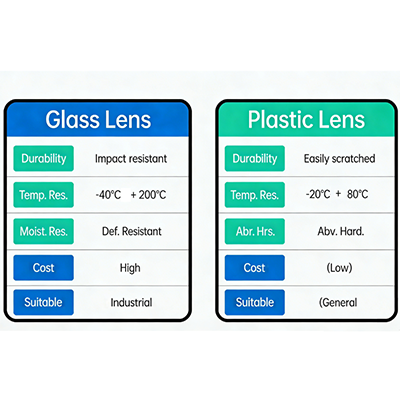
Glass vs. Plastic Lenses is an important consideration when selecting optical components for industrial cameras, machine vision systems, automotive imaging and embedded vision applications. Both materials can deliver excellent imaging performance, but their optical properties, mechanical characteristics, manufacturing processes and environmental stability are different.Optical glass is widely used when designers need a broad choice of refractive indices, controlled dispersion, surface durability and stable optical performance. Optical plastics, including PMMA, polycarbonate (PC) and cyclic olefin polymers (COP/COC), offer advantages in weight reduction, injection molding and compact optical designs.However, glass is not automatically better than plastic for every imaging application. The right choice depends on wavelength, transmission requirements, operating temperature, image quality, mechanical conditions, production volume and total system cost.
This guide compares glass and plastic optical lenses, explains the differences between common optical materials, and shows how to select suitable materials for machine vision, ADAS, smart security and other industrial imaging systems.
Key Takeaways: Glass vs. Plastic Lenses
- Optical glass: Offers a wide range of refractive indices, dispersion characteristics, surface hardness and optical design options.
- Fused silica: Provides low thermal expansion and useful transmission characteristics across selected UV, visible and near-infrared wavelength ranges.
- PMMA: Provides high visible-light transparency, low weight and good moldability.
- Polycarbonate (PC): Offers high impact resistance and lightweight construction, although surface protection and optical stress require consideration.
- COC/COP: Offers low moisture absorption, good optical transparency and useful dimensional stability for precision molded optics.
- Industrial lens selection: Should consider the complete optical design, sensor compatibility, environmental conditions and production requirements rather than material alone.
1. Glass vs. Plastic Lenses: Quick Comparison
The main difference between glass and plastic lenses is not simply durability. Each material has different optical, mechanical and manufacturing characteristics that influence the final imaging system.
| Comparison | Optical Glass | Optical Plastic |
|---|---|---|
| Optical properties | Wide range of refractive indices and dispersion options | Material-grade dependent optical properties |
| Light transmission | Depends on glass type, wavelength and thickness | Depends on polymer type, wavelength and thickness |
| Scratch resistance | Generally higher | Generally lower; hard coatings can help |
| Impact resistance | Can fracture under impact | Generally better impact resistance |
| Thermal behavior | Often lower thermal expansion, depending on glass grade | Generally higher thermal expansion; grade dependent |
| Weight | Generally heavier | Generally lighter |
| Manufacturing | Grinding, polishing, precision molding and other processes | Injection molding, precision molding and machining |
| Production economics | Processing and finishing costs can be significant | Can be economical for suitable high-volume designs |
Neither material is universally superior. Optical glass is often preferred for precision imaging and demanding surface conditions, while optical plastics can be attractive for compact, lightweight and high-volume camera systems.
1.1 Optical Performance
Optical performance depends on refractive index, Abbe number, dispersion, homogeneity, birefringence, surface quality and the overall lens configuration.
Optical glass provides designers with a broad selection of material properties, making it useful for controlling chromatic aberration and optimizing multi-element optical systems. However, high-quality optical polymers can also deliver excellent imaging performance when the material and lens design are properly selected.
1.2 Light Transmission
Light transmission is one of the most important factors in an imaging system. However, it is incorrect to assume that every glass lens transmits more light than every plastic lens.
Transmission depends on the material’s absorption spectrum, wavelength, element thickness, surface reflections, optical coatings and number of optical surfaces.
For visible imaging, some optical polymers provide high transparency. For UV, near-infrared or specialized wavelength applications, the exact material grade must be evaluated using its spectral transmission data.
1.3 Scratch and Impact Resistance
Optical glass generally has greater surface hardness than common optical plastics, making it more resistant to everyday abrasion. This can be valuable in applications exposed to dust, cleaning and repeated handling.
Plastic optics generally offer better resistance to impact-related fracture. Nevertheless, plastic surfaces can scratch more easily. Appropriate hard coatings and protective mechanical structures may improve surface durability.
Material hardness and impact resistance are different properties. A hard material is not necessarily the material that performs best under mechanical shock.
1.4 Thermal Stability
Temperature changes can affect refractive index, element dimensions, lens spacing and focus position.
Many optical glasses have relatively low thermal expansion, although their thermal behavior varies by glass composition. Optical plastics generally have higher thermal expansion, but specialized grades such as some COP materials can provide useful heat resistance and dimensional stability.
For industrial cameras operating across changing temperatures, designers should evaluate the complete optical assembly rather than relying on the maximum temperature of a raw material.
1.5 Weight and Manufacturing Cost
Plastic optical components can reduce the weight of compact camera modules and support complex geometries through molding. This can be advantageous for embedded cameras, portable devices and high-volume products.
Glass elements may involve more demanding grinding, polishing and finishing processes. However, cost depends on geometry, tolerances, coatings, production volume and inspection requirements. Plastic optics also require tooling investment and process control.
For this reason, the lowest material price does not necessarily produce the lowest total system cost.
2. Understanding Different Optical Lens Materials
Glass and plastic are broad material categories. A practical lens selection process should identify the specific material family and its optical properties.
2.1 Optical Glass
Optical glass is manufactured with controlled refractive index, dispersion, transmission and material homogeneity. Different glass families provide different combinations of optical and mechanical properties.
Common optical glass applications include:
- Industrial machine vision lenses
- Precision measurement and inspection systems
- Automotive camera optics
- Scientific and medical imaging
- High-resolution optical assemblies
Optical glass is particularly useful when a design requires precise optical correction, stable surface quality or a specific refractive index. The selected glass grade must still be checked for transmission, thermal characteristics and chemical compatibility.
2.2 Fused Silica
Fused silica is a high-purity amorphous form of silicon dioxide. Although it is a type of glass, its composition and thermal characteristics distinguish it from many conventional optical glass formulations.
Its important characteristics include:
- Very low coefficient of thermal expansion.
- Good transmission over selected ultraviolet and visible wavelength ranges.
- Useful transmission into parts of the near-infrared spectrum, depending on grade and thickness.
- Good thermal stability for demanding optical applications.
Fused silica is often considered for laser optics, UV imaging, scientific instruments and systems exposed to significant temperature changes.
It is not automatically the best choice for every camera lens. Its suitability depends on optical power, wavelength, design requirements, processing cost and system performance.
2.3 PMMA (Acrylic Optical Plastic)
Polymethyl methacrylate (PMMA), commonly known as acrylic, is widely used in optical components because of its high visible-light transparency, low weight and good molding characteristics.
Typical applications include:
- Compact imaging components
- Light guides and optical covers
- Display and illumination optics
- Cost-sensitive molded optical components
PMMA is generally less scratch-resistant than optical glass. Its thermal expansion, moisture response and chemical compatibility should also be considered when used in precision imaging systems.
2.4 Polycarbonate (PC)
Polycarbonate is an engineering thermoplastic known for its impact resistance and lightweight construction. Optical-grade PC can be used in transparent components and selected imaging applications.
Its advantages include:
- High impact resistance compared with many conventional optical materials.
- Good molding capability for complex geometries.
- Lightweight construction.
- Potential for integration into protective optical components.
However, PC can exhibit optical stress and birefringence during molding. Surface scratching, chemical compatibility and thermal behavior also require attention.
2.5 COC and COP Optical Polymers
Cyclic olefin copolymer (COC) and cyclic olefin polymer (COP) are specialized optical plastics used in precision optical components.
Depending on the grade, these materials can provide:
- High optical transparency.
- Low moisture absorption.
- Low birefringence in suitable formulations.
- Good dimensional stability.
- Precision molding capability.
Some optical COP grades are used in camera lenses, sensor optics and automotive imaging components. Their thermal properties and spectral transmission vary by formulation and should be verified using manufacturer datasheets.
2.6 Glass-Plastic Hybrid Optical Designs
Some imaging systems combine glass and plastic optical elements within the same lens assembly.
A hybrid optical design can balance optical correction, weight, manufacturing requirements and cost. The appropriate element distribution depends on the optical prescription, required image quality and environmental conditions.
Hybrid construction should not be assumed to be a universal feature of M12 or board lenses. The actual material configuration must be confirmed for each product design.
Material selection tip:
When comparing optical materials, request the actual material grade and its wavelength-dependent transmission, refractive index, thermal data and mechanical properties. Generic labels such as glass or plastic are not sufficient for precision lens selection.
3. How Material Affects Optical Performance
3.1 Light Transmission Across Different Wavelengths
Different optical materials transmit different wavelength ranges. A material that performs well in visible imaging may not be suitable for ultraviolet or near-infrared applications.
For example:
- Visible-light cameras require materials with suitable transmission across the visible spectrum.
- UV imaging systems need materials with adequate transmission at their target UV wavelengths.
- Near-infrared systems require materials and coatings optimized for the intended NIR band.
- 850 nm and 940 nm camera systems need spectral verification at their operating wavelengths.
For NIR imaging, consider the complete optical transmission curve rather than a single visible-light transmission percentage.
Explore TOWIN smart security lens solutions for imaging applications that may require day-and-night performance and infrared compatibility.
3.2 Refractive Index and Optical Design
The refractive index determines how strongly a material bends light. It influences lens curvature, optical power, aberration correction and the overall structure of an optical assembly.
Dispersion describes how refractive index changes with wavelength. A material with different dispersion characteristics may be needed to control chromatic aberration in a multi-element lens.
Consequently, selecting a material solely by its transparency can lead to an unsuitable optical design.
3.3 Thermal Expansion and Environmental Stability
Industrial imaging systems may operate in environments where temperature changes affect focus and image quality.
Material selection should consider:
- Coefficient of thermal expansion.
- Temperature coefficient of refractive index.
- Thermal deformation of the lens barrel and mounting structure.
- Adhesive and assembly behavior.
- Temperature-related focus shift.
A thermally stable optical element cannot compensate for an unstable lens barrel or mounting structure. The entire assembly must be designed and verified together.
3.4 Surface Coatings and Scratch Resistance
Optical coatings can improve performance by reducing surface reflections, controlling spectral transmission or adding protective properties.
Common coating considerations include:
- Anti-reflection (AR) coatings to reduce unwanted reflections.
- Hard coatings to improve the abrasion resistance of suitable plastic surfaces.
- Spectral coatings for specific visible or infrared wavelength bands.
- Protective coatings selected for the environmental and cleaning requirements.
Coatings must be compatible with the substrate material and operating conditions. An anti-reflection coating does not automatically provide scratch resistance, and a hard coating does not automatically improve spectral transmission.
3.5 Resolution, MTF and Distortion
Lens material affects optical design, but image resolution is determined by the complete optical system.
Important evaluation parameters include:
- MTF performance across the image field.
- Chromatic aberration.
- Geometric distortion.
- Relative illumination.
- Image sharpness at the center and edges.
- Compatibility with the camera sensor and pixel size.
For applications requiring accurate measurement, low distortion lenses can be considered when geometric accuracy is a key requirement.
Learn more about the relationship between optical parameters and system requirements in our industrial lens selection guide.
4. Glass vs. Plastic Lenses for Industrial Applications
In industrial imaging, lens material selection should start with the application rather than a general preference for glass or plastic.
4.1 Machine Vision Systems
Machine vision systems are used for automated inspection, measurement, defect detection, barcode reading and object recognition.
These applications may require high resolution, low distortion, stable focus and consistent image quality across the field of view.
Optical glass is frequently considered for precision imaging systems because of its broad range of optical properties and surface durability. However, suitable plastic or hybrid designs may also meet the required performance, particularly in compact embedded vision applications.
When selecting a lens, consider sensor size, pixel pitch, working distance, field of view, required resolution and distortion tolerance.
Explore TOWIN machine vision solutions and C-Mount industrial lenses for inspection and measurement applications.
4.2 Automotive Imaging and ADAS
Automotive imaging systems operate under demanding environmental conditions. Camera lenses may be exposed to temperature changes, vibration, moisture, dust and repeated mechanical stress.
Material selection should consider:
- Temperature-related optical stability.
- Impact and vibration requirements.
- Visible and near-infrared transmission.
- Lens sealing and environmental protection.
- Image quality across the required field of view.
Glass, optical polymers and hybrid optical assemblies can all be considered depending on the camera architecture and performance requirements.
For compact automotive camera modules, explore TOWIN waterproof automotive lenses and ADAS imaging solutions.
4.3 Smart Security and Surveillance Cameras
Security cameras need consistent image quality in different lighting conditions. Some systems also operate outdoors and require protection against moisture, dust and temperature variation.
Important optical considerations include:
- Visible and near-infrared spectral transmission.
- Day-and-night focus consistency.
- Scratch resistance of exposed optical surfaces.
- Low-light imaging performance.
- Mechanical and environmental durability.
Glass elements may be advantageous for surface durability and selected IR-corrected optical designs. However, suitable optical polymers may also be used in compact camera modules and protective components.
Explore TOWIN CS-Mount lenses for security and surveillance camera applications.
4.4 Embedded Vision and M12 Camera Modules
Embedded vision systems are used in robotics, smart devices, compact AI cameras, drones and industrial equipment.
These systems often have strict size, weight and cost requirements. Optical plastic and hybrid designs can provide useful flexibility in compact optical assemblies, while glass elements may be selected when the required optical performance or environmental conditions justify them.
Material selection should consider the sensor format, image resolution, field of view, mounting interface, operating temperature and production volume.
Explore TOWIN M12 / S-Mount lenses for compact embedded imaging systems.
5. How to Choose the Right Lens Material
Choosing between glass and plastic lenses requires a structured evaluation of optical, mechanical and production requirements.
5.1 Compare the Main Optical Material Options
| Material | Main Advantages | Considerations | Potential Applications |
|---|---|---|---|
| Optical Glass | Wide optical material selection, surface hardness | Weight, brittleness and processing cost | Machine vision, precision imaging |
| Fused Silica | Low thermal expansion, selected UV transmission | Cost and application-specific processing | UV optics, laser systems, scientific imaging |
| PMMA | Visible transparency, low weight, moldability | Scratch resistance and thermal behavior | Optical covers, light guides, molded optics |
| Polycarbonate | Impact resistance, lightweight construction | Optical stress, surface scratching and chemical compatibility | Protective optics, molded optical components |
| COC / COP | Low moisture absorption, optical transparency, moldability | Grade-dependent thermal and spectral performance | Precision molded optics, camera and sensor components |
5.2 Select Materials Based on Wavelength
Identify the operating wavelength range before selecting an optical material.
- Visible imaging: Compare transmission, refractive index and dispersion across the visible spectrum.
- UV imaging: Check UV transmission, absorption and coating compatibility.
- NIR imaging: Evaluate transmission at the actual illumination wavelengths, such as 850 nm or 940 nm.
5.3 Evaluate Operating Temperature
Consider the minimum and maximum operating temperatures, thermal cycling, temperature gradients and focus stability requirements.
Do not use a material’s glass transition temperature, softening point or melting temperature as a substitute for the allowable operating temperature of a finished lens assembly.
5.4 Match the Lens to the Camera Sensor
Material selection alone cannot guarantee high image quality. The lens must also be matched to the camera sensor and its optical requirements.
Important parameters include:
- Sensor format and image circle.
- Pixel size and required resolution.
- Focal length and field of view.
- F-number and illumination conditions.
- MTF and distortion performance.
- Mounting interface and mechanical clearance.
5.5 Consider Production Volume and Total Cost
For prototype development or low-volume production, precision glass processing may be appropriate for a particular optical design. For large production volumes, molded optical plastics may offer manufacturing and weight advantages.
However, total cost should include tooling, material, finishing, coating, inspection, assembly yield and product lifecycle requirements.
For a practical selection process, review the complete industrial lens selection guide before finalizing a lens specification.
6. Why Optical Design Matters More Than Material Alone
When comparing glass vs. plastic lenses, it is important to understand that material is only one part of the imaging system.
A well-designed optical system must balance several parameters:
- Optical prescription: Element curvature, spacing and material selection determine how light is focused.
- Sensor compatibility: The lens must cover the sensor format and meet its resolution requirements.
- Aberration correction: Spherical aberration, chromatic aberration, coma and field curvature affect image quality.
- Distortion control: Low-distortion designs are important for measurement and machine vision.
- Environmental design: Temperature, vibration, humidity and mechanical protection affect system reliability.
- Coating and assembly: Surface treatments, lens spacing and barrel construction influence final performance.
For example, a plastic lens with an appropriate optical prescription may outperform a poorly designed glass lens in a specific application. Likewise, a glass optical assembly may be more suitable when surface durability, optical correction or environmental stability is critical.
The correct decision should therefore be based on measured optical performance and system requirements, not simply on the material label.
6.1 Optical Engineering for Industrial Imaging
TOWIN provides industrial optical lens solutions for machine vision, embedded vision, automotive imaging and intelligent camera applications.
Its product range includes M12 / S-Mount lenses, C-Mount lenses, CS-Mount lenses and specialized optical solutions.
For projects with specific imaging requirements, optical development can involve focal length selection, sensor matching, field-of-view optimization, distortion control, wavelength requirements and mechanical integration.
Learn more about TOWIN’s industrial lens manufacturing and OEM/ODM capabilities.
Need Help Selecting an Optical Lens?
Choosing between glass, fused silica and optical plastic requires a clear understanding of your imaging requirements. TOWIN supports industrial lens selection and customized optical development based on sensor format, focal length, field of view, distortion, wavelength and mechanical requirements.
Share your camera specifications and application requirements to discuss a suitable optical solution.
7. Frequently Asked Questions
Q1: Are glass lenses better than plastic lenses?
A: Not in every application. Glass generally offers higher surface hardness and a wide range of optical material properties, while plastic offers lower weight, better impact resistance in many cases and greater molding flexibility. The better option depends on optical performance, environmental conditions and production requirements.
Q2: Which lens material has better light transmission?
A: Light transmission depends on the material grade, wavelength, thickness, surface reflections and coatings. Some optical plastics provide excellent visible-light transmission, while selected glass and fused silica grades are suitable for specific UV, visible and infrared applications. Always compare spectral transmission data at the intended operating wavelength.
Q3: What is the difference between optical glass and fused silica?
A: Optical glass includes many glass compositions with different refractive indices, dispersion and thermal properties. Fused silica is a high-purity amorphous silicon dioxide material known for its very low thermal expansion and useful UV transmission. The appropriate material depends on the wavelength and environmental requirements.
Q4: Is PMMA or polycarbonate better for optical lenses?
A: PMMA generally provides excellent visible-light transparency and good surface quality, while polycarbonate offers higher impact resistance. However, both materials have different thermal, optical and mechanical characteristics. The right choice depends on the lens design, operating environment and required surface performance.
Q5: Are COC and COP suitable for camera lenses?
A: Yes. Certain optical-grade COC and COP materials are used in precision molded optical components and camera-related applications. They can offer high transparency, low moisture absorption and useful dimensional stability. The specific grade must be evaluated for wavelength, refractive index, birefringence and temperature requirements.
Q6: Can plastic optical lenses be made more scratch-resistant?
A: Yes. Suitable hard coatings can improve the abrasion resistance of some optical plastic surfaces. However, coating performance depends on the substrate, coating process and operating conditions. A hard coating should not be assumed to provide the same mechanical properties as bulk optical glass.
Q7: Which material is best for industrial machine vision lenses?
A: There is no universal best material. Optical glass is often considered for precision imaging, demanding surface conditions and specific optical corrections. Optical plastics and hybrid designs can be suitable for compact, lightweight or high-volume systems. Selection should consider sensor resolution, MTF, distortion, wavelength, temperature and mechanical requirements.
Q8: Can TOWIN help select or customize industrial camera lenses?
A: TOWIN provides M12, C-Mount, CS-Mount and specialized industrial lens solutions, together with OEM/ODM support. Lens requirements can be discussed based on sensor size, focal length, field of view, distortion, wavelength and mechanical integration. Contact TOWIN to discuss your project requirements.
8. Conclusion: Choosing Between Glass and Plastic Lenses
When comparing Glass vs. Plastic Lenses, the most important consideration is how the material affects the complete optical system. Optical glass offers a broad range of refractive and dispersion properties, surface hardness and design options. Fused silica is useful for selected applications requiring low thermal expansion and specific wavelength transmission. PMMA, PC and COC/COP provide different combinations of transparency, impact resistance, weight and molding flexibility.
For machine vision, automotive imaging, smart security and embedded vision, the right material should be selected according to image quality, sensor compatibility, wavelength, operating temperature, mechanical durability and production cost.
Ultimately, a suitable optical design matters more than simply choosing glass or plastic. TOWIN provides industrial lens solutions across M12 / S-Mount, C-Mount and CS-Mount platforms, with OEM/ODM support for application-specific imaging requirements.
If you are evaluating optical materials or planning a new industrial camera project, contact TOWIN to discuss your lens selection and optical development requirements.