


5mm FA Lens: Balanced FOV & Detail
10/29/2025
ISO-certified CCTV lens
10/29/2025
Circular vs. Diagonal Fisheye Lens: What Is the Difference?
A circular fisheye lens and a diagonal fisheye lens both capture extremely wide scenes, but they differ in image coverage, sensor utilization, and application requirements. Understanding the difference between circular and full-frame fisheye lenses helps engineers select the right optical solution for machine vision, robotics, automotive imaging, and wide-area monitoring.
1. Circular vs. Diagonal Fisheye Lens: Quick Comparison
The main difference between a circular fisheye lens and a diagonal fisheye lens is how the captured image covers the camera sensor.
A circular fisheye lens produces a circular image within the rectangular sensor frame. Depending on the optical design and sensor dimensions, unused or dark areas may appear around the circular image.
A diagonal fisheye lens, also commonly called a full-frame fisheye lens, is designed to cover the diagonal dimension of a rectangular sensor, using more of the available image area.
Key Differences at a Glance
| Feature | Circular Fisheye | Diagonal Fisheye |
|---|---|---|
| Image shape | Circular | Rectangular |
| Sensor coverage | May leave unused corners | Covers the sensor diagonal |
| Image circle | Forms a visible circular image | Covers the rectangular frame |
| FOV | Can provide very wide angular coverage | Often specified diagonally |
| Main selection factor | Circular image coverage | Sensor utilization |
| Applications | Panoramic and hemispherical imaging | Robotics, security and automotive vision |
Neither design is universally better. The right choice depends on the required field of view, sensor format, image circle, resolution, and image-processing requirements.
2. What Is a Circular Fisheye Lens?
A circular fisheye lens is an ultra-wide-angle optical lens that produces a circular image inside a rectangular camera sensor frame. The captured scene appears within a circular boundary, while the surrounding sensor corners may remain dark or unused.
This image format is particularly useful when an imaging system needs to capture a very wide angular scene around the optical axis rather than fill a conventional rectangular image.
2.1 Key Characteristics of Circular Fisheye Lenses
- Circular image formation: Produces a recognizable circular image within the sensor frame.
- Wide angular coverage: Can capture an extensive surrounding scene, depending on the optical design.
- Image circle requirements: The image circle diameter must be matched to the sensor and required image coverage.
- Sensor utilization: Some sensor pixels may not contain useful image information.
- Optical projection: Uses a fisheye projection to map a wide angular scene onto the image plane.
2.2 Common Applications of Circular Fisheye Lenses
Circular fisheye lenses are suitable for imaging systems that prioritize broad angular coverage and circular image formation.
- Panoramic imaging: Capturing a wide surrounding environment with a single camera.
- Hemispherical monitoring: Monitoring large areas from an overhead or central camera position.
- Environmental sensing: Capturing a broad view of the surrounding environment.
- Compact camera modules: Integrating wide-angle imaging into space-constrained devices.
For applications requiring a different image format or more complete rectangular sensor coverage, a diagonal fisheye lens may be a more suitable choice.
3. What Is a Diagonal (Full-Frame) Fisheye Lens?
A diagonal fisheye lens, commonly referred to as a full-frame fisheye lens, is designed to cover the diagonal dimension of a rectangular image sensor. Unlike a circular fisheye lens, it produces a distorted rectangular image that uses more of the available sensor area.
The term full-frame in this context refers to filling the image frame, not necessarily compatibility with a full-frame photographic camera sensor. Industrial camera systems must still match the lens image circle to the actual sensor format.
3.1 Key Characteristics of Diagonal Fisheye Lenses
- Rectangular image coverage: Designed to cover the sensor’s image frame.
- Diagonal field of view: The diagonal FOV is often the main specification used to describe its wide-angle coverage.
- Improved sensor utilization: Uses more of the available rectangular image area.
- Wide-area imaging: Captures a large surrounding scene without requiring a separate circular image format.
- System integration: Can be used in compact embedded cameras and industrial vision systems.
3.2 Common Applications of Diagonal Fisheye Lenses
Diagonal fisheye lenses are useful when a camera system needs wide-angle coverage while retaining a rectangular image format.
- Robotics vision: Supporting environmental awareness and obstacle detection.
- Automotive imaging: Capturing wide scenes for surround-view and monitoring systems.
- Smart security: Monitoring large indoor and outdoor areas with fewer camera positions.
- Drone imaging: Capturing broad environmental views in compact camera systems.
- Embedded AI cameras: Providing wide-area image input for intelligent visual processing.
Explore TOWIN’s robotics vision systems and automotive surround-view applications to understand how wide-angle optical solutions can support different imaging requirements.
4. Circular vs. Diagonal (Full-Frame) Fisheye Lens: Understanding Image Coverage
Image coverage is one of the most important considerations when comparing circular and full-frame fisheye lenses. The difference is determined by how the optical system maps incoming light onto the image sensor.
4.1 Image Circle and Sensor Format
The image circle is the diameter of the usable image formed by a lens. For a circular fisheye system, the image circle creates the visible circular image within the sensor frame.
With a diagonal fisheye system, the usable image circle must cover at least the diagonal dimension of the sensor to deliver full rectangular image coverage.
For example, a lens designed for a smaller sensor may produce dark corners or incomplete coverage when used with a larger sensor. Conversely, a lens with a sufficiently large image circle can cover a smaller compatible sensor, although the effective field of view and image sampling will change.
4.2 How Sensor Size Affects Fisheye Image Coverage
Sensor size directly influences the image area captured by a fisheye lens. Even when two cameras use the same focal length lens, their resulting image coverage may differ because their sensor dimensions are different.
Before choosing a fisheye lens, engineers should check:
- Sensor optical format, such as 1/2.5″, 1/2.7″, or 1/1.8″.
- Actual sensor width, height, and diagonal dimensions.
- Lens image circle diameter.
- Horizontal, vertical, and diagonal field of view.
- Image resolution and pixel-level requirements.
For a more detailed explanation of how focal length, sensor dimensions, and projection models affect image coverage, read our guide to fisheye lens focal length and FOV.
4.3 Why Field of View Specifications Matter
Field of view (FOV) describes the angular range captured by a lens. It is commonly specified as horizontal (H), vertical (V), and diagonal (D) field of view.
For fisheye lenses, these values depend on the optical projection model, focal length, image format, and sensor dimensions. A lens with a nominal 180° field of view does not necessarily provide 180° coverage in every direction.
When comparing circular and diagonal fisheye lenses, always confirm whether the specified FOV refers to horizontal, vertical, diagonal, or circular angular coverage.
5. How to Choose Between Circular and Diagonal Fisheye Lenses
Selecting between a circular and diagonal fisheye lens requires more than comparing the maximum field of view. Engineers should evaluate the entire imaging system, including the camera sensor, installation position, resolution, and image-processing requirements.
5.1 Define the Required Image Coverage
First, determine whether the application requires a circular image or a rectangular image that utilizes more of the sensor area.
- Choose a circular fisheye design when circular or hemispherical image coverage is the primary requirement.
- Choose a diagonal fisheye design when the camera needs to capture a wide scene across a rectangular sensor frame.
5.2 Match the Lens to the Image Sensor
Check the sensor format and its actual dimensions before selecting a lens. The image circle must provide the required sensor coverage without unacceptable vignetting or loss of usable image area.
For compact camera modules, M12 / S-mount lenses are commonly considered because of their compact mechanical design and integration flexibility.
5.3 Evaluate Resolution and Optical Performance
A wide field of view alone does not guarantee good image quality. The lens must also meet the camera system’s resolution and optical performance requirements.
Important specifications include:
- Resolution: The lens should support the intended sensor resolution.
- Optical distortion: Evaluate distortion according to the required image geometry and calibration method.
- Relative illumination: Check brightness distribution across the image, particularly near the edges.
- MTF performance: Evaluate image contrast and resolution across the field.
- Aperture: Consider light sensitivity and the required operating environment.
- Working distance: Ensure the lens can capture the required scene at the intended installation distance.
5.4 Consider Installation and Image Processing
Fisheye images often require geometric calibration and image correction before being used in machine vision or AI systems.
Depending on the application, image processing may include:
- Fisheye distortion correction.
- Panoramic image transformation.
- Image stitching and perspective conversion.
- Camera calibration and coordinate mapping.
The lens and image-processing pipeline should be evaluated together to ensure the required field of view and usable image resolution are maintained.
6. Industrial Applications of Fisheye Lenses
Industrial fisheye lenses are used in imaging systems that require broad scene coverage, compact optical integration, or wide-angle environmental perception. The appropriate lens format depends on the sensor, application, and image-processing requirements.
6.1 Robotics Vision Systems
Mobile robots and autonomous platforms often need to observe their surrounding environment using compact camera modules. Wide-angle fisheye lenses can provide broad visual coverage for obstacle awareness, navigation, and environmental monitoring.
Explore TOWIN’s robotics vision solutions for industrial imaging applications.
6.2 Automotive and ADAS Imaging
Automotive camera systems use wide-angle lenses to capture areas around a vehicle. Fisheye optics can support surround-view imaging, parking assistance, and other wide-area monitoring applications.
Explore our ADAS imaging solutions for automotive camera applications.
6.3 Smart Security and Wide-Area Monitoring
Wide-angle fisheye cameras can monitor large indoor or outdoor spaces from a single camera position. They are useful for applications such as retail monitoring, building security, and panoramic surveillance.
Learn more about wide-area security monitoring and the optical requirements of intelligent camera systems.
6.4 Drone and Embedded Imaging
Compact fisheye lenses can provide broad environmental coverage for drone cameras and embedded imaging devices. Their short focal lengths and compact mechanical structures make them useful in space-constrained camera designs.
Explore TOWIN’s drone imaging systems for additional application information.
7. TOWIN M12 Fisheye Lenses for Wide-Angle Imaging
TOWIN provides a range of compact fisheye lenses for wide-angle imaging, embedded vision, panoramic cameras, and industrial camera systems.
When selecting an M12 fisheye lens, engineers should consider focal length, sensor compatibility, image circle, field of view, resolution, and optical distortion together.
Example: 190° M12 Fisheye Lens
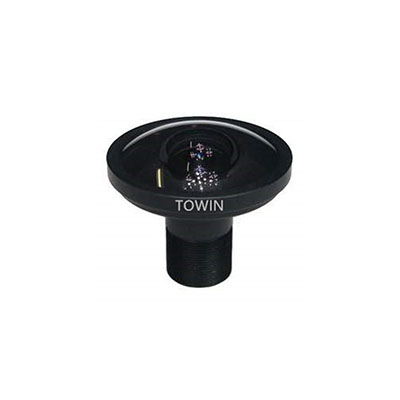
The TOWIN 1.7mm M12 fisheye lens is an example of an ultra-wide-angle optical solution for compact imaging systems.
- Focal Length: 1.7mm
- Field of View: 190° (D), 190° (H), 190° (V), according to the published product specifications
- Resolution: 16 Megapixels
- Aperture: F2.4
- Mount: M12 × 0.5
This product can be considered for panoramic and wide-area imaging applications where extensive angular coverage is required. Actual sensor compatibility and image coverage should be verified against the camera configuration.
View the complete range of TOWIN fisheye lenses to compare available focal lengths, sensor formats, field of view, and resolution specifications.
For additional compact optical solutions, explore our M12 lens product range.
8. Frequently Asked Questions About Circular vs. Diagonal Fisheye Lens
Q1: What is the difference between a circular and a full-frame fisheye lens?
A circular fisheye lens produces a circular image within the rectangular sensor frame, while a full-frame fisheye lens is designed to cover the sensor’s diagonal dimension and produce a rectangular image. The main difference is how each optical design uses the available sensor area.
Q2: Is a full-frame fisheye lens the same as a diagonal fisheye lens?
Yes. In common imaging terminology, full-frame fisheye and diagonal fisheye generally refer to a lens design that covers the diagonal dimension of a rectangular image sensor. Always confirm the actual image format and coverage specifications.
Q3: Does a circular fisheye lens always provide a 180-degree field of view?
No. Although many circular fisheye designs provide approximately 180 degrees or wider angular coverage, the actual field of view depends on the optical design, projection model, and sensor configuration. Check the manufacturer’s horizontal, vertical, and diagonal FOV specifications.
Q4: Can a circular fisheye lens be used with a rectangular image sensor?
Yes. A circular fisheye lens can be used with a rectangular sensor if the optical and mechanical specifications are compatible. However, the resulting image may contain dark or unused areas outside the circular image.
Q5: How does sensor size affect fisheye lens performance?
Sensor size affects the captured image area and effective field of view. The lens image circle must adequately cover the required sensor area. A mismatch may cause vignetting, incomplete coverage, or changes in the usable field of view.
Q6: Are M12 fisheye lenses suitable for machine vision?
Yes. M12 fisheye lenses can be used in machine vision and embedded imaging systems that require wide-area coverage and compact optical integration. Engineers should verify sensor compatibility, resolution, FOV, distortion, and working distance before selecting a lens.
Q7: How do I choose the right fisheye lens for an industrial camera?
Start by identifying the camera sensor format, required horizontal and diagonal FOV, image coverage, and resolution. Then evaluate focal length, image circle, optical performance, mounting dimensions, and image-processing requirements. Comparing these parameters helps identify a suitable lens for the intended application.
9. Conclusion: Choosing the Right Fisheye Lens for Your Application
The choice between a circular vs. diagonal fisheye lens depends primarily on image coverage and sensor utilization. Circular fisheye lenses are suitable when a circular image and broad angular coverage are required, while diagonal or full-frame fisheye lenses are designed to use more of a rectangular sensor’s available image area.
For industrial imaging systems, the best choice also depends on sensor size, image circle, field of view, resolution, optical distortion, and system integration requirements. Evaluating these factors together helps engineers select an appropriate fisheye lens for machine vision, robotics, automotive imaging, and wide-area monitoring.
Looking for the Right Industrial Fisheye Lens?
Whether your application requires circular image coverage, diagonal fisheye imaging, or a customized M12 optical solution, TOWIN can help you evaluate the appropriate lens specifications for your camera system.