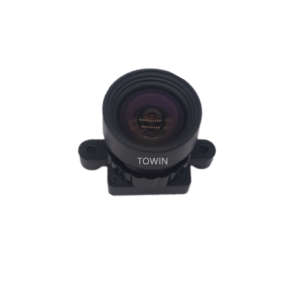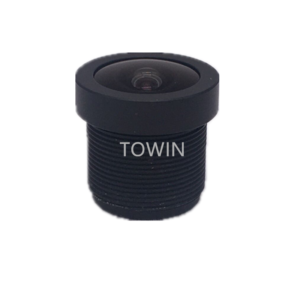



Wide Angle Lens – CCL117080MPF-1
10/30/2025
Low Distortion Lens – M42183028M4K
10/30/2025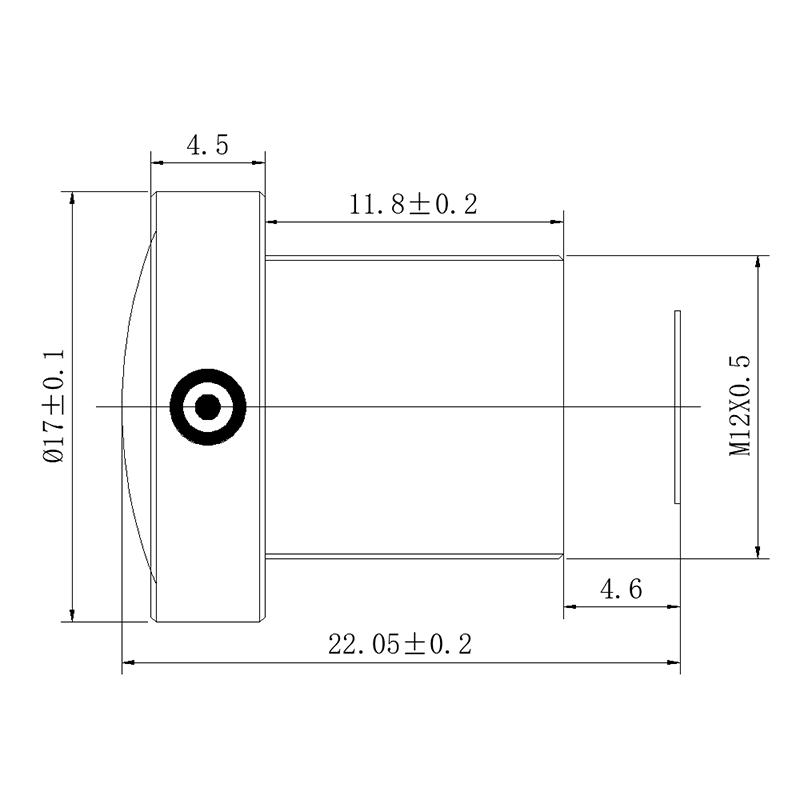
Wide Angle Lens – S02612513120F
2.6mm M12 ultra wide angle lens with 5MP resolution, 160° FOV, F2.0 aperture, 0.2m M.O.D., and M12 × 0.5 mount for embedded vision.
S02612513120F is Wide angle 5-Megapixel 1/2.5″ Φ7.5 M12 lens with Built-In IR Filter, 160° field of view, F2.0 aperture, for security surveillance.
| IMAGE FORMAT | Max Φ7.5, 1/2.5″ |
| FOCAL LENGTH | 2.6mm |
| F.O.V. (1/2.5″) | 160° (D=7.12) |
| 131° (H=5.70) | |
| 95° (D=4.28) | |
| RESOLUTION | 5 MP |
| TV DISTORTION | <-29% |
| APERTURE | F2.0 |
| MOUNT | M12x0.5 |
| IRIS | Fixed |
| M.O.D. | 0.2m |
| T.T.L. | 22.05mm |
| STRUCTURE | With IRCF |
M12 2.6mm 5MP Ultra Wide Angle Lens
This 2.6mm M12 wide angle lens is designed for 1/2.5″ camera systems requiring an exceptionally broad field of view in a compact optical package. With 5MP resolution, a 160° diagonal FOV, F2.0 aperture, and 0.2m minimum object distance, it is well suited to embedded vision, industrial monitoring, and wide-area imaging applications.
The combination of a 2.6mm focal length and extremely wide field of view allows a single camera to capture a large surrounding area from a relatively short installation distance. For engineers evaluating sensor and viewing coverage, the FOV Calculator can help estimate the required field of view based on sensor size and working distance.
Product Core Highlights
- 160° Ultra-Wide FOV: Captures an exceptionally broad scene with a single compact camera.
- 5MP Resolution: Provides detailed imaging for embedded and industrial vision systems.
- F2.0 Aperture: Provides strong light transmission for wide-area imaging.
- 0.2m M.O.D.: Supports relatively close-range wide-angle applications.
- M12 × 0.5 Mount: Enables straightforward integration into compact camera modules.
M12 2.6mm Ultra Wide Angle Lens Applications
Core Application Scenes
This 2.6mm M12 ultra wide angle lens is designed for imaging applications where maximum scene coverage is more important than maintaining low geometric distortion. Its 160° diagonal field of view allows a single camera to observe an exceptionally broad area, making it useful when camera installation space is limited or when multiple viewing directions need to be covered with fewer camera modules.
The 0.2m minimum object distance makes this lens particularly useful for close-range wide-area observation. Designers can mount it inside compact equipment, embedded devices, robotic platforms, and monitoring modules where the camera needs to observe both nearby objects and a large surrounding area.
With 5MP resolution and an F2.0 fixed aperture, the lens provides a practical combination of image detail and light throughput for embedded vision systems. The strong wide-angle distortion is an inherent characteristic of this optical configuration, so the lens is better suited to applications where scene coverage and spatial awareness are more important than precise geometric measurement.
For optical engineers comparing focal lengths and viewing angles, the Lens Selection Guide provides additional information for selecting an appropriate lens according to the imaging environment and system requirements.
Compatible Device List
- Embedded Vision Cameras: Suitable for compact camera modules that need to monitor a very broad surrounding area from a single installation point.
- Robotic Vision Systems: The ultra-wide viewing angle can provide robots with broader environmental awareness in confined operating spaces.
- Industrial Equipment Monitoring: Useful for observing machine surroundings, equipment status, and operator-access areas where broad coverage is required.
- Smart IoT Cameras: Suitable for compact connected camera devices requiring wide-area visual monitoring.
- Close-Range Monitoring Modules: The 0.2m M.O.D. supports applications where the camera must observe nearby objects while retaining a very wide viewing range.
- OEM Camera Modules: The M12 × 0.5 mount provides a compact mechanical interface for customized embedded imaging equipment.
For projects involving robotic perception and embedded visual sensing, explore TOWIN’s Robotics Vision solutions for additional optical application information.
Designed for ultra-wide industrial monitoring, embedded vision, robotic perception, and close-range wide-area imaging applications.
Frequently Asked Questions
Q: What sensor size is this 2.6mm M12 lens designed for?
A: The lens is specified for 1/2.5″ image formats and provides 5MP resolution for compatible camera systems.
Q: What is the field of view of this M12 wide angle lens?
A: On a 1/2.5″ sensor, the lens provides a 160° diagonal, 131° horizontal, and 95° vertical field of view.
Q: Is this lens suitable for ultra-wide-angle applications?
A: Yes. Its 160° diagonal FOV makes it suitable for applications requiring exceptionally broad scene coverage from a single compact camera.
Q: Does this lens provide low distortion imaging?
A: No. The specified TV distortion is below -29%. This lens is designed for very wide scene coverage rather than geometric accuracy, so it should not be classified as a low distortion lens.
Q: Is this lens a fisheye lens?
A: For TOWIN’s product classification, this model is positioned as a Wide Angle Lens, not a Fisheye Lens. Its primary product positioning is based on its ultra-wide field of view and M12 embedded camera applications.
Q: What is the minimum object distance of this lens?
A: The M.O.D. is 0.2m, allowing the lens to capture relatively close subjects while maintaining an exceptionally wide viewing area.
Q: What aperture does the lens use?
A: The lens features a fixed F2.0 aperture, providing consistent optical performance and good light transmission for wide-angle imaging.
Q: Does the IRCF specification mean this is an IR corrected lens?
A: No. IRCF refers to an IR Cut Filter. It should not be interpreted as an IR-corrected optical design. The lens is primarily configured for visible-light imaging.
Online contact