


Automotive Lens – S02013014024F67
09/04/2025
Fisheye Lens – S02106819020F69
09/05/2025
Fisheye Lens – S01812819018F
1.8mm 2MP M12 fisheye lens with 210° FOV, F1.8 aperture, <9% f-θ distortion and M12X0.5 mount for extreme wide-angle imaging.
S01812819018F is Fisheye Lens with Built-In IR Filter, 2-Megapixel CCTV lens, 1/2.8″ 210° M12/S-Mount, F1.8 aperture for security surveillance.
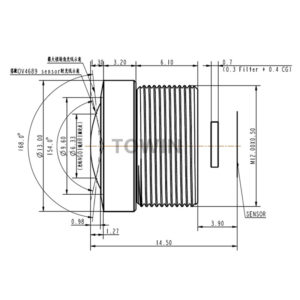
| IMAGE SIZE | 1/2.8″ |
| FOCAL LENGTH | 1.8mm |
| 1/2.8″ (IMX307) | 210°(D) |
| 190°(H) | |
| 105°(V) | |
| RESOLUTION | 2MegaPixel |
| f-θ DISTORTION | <9% |
| APERTURE | F1.8 |
| MOUNT | M12X0.5 |
| IRIS | Fixed |
| FOCUS | Manual |
| ZOOM | Fixed |
| T.T.L. | 14.5mm |
| CONSTRUCTION | 6G+IRCF |
1.8mm 2MP M12 210° Fisheye Lens
This 1.8mm 2MP M12 fisheye lens is designed for extreme wide-angle imaging, delivering a 210° diagonal field of view on the 1/2.8″ Sony IMX307 sensor. Its f-θ distortion is specified at less than 9%, providing a controlled angular mapping characteristic for applications requiring an exceptionally wide viewing range with predictable image geometry.
M12 Fisheye Lens Core Highlights
- 210° ultra-wide FOV captures an exceptionally broad scene from a single camera position.
- f-θ distortion below 9% provides controlled angular mapping for specialized ultra-wide imaging.
- 2MP compatibility with Sony IMX307 supports compact low-light camera module designs.
- F1.8 aperture provides efficient light gathering for demanding imaging environments.
- M12X0.5 compact construction simplifies integration into embedded camera systems.
1.8mm M12 Fisheye Lens Applications
Core Application Scenes
This 1.8mm M12 fisheye lens is designed for imaging systems that require an exceptionally large viewing angle while maintaining controlled f-θ optical characteristics. With a 210° diagonal field of view, the lens can capture scenes extending beyond the conventional forward-facing viewing range of standard wide-angle lenses.
The combination of 210° FOV and less than 9% f-θ distortion makes this lens particularly relevant to applications where the relationship between incident angle and image position needs to remain controlled. Rather than simply maximizing geometric distortion, the optical design provides a more predictable angular representation for specialized panoramic and ultra-wide imaging systems.
The lens is optimized for the 1/2.8″ Sony IMX307, a sensor commonly used in compact camera modules. Its F1.8 aperture further supports image acquisition in environments where available light is limited, while the compact M12X0.5 interface makes it practical for embedded optical assemblies.
The fixed focal length and fixed iris configuration also provide a stable optical setup for equipment that does not require field adjustment after installation.
Compatible Device List
- Ultra-Wide-Angle Camera Modules: Suitable for embedded cameras requiring coverage beyond conventional wide-angle optics.
- Panoramic Imaging Systems: The 210° FOV allows a single optical module to capture an exceptionally broad surrounding scene.
- Compact Embedded Vision Devices: The M12X0.5 mount is suitable for space-constrained camera housings and embedded imaging platforms.
- IMX307-Based Camera Modules: Specifically matched to 1/2.8″ Sony IMX307 sensor configurations.
- Low-Light Camera Systems: The F1.8 aperture supports efficient light collection in dim or changing illumination conditions.
- Specialized Wide-Angle Monitoring Devices: The controlled f-θ distortion can be valuable in imaging systems where angular mapping characteristics are an important design consideration.
Designed for extreme wide-angle imaging, panoramic camera modules, compact embedded vision systems, and specialized 210° field-of-view applications.
For engineers developing compact camera systems, the M12 Lenses product range provides additional focal-length and field-of-view configurations.
Frequently Asked Questions
Q: What type of lens is this 1.8mm M12 lens?
A: It is a 1.8mm M12 fisheye lens designed for extreme wide-angle imaging, with a maximum specified diagonal field of view of 210°.
Q: What is the maximum field of view of this lens?
A: The lens provides 210° diagonal, 190° horizontal, and 105° vertical FOV when used with the specified 1/2.8″ sensor configuration.
Q: Which sensor is this lens designed for?
A: The specification identifies the 1/2.8″ Sony IMX307 as the target sensor configuration, with 2-megapixel resolution support.
Q: What does f-θ distortion below 9% mean?
A: f-θ distortion describes how image position relates to the incident angle in an angular or equidistant-style optical system. A value below 9% indicates that the lens provides controlled angular mapping despite its extremely wide field of view.
Q: Is this lens a low-distortion lens?
A: It should not automatically be classified as a conventional low-distortion lens. The specified f-θ distortion <9% describes angular mapping behavior and is different from the rectilinear distortion specification normally used to classify low-distortion machine vision lenses.
Q: Does this lens have a fixed aperture?
A: Yes. The lens uses a fixed F1.8 aperture and fixed iris, providing a stable optical configuration after installation.
Q: Can the lens be focused or zoomed?
A: The lens uses manual focus and a fixed focal length. It does not provide optical zoom adjustment.
Q: What type of camera system can use this lens?
A: It is suitable for compact camera modules using a 1/2.8″ Sony IMX307 sensor, particularly systems requiring extreme wide-angle or panoramic scene acquisition.
Related Optical Resources
When designing an ultra-wide-angle camera system, the relationship between sensor size, focal length, and field of view is critical. Engineers can use the Sensor Guide to evaluate sensor compatibility and the Lens Selection Guide to compare different lens configurations.
For calculating the expected field of view based on sensor dimensions and focal length, the FOV Calculator provides a useful starting point during optical system design.
Because this lens uses an f-θ optical specification, engineers may also benefit from reviewing Optical Design and Lens Basics when evaluating different wide-angle optical architectures.
For information about image geometry and different types of lens distortion, see the Distortion Guide.
For additional M12 optical configurations, explore the complete M12 Lenses product range; For customized lens requirements, please contact Towin.
Online contact