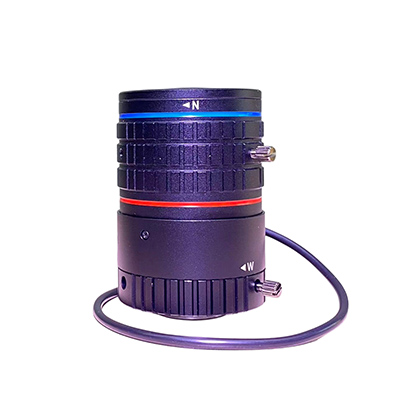



Scientific research pinhole lens
08/21/2025
Low distortion rectilinear M12 S-mount board lens
08/21/2025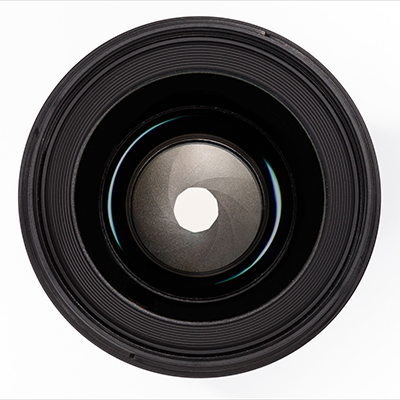
Aperture is measured in f-numbers (f-stops) because the f-number expresses the ratio between a lens’s focal length and its entrance pupil diameter. This standardized measurement makes it possible to compare the relative light-gathering capability of lenses with different focal lengths. Understanding aperture numbers is essential not only in photography but also in industrial optics, where aperture affects image brightness, depth of field, exposure time, and machine vision performance.
For engineers selecting an industrial lens, knowing what aperture numbers mean helps balance light sensitivity, image sharpness, and depth of field. In this guide, we explain how f-numbers work, why aperture is measured in f-stops, and how to select the appropriate aperture for industrial imaging applications.
1. What Is an F-Number?
An f-number, also called an f-stop or aperture number, describes the relative aperture of a camera lens. It indicates the relationship between the focal length and the diameter of the lens’s entrance pupil.
The standard formula for calculating an f-number is:
N = f / D
Where:
- N: F-number (such as f/2, f/2.8, or f/4)
- f: Lens focal length
- D: Entrance pupil diameter
For example, consider a lens with a focal length of 50 mm and an entrance pupil diameter of 25 mm.
N = 50 / 25 = 2
Therefore, the lens has an aperture of f/2.
The entrance pupil is the apparent image of the aperture stop as viewed from the front of the lens. It is not necessarily the same as the physical diameter of the iris opening because the optical elements in front of the aperture stop can magnify or reduce its apparent size.
2. What Is Aperture Measured In?
Aperture is commonly measured and specified using f-numbers (f-stops), rather than simply stating the physical opening diameter in millimeters.
Common aperture values include:
- f/1.2
- f/1.4
- f/1.8
- f/2
- f/2.8
- f/4
- f/5.6
- f/8
- f/11
- f/16
A smaller f-number represents a wider relative aperture, allowing more light to pass through the lens under comparable conditions. A larger f-number represents a smaller relative aperture, reducing the amount of light reaching the image sensor.
For example, an f/2 lens has a wider relative aperture than an f/8 lens. This makes f/2 more suitable when a system needs to collect more light, while f/8 may be useful when greater depth of field is required.
3. Why Is Aperture Measured in F-Stops Instead of Millimeters?
The main reason aperture is measured in f-stops is standardization. The physical diameter of an aperture alone does not describe how much light a lens can collect relative to its focal length.
Consider two lenses:
- Lens A: 50 mm focal length with a 25 mm entrance pupil.
- Lens B: 100 mm focal length with a 50 mm entrance pupil.
Both lenses have an f-number of f/2:
- Lens A: 50 / 25 = f/2
- Lens B: 100 / 50 = f/2
Although their physical entrance pupil diameters are different, they share the same relative aperture.
This standardized ratio makes it easier to compare lenses with different focal lengths and calculate exposure settings. Without f-numbers, lens specifications would be more difficult to compare consistently.
Why F-Numbers Make Lens Comparison Easier
F-numbers provide a common reference for evaluating relative aperture across different focal lengths. This is particularly useful when comparing industrial lenses designed for different fields of view, sensor formats, and imaging distances.
However, the same f-number does not guarantee identical real-world image brightness across different lenses. Actual light transmission, optical coatings, vignetting, and other optical losses also affect the amount of light reaching the sensor.
4. What Do Aperture Numbers Mean?
Aperture numbers describe how wide or narrow the relative opening of a lens is. Understanding the relationship between f-numbers and light is important when selecting a lens for different imaging environments.
| F-Number | Relative Aperture | Relative Light Level* |
|---|---|---|
| f/1.4 | Very wide | 4.0 |
| f/2 | Wide | 2.0 |
| f/2.8 | Moderate | 1.0 |
| f/4 | Smaller | 0.5 |
| f/5.6 | Small | 0.25 |
| f/8 | Narrow | 0.125 |
*Relative light levels are approximate geometric values compared with f/2.8, assuming the same scene, exposure time, and idealized optical transmission.
The important principle is that a lower f-number means a wider aperture and greater light-gathering capability, while a higher f-number means a narrower aperture.
5. Why Does Each F-Stop Change Light by a Factor of Two?
The traditional f-stop sequence follows a geometric progression based on the square root of two (approximately 1.414).
The reason is that the area of a circular aperture is proportional to the square of its diameter. To halve the light passing through an idealized aperture, the f-number must increase by approximately √2.
N₂ = N₁ × √2
For example:
- f/1.4 to f/2: approximately one stop less light.
- f/2 to f/2.8: approximately one stop less light.
- f/2.8 to f/4: approximately one stop less light.
- f/4 to f/5.6: approximately one stop less light.
The relative irradiance at the image plane is approximately proportional to:
E ∝ 1 / N²
This relationship explains why changing from f/4 to f/2 approximately quadruples the idealized image-plane irradiance, assuming other conditions remain constant.
6. How Does Aperture Affect Image Quality?
Aperture affects more than image brightness. It also influences depth of field, exposure time, diffraction, and the amount of detail captured by an imaging system.
6.1 Light Sensitivity and Exposure
A wider aperture allows more light to reach the image sensor. This can help an imaging system achieve the required exposure with a shorter exposure time or lower illumination intensity.
This is particularly important in low-light environments, high-speed inspection, and applications involving moving objects.
6.2 Depth of Field
Depth of field (DOF) describes the range of distances in which objects appear acceptably sharp in an image.
A wider aperture generally produces a shallower depth of field, while a narrower aperture generally increases depth of field.
In industrial inspection, sufficient depth of field is important when objects have different heights, uneven surfaces, or varying positions.
6.3 Diffraction and Image Sharpness
Although reducing the aperture can increase depth of field, making it too small can introduce diffraction.
Diffraction occurs when light waves spread as they pass through a small aperture. This can reduce image contrast and fine-detail resolution, particularly when working with high-resolution image sensors.
Therefore, the smallest available aperture is not necessarily the best choice. The optimal setting depends on the lens design, sensor pixel size, magnification, illumination, and imaging requirements.
6.4 Exposure Consistency
Different lenses with the same nominal f-number may transmit different amounts of light because of differences in optical design, coatings, and internal reflections.
For applications requiring consistent exposure across multiple cameras or lenses, actual transmission should also be considered.
7. F-Number vs. T-Stop: What’s the Difference?
F-number and T-stop are both used to describe aperture-related optical performance, but they represent different properties.
- F-number: A geometric ratio between focal length and entrance pupil diameter.
- T-stop: A transmission-adjusted aperture value that accounts for optical light losses.
A simplified relationship is:
T-stop = F-number / √τ
Here, τ represents the fraction of incident light transmitted through the lens under the specified measurement conditions.
For example, a lens with an f-number of f/2 and a transmission factor of 0.81 has an approximate T-stop of T/2.22.
F-numbers are widely used in photography and industrial lens specifications. T-stops are particularly useful in cinematography and applications where consistent transmitted light levels are important.
8. How Does Aperture Affect Machine Vision Performance?
In machine vision systems, aperture is an important optical parameter that directly affects image acquisition. Choosing an appropriate f-number helps engineers balance brightness, depth of field, resolution, and inspection speed.
8.1 Low-Light Machine Vision
When a machine vision camera operates under limited illumination, a lens with a larger maximum aperture can collect more light. This may help improve image brightness or allow shorter exposure times.
A suitable large-aperture industrial lens can be useful in applications such as smart security, traffic monitoring, robotics, and high-speed inspection.
8.2 High-Speed Inspection
Industrial production lines often require cameras to capture moving objects without motion blur. A wider aperture can provide additional light, making shorter exposure times possible when the illumination and sensor support the required imaging conditions.
8.3 Depth of Field in Industrial Inspection
When inspecting components with different surface heights, a smaller aperture may help keep more of the target within the acceptable focus range.
However, excessive stopping down can reduce fine-detail contrast because of diffraction. Engineers should test the complete imaging system to find a practical balance between depth of field and resolution.
8.4 Resolution and Sensor Matching
High-resolution sensors require suitable optical performance. Aperture selection should consider pixel size, optical resolution, magnification, and the required level of image detail.
A lens should be evaluated as part of the complete camera system rather than selected by its maximum aperture alone.
For a broader overview of these factors, read our Machine Vision Lens Selection Guide.
9. Fixed Aperture vs. Adjustable Iris: Which Is Better?
Industrial lenses are available with different aperture control mechanisms. Two common configurations are fixed aperture and adjustable iris.
Fixed Aperture Lenses
A fixed aperture lens has a predetermined aperture that cannot be adjusted by the user. Its optical configuration is designed for applications with relatively stable lighting and imaging conditions.
Advantages include:
- Simple mechanical construction.
- Consistent aperture configuration.
- Compact integration for embedded cameras.
- Suitable for applications with controlled illumination.
Fixed aperture configurations are commonly found in compact M12 and S-Mount lenses.
Explore TOWIN M12 lenses for compact industrial imaging, embedded vision, and AI camera applications.
Adjustable Iris Lenses
An adjustable iris lens allows users to change the aperture opening according to imaging conditions.
Advantages include:
- Flexible control of image brightness.
- Adjustable depth of field.
- Better adaptability to changing illumination.
- Greater flexibility during system integration.
Adjustable iris lenses are useful in industrial inspection, factory automation, and machine vision applications where lighting or depth-of-field requirements may change.
Explore TOWIN C-Mount industrial lenses for machine vision, factory automation, and high-resolution imaging applications.
10. How to Choose the Right Aperture for an Industrial Lens
Selecting the right aperture requires considering the entire imaging system rather than focusing on one specification.
Step 1: Evaluate Available Illumination
Determine the amount of light available at the inspection area. Low-light applications may require a larger maximum aperture or additional illumination.
Step 2: Determine the Required Exposure Time
For moving objects, a shorter exposure time may be necessary to reduce motion blur. The aperture and illumination should be selected together to achieve the required exposure.
Step 3: Evaluate Depth of Field
Determine the acceptable focus range based on object dimensions, surface variations, and working distance. A smaller aperture may increase depth of field, but diffraction must also be considered.
Step 4: Match the Lens to the Sensor
Check sensor size, pixel size, resolution, and image circle compatibility. The lens must provide sufficient optical performance for the camera’s imaging requirements.
Step 5: Test the Complete Imaging System
Evaluate the selected lens using the actual camera, lighting, working distance, and inspection target. Check image sharpness, exposure, edge performance, and measurement repeatability.
You can also use our Field of View Calculator to estimate the required field of view and support the initial lens selection process.
For application-specific guidance, see our guide to selecting a lens for a machine vision camera.
Frequently Asked Questions About Aperture and F-Numbers
1. What is aperture measured in?
Aperture is commonly expressed in f-numbers or f-stops, such as f/1.4, f/2, f/2.8, and f/4. These values describe the ratio between the lens’s focal length and entrance pupil diameter.
2. Why is aperture measured in f-stops?
Aperture is measured in f-stops because this standardized system accounts for focal length. It makes it easier to compare the relative aperture and light-gathering capability of lenses with different focal lengths.
3. What do aperture numbers mean?
Aperture numbers indicate the relative size of the lens opening. A smaller f-number means a wider aperture that allows more light through, while a larger f-number means a narrower aperture that allows less light through.
4. Is f/2.8 bigger than f/8?
No. An f/2.8 aperture is wider than f/8. The smaller f-number represents a larger relative aperture and allows more light to enter the lens under comparable conditions.
5. How is the f-number calculated?
The f-number is calculated by dividing the focal length by the entrance pupil diameter. For example, a 50 mm lens with a 25 mm entrance pupil has an f-number of f/2.
6. Does a lower f-number mean more light?
Yes. A lower f-number represents a wider relative aperture. Under the same conditions, reducing the f-number increases the amount of light reaching the image sensor.
7. What is the difference between F-number and T-stop?
F-number describes the geometric relationship between focal length and entrance pupil diameter. T-stop also accounts for light transmission losses within the lens, making it useful when consistent transmitted light levels are important.
8. How does aperture affect machine vision image quality?
Aperture influences image brightness, exposure time, depth of field, and diffraction. A wider aperture collects more light, while a smaller aperture can increase depth of field. The optimal setting depends on the sensor, lens, illumination, and inspection requirements.
Conclusion: Why F-Numbers Matter in Industrial Optics
Aperture is measured in f-numbers because this standardized ratio makes it possible to compare the relative aperture of lenses with different focal lengths. It also provides a practical way to understand how aperture affects light collection, exposure, and depth of field.
In industrial imaging, choosing the right aperture requires balancing light sensitivity, depth of field, optical resolution, and diffraction. These factors should be considered alongside sensor size, focal length, working distance, and application requirements.
Understanding why aperture is measured in f-numbers is an important starting point for selecting the right industrial lens and building a reliable machine vision system.
TOWIN provides industrial optical lenses and customized OEM/ODM solutions for machine vision, robotics, AI imaging, and industrial camera applications. If you need help selecting an appropriate aperture or lens configuration, contact TOWIN’s optical team to discuss your project requirements.