


Does Towin Provide Custom Robotics Lenses?
06/16/2026
What is an IR-corrected lens?
06/17/2026
Surveillance cameras play a critical role in modern security systems, helping businesses and cities improve safety, monitor assets, and support intelligent analytics. However, while camera sensors often receive the most attention, the lens is equally important in determining image quality, field of view, and recognition performance.
The right lens can significantly improve facial recognition accuracy, license plate capture, low-light imaging, and AI-based object detection. Whether you are designing a CCTV system, building an AI camera, or integrating a smart city solution, selecting the correct lens is essential for reliable performance.
In this guide, we explain how to choose the best lens for surveillance cameras based on sensor size, focal length, field of view, and application requirements. You can also explore our Smart Security Lens Solutions to learn how optical technologies support modern surveillance systems.
Why Is the Lens Important in Surveillance Cameras?
The lens determines how much light reaches the sensor and how accurately the scene is reproduced. Even with a high-resolution sensor, poor lens selection can result in blurry images, distortion, reduced night vision performance, and inaccurate object recognition.
High-quality surveillance lenses improve:
- Image sharpness and resolution
- Low-light imaging performance
- Recognition distance
- AI object detection accuracy
- Field of view coverage
Today’s security systems are increasingly powered by artificial intelligence. Applications such as facial recognition, license plate recognition, and smart city monitoring require advanced optics to deliver reliable results.
Learn more about security imaging technologies in our Smart Security Lens Solutions.
Key Factors When Choosing a Lens for Surveillance Cameras
Selecting the best lens involves balancing several optical parameters. The ideal solution depends on the installation environment, target distance, lighting conditions, and camera specifications.
1. Sensor Size Compatibility
The lens image circle must fully cover the camera sensor. If the sensor is larger than the lens image circle, vignetting or dark corners may occur.
Common sensor sizes used in security cameras include:
- 1/4″
- 1/3″
- 1/2.8″
- 1/1.8″
- 1″
Understanding sensor compatibility is critical when selecting lenses for security applications. Read our Sensor Guide to learn more.
2. Field of View (FOV)
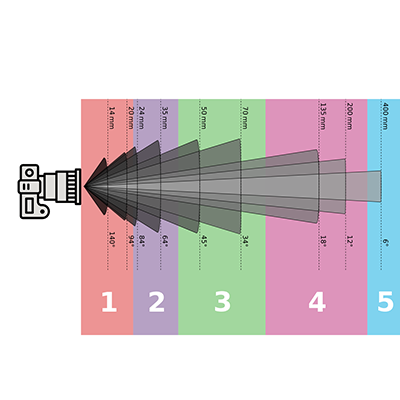
Field of view determines how much area the camera can observe. A wider FOV captures more of the scene, while a narrower FOV provides greater detail at longer distances.
Applications requiring a wide field of view include:
- Retail stores
- Office monitoring
- Indoor surveillance
- Public spaces
Applications requiring a narrow field of view include:
- Traffic monitoring
- Perimeter security
- License plate recognition
- Long-distance observation
Use our FOV Calculator to estimate the appropriate focal length for your installation.
3. Low-Light Performance
Security systems often operate 24/7. Therefore, low-light imaging capability is extremely important.
Lenses with larger apertures such as F1.4 or F1.8 allow more light to reach the sensor, improving image quality under dark conditions.
IR-corrected lenses are also widely used in day-and-night surveillance systems because they maintain focus under both visible and infrared light.
4. Image Distortion
Lens distortion can reduce recognition accuracy, especially in AI applications such as facial recognition and object detection.
Low-distortion lenses provide more accurate image geometry and improve algorithm performance.
Learn more in our Lens Distortion Guide.
Security Camera Focal Length Comparison
Focal length directly affects viewing angle and target size. Choosing the correct focal length is one of the most important factors in designing surveillance systems.
| Focal Length | Field of View | Typical Application |
|---|---|---|
| 2.8mm | Wide | Indoor monitoring |
| 4mm | Medium | General surveillance |
| 6mm | Narrower | Facial recognition |
| 8mm | Narrow | Perimeter monitoring |
| 12mm+ | Telephoto | License plate recognition |
2.8mm Lens
A 2.8mm lens provides a wide viewing angle and is commonly used for indoor security systems where broad area coverage is required.
Typical applications include:
- Retail stores
- Warehouses
- Reception areas
- Office monitoring
4mm Lens
A 4mm lens offers a balance between coverage and detail, making it one of the most popular choices for general CCTV installations.
6mm to 8mm Lens
These focal lengths provide greater detail and are commonly used in facial recognition systems and perimeter security.
12mm and Above
Telephoto lenses are suitable for long-distance monitoring applications such as traffic surveillance and license plate recognition.
M12 vs C-Mount Lenses for Surveillance Cameras
Two of the most common lens mounts used in security imaging are M12 and C-Mount.
M12 lenses are compact, lightweight, and cost-effective, making them ideal for embedded AI cameras and smart devices. C-Mount lenses support larger sensors and typically deliver higher optical performance.
Read our detailed comparison: M12 vs C-Mount Lenses.
| Feature | M12 Lens | C-Mount Lens |
|---|---|---|
| Size | Compact | Larger |
| Sensor Support | Small Sensors | Large Sensors |
| Cost | Lower | Higher |
| Optical Performance | Good | Excellent |
For compact AI surveillance systems, M12 lenses remain one of the most popular choices.
Which Lens Is Best for Different Security Applications?
| Application | Recommended Lens |
|---|---|
| Indoor CCTV | 2.8mm M12 Lens |
| Facial Recognition | Low-Distortion Lens |
| Smart City Monitoring | IR-Corrected Lens |
| Traffic Monitoring | 12mm+ Telephoto Lens |
| AI Cameras | M12 AI Lens |
Modern surveillance cameras are increasingly integrated with AI technologies that require high-resolution optics, low distortion, and reliable imaging under challenging lighting conditions.
Explore our Optical Lens Solutions and Smart Security Lens Solutions to find the right lens for your application.
How to Choose the Right Lens for Surveillance Cameras in 5 Steps
Selecting the right lens can significantly improve image quality, detection accuracy, and system reliability. Follow these five steps to choose the optimal lens for your security application.
Step 1: Determine Sensor Size
The lens image circle must fully cover the camera sensor. A mismatch between sensor and lens can cause vignetting and reduced image quality.
Common sensor formats include 1/4″, 1/3″, 1/2.8″, 1/1.8″, and 1″. Larger sensors generally provide better low-light performance and higher image quality.
Learn more in our Sensor Guide.
Step 2: Calculate the Required Field of View
Field of view determines how much area the camera can monitor. A wider viewing angle captures more of the scene, while a narrower angle provides greater detail.
Use our FOV Calculator to estimate the ideal focal length for your installation.
Step 3: Select the Appropriate Focal Length
- 2.8mm: Wide-angle indoor monitoring
- 4mm: General-purpose surveillance
- 6–8mm: Facial recognition and perimeter monitoring
- 12mm+: Traffic monitoring and license plate recognition
Step 4: Consider Low-Light and IR Performance
For 24/7 monitoring, IR-corrected lenses help maintain focus under both visible and infrared light. Lenses with larger apertures improve night imaging performance.
Step 5: Match the Lens to the Application
Different applications require different optical characteristics:
- Retail Security: Wide-angle lenses
- Facial Recognition: Low-distortion lenses
- Traffic Monitoring: Telephoto lenses
- Smart Cities: High-resolution AI lenses
Explore more security applications in our Smart Security Lens Solutions.
Recommended Lens Types for Security Systems
| Lens Type | Advantages | Typical Applications |
|---|---|---|
| M12 Lens | Compact, lightweight, cost-effective | AI cameras, smart devices |
| IR-Corrected Lens | Day-and-night imaging | Outdoor surveillance |
| Low-Distortion Lens | Improved AI accuracy | Facial recognition |
| Telephoto Lens | Long-distance capture | Traffic monitoring |
Learn more about What Is an M12 Lens? and its role in modern AI security systems.
Future Trends in Smart Security Imaging
The security industry is rapidly evolving toward AI-powered surveillance systems. Advanced imaging technologies enable real-time object detection, facial recognition, and intelligent analytics.
Emerging trends include:
- AI-powered video analytics
- Edge computing cameras
- Multi-sensor imaging systems
- Higher-resolution surveillance cameras
- Infrared and low-light optimization
As these technologies continue to develop, lens performance will become increasingly important in ensuring reliable and accurate imaging.
Explore additional applications in our Optical Lens Solutions.
Frequently Asked Questions
Q: What lens is best for surveillance cameras?
A: The best lens depends on the application. Wide-angle lenses are suitable for indoor monitoring, while telephoto lenses are ideal for long-distance surveillance and license plate recognition.
Q: Is 2.8mm or 4mm better for security cameras?
A: A 2.8mm lens provides a wider field of view, while a 4mm lens offers a better balance between coverage and detail.
Q: What lens is best for facial recognition?
A: Low-distortion lenses with higher resolution are typically preferred for facial recognition systems because they preserve image accuracy.
Q: Do surveillance cameras require IR-corrected lenses?
A: Yes. IR-corrected lenses maintain focus under both visible and infrared light, making them ideal for day-and-night monitoring.
Q: What is the difference between M12 and C-Mount lenses?
A: M12 lenses are compact and cost-effective, while C-Mount lenses support larger sensors and higher optical performance. Learn more in our M12 vs C-Mount Lenses Guide.
Q: Which lens is best for low-light surveillance?
A: Lenses with larger apertures and IR correction generally provide better low-light imaging performance.
Q: Can M12 lenses support AI surveillance systems?
A: Yes. Many modern AI cameras use M12 lenses due to their compact size and excellent optical performance.
Q: How do I calculate the required field of view?
A: You can estimate field of view using our FOV Calculator.
Conclusion
Choosing the right lens requires careful consideration of sensor size, focal length, field of view, lighting conditions, and application requirements. Whether you need compact M12 lenses for AI devices or high-performance optics for industrial security systems, selecting the correct lens is essential for achieving reliable imaging performance.
Explore our Smart Security Lens Solutions to discover lens technologies designed for AI cameras, smart cities, facial recognition systems, and advanced imaging applications.
As security technologies continue to evolve, high-performance optics will remain critical for ensuring that surveillance cameras deliver accurate, reliable, and intelligent monitoring in every environment.
Need Help Selecting the Right Security Lens?
Tell us your sensor size, resolution, working distance, and field of view requirements. Our optical engineers will recommend the optimal lens solution for your application.