


What Is Low-Distortion Imaging?
07/09/2026
How Do I Choose a Low Distortion Lens?
07/11/2026
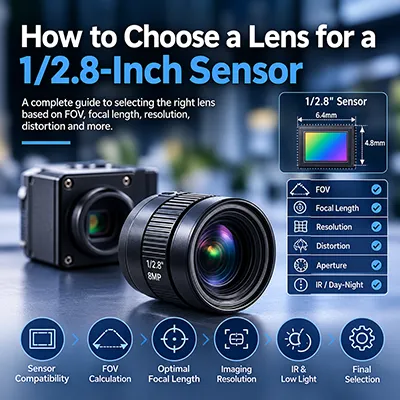
How Does Sensor Size Affect Lens Selection is one of the most important questions when designing an industrial vision system. Selecting the right lens is not only about focal length or resolution. The camera sensor size directly influences image coverage, field of view, image quality, and lens compatibility.
In machine vision applications, mismatching the sensor and lens can lead to problems such as image vignetting, reduced edge sharpness, incorrect field of view, and poor measurement accuracy. Understanding the relationship between sensor size and lens performance helps engineers choose the right optical solution and avoid unnecessary system redesign.
Before selecting a lens, it is recommended to understand the fundamentals of industrial optics through our Industrial Lens Basics Guide .
What Is Camera Sensor Size?
Camera sensor size refers to the physical dimensions of the imaging area inside a camera. It determines how much light the camera can capture and how much of the lens image circle can be utilized.
Industrial cameras commonly use sensor formats such as:
| Sensor Format | Typical Application |
|---|---|
| 1/4″ | Compact embedded cameras |
| 1/3″ | Security and industrial imaging |
| 1/2.7″ | AI cameras and smart vision systems |
| 1/1.8″ | High-resolution machine vision |
| 1″ | Advanced industrial inspection |
For more details about sensor formats and compatibility, visit our camera sensor size guide .
Why Does Sensor Size Matter for Lens Selection?
The sensor size affects several important optical factors, including image circle coverage, field of view, and overall lens compatibility. A correct match between the sensor and lens ensures the camera can capture the complete image area without losing image quality.
1. Sensor Size Determines Image Circle Compatibility
Every industrial lens produces a circular image projection called the image circle. The sensor must fit inside this image circle to receive a complete image.
| Sensor Size | Required Image Circle | Common Lens Type |
|---|---|---|
| 1/4″ | Approx. 4.5mm | M12 Lens |
| 1/3″ | Approx. 6mm | M12 Lens |
| 1/2.7″ | Approx. 7mm | M12 Low Distortion Lens |
| 1/1.8″ | Approx. 9mm | M12 / C-Mount Lens |
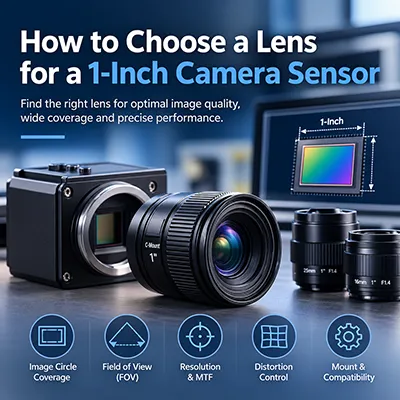
| 1″ | Approx. 16mm | C-Mount Lens |
Using a lens designed for a smaller sensor with a larger sensor may cause:
- Image corner loss
- Vignetting
- Reduced optical performance
- Lower measurement accuracy
2. Sensor Size Changes Field of View
The sensor size directly influences the field of view (FOV). With the same focal length lens, a larger sensor captures a wider viewing area, while a smaller sensor produces a narrower field of view.
| Lens | Sensor | Field of View |
|---|---|---|
| 12mm Lens | 1/3″ Sensor | Narrow View |
| 12mm Lens | 1/1.8″ Sensor | Wider View |
| 12mm Lens | 1″ Sensor | Maximum Coverage |
Engineers can quickly estimate the required viewing area using our FOV Calculator .
Sensor Size Compatibility With Industrial Lenses
Different lens types are designed for different sensor formats. Choosing the correct lens category is essential for achieving the required imaging performance.
M12 Lens for Small and Medium Sensors
M12 lenses are widely used in compact industrial cameras because of their small size, lightweight design, and flexible integration.
Typical compatible sensors include:
- 1/4″ Sensor
- 1/3″ Sensor
- 1/2.7″ Sensor
- 1/2″ Sensor
Common applications include robotics, smart security, embedded vision, and AI cameras.
C-Mount Lens for Larger Sensors
C-Mount lenses are commonly selected for larger sensors and high-performance machine vision systems requiring higher resolution and greater optical flexibility.
Typical applications include:
- Industrial inspection
- Precision measurement
- Semiconductor inspection
How to Select the Right Lens Based on Sensor Size
A practical lens selection process should follow these steps:
- Identify Sensor Size
Confirm the camera sensor format before selecting the lens. - Check Image Circle Compatibility
Make sure the lens image circle covers the complete sensor area. - Calculate Required Field of View
Determine the required scene coverage based on working distance. - Match Resolution Requirements
Ensure lens resolution matches camera pixel performance. - Select Lens Mount
Choose M12, C-Mount, or other mounting options. - Verify Optical Performance
Check distortion, MTF, and illumination performance.
For a complete selection process, see our Industrial Lens Selection Guide .
Recommended Lens Selection by Sensor Size
| Sensor Size | Recommended Lens | Typical Applications |
|---|---|---|
| 1/4″ | M12 Lens | Embedded cameras, compact vision |
| 1/3″ | M12 Lens | Security and AI vision |
| 1/2.7″ | Low Distortion M12 Lens | Measurement and inspection |
| 1/1.8″ | High Resolution M12/C-Mount Lens | Machine vision |
| 1″ | C-Mount Lens | Industrial imaging |
Frequently Asked Questions
Q: Does a larger sensor require a larger lens?
A: Yes. Larger sensors usually require lenses with larger image circles to fully cover the imaging area.
Q: Can I use a smaller sensor lens on a larger sensor?
A: Usually not recommended. The lens may not cover the entire sensor, causing dark corners and image quality loss.
Q: Does sensor size affect field of view?
A: Yes. A larger sensor provides a wider field of view when using the same focal length lens.
Q: What sensor sizes are commonly used with M12 lenses?
A: M12 lenses are commonly used with small and medium sensors including 1/4″, 1/3″, 1/2.7″, and 1/2″ formats.
Q: How do I choose between M12 and C-Mount lenses?
A: The choice depends on sensor size, resolution requirements, working distance, and application requirements.
Conclusion
Choosing the correct industrial lens requires a clear understanding of sensor size, image circle, field of view, and optical performance.
How Does Sensor Size Affect Lens Selection is a key consideration for engineers designing machine vision systems because the sensor directly determines lens compatibility and imaging performance.
By matching sensor format with the correct lens solution, users can achieve better image quality, improved system reliability, and optimized vision performance.
TOWIN provides professional M12 lenses, C-Mount lenses, and customized optical solutions for different sensor sizes and industrial applications.