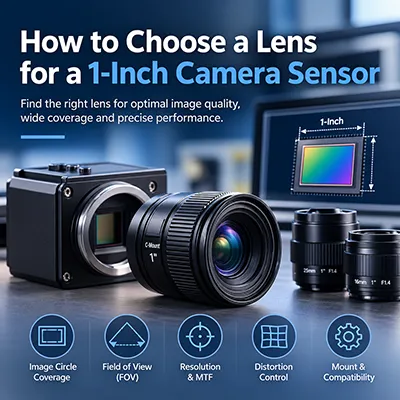



How to Choose a Lens for a 1-Inch Camera Sensor
10/02/2026
How to Choose a Lens for a 1/1.8-Inch Sensor
10/09/2026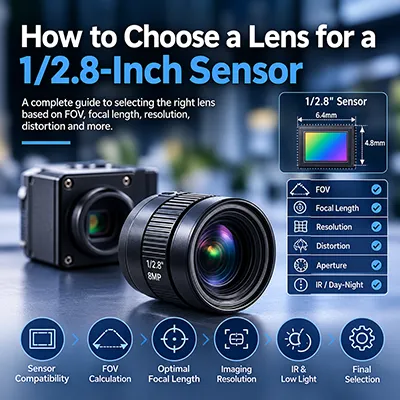
Choosing the right lens for a 1/2.8-inch camera sensor requires more than simply matching the sensor format. The lens must provide sufficient image-circle coverage, the right field of view (FOV), appropriate focal length, adequate optical resolution, acceptable distortion, and mechanical compatibility with the camera.
For CCTV, smart security, embedded vision, robotics, and compact industrial imaging systems, the lens also needs to match requirements such as low-light performance, aperture, IR imaging, and camera size. In this guide, we explain How to Choose a Lens for a 1/2.8-Inch Sensor step by step, from sensor compatibility and FOV calculation to focal length, resolution, distortion, IR performance, and final product selection.
Why Is 1/2.8-Inch Sensor Lens Selection Important?
The 1/2.8-inch sensor format is widely used in compact cameras, security cameras, embedded vision systems, AI cameras, and other imaging devices where a combination of compact size, resolution, and wide-angle coverage is required.
However, sensor format alone does not determine which lens should be used. Two lenses that both support a 1/2.8-inch sensor can have very different focal lengths, FOVs, distortion levels, apertures, optical resolutions, and mechanical dimensions.
For example, a 2.8mm lens can provide a very wide viewing angle, while a 6mm lens on the same sensor format provides a narrower field of view and greater image magnification. An 8MP low-distortion lens may also be more appropriate for recognition or inspection than a general-purpose wide-angle lens.
This is why lens selection should be treated as a complete optical-system problem rather than a simple sensor-to-lens compatibility check.
TOWIN’s industrial lens selection guide follows this system-level approach by considering sensor size, FOV, working distance, resolution, distortion, and application requirements together.
What Should You Check Before Choosing a 1/2.8-Inch Lens?
Before selecting a specific lens, define the basic requirements of the camera and imaging application. The following parameters provide a practical starting point.
| Parameter | What to Check | Why It Matters |
|---|---|---|
| Sensor Format | 1/2.8-inch | Determines the required lens coverage |
| Actual Sensor Dimensions | Sensor width and height | Used for accurate FOV calculations |
| Image Circle | Must cover the active sensor area | Prevents vignetting and incomplete coverage |
| Resolution | 2MP, 3MP, 5MP, 8MP, etc. | Determines required optical resolving capability |
| Pixel Size | Pixel pitch from camera datasheet | Affects lens MTF and detail reproduction |
| Focal Length | mm | Controls FOV and magnification |
| Working Distance | Distance from lens to target | Determines imaging geometry |
| FOV | Horizontal, vertical, and diagonal | Defines the target area captured |
| Distortion | TV distortion or other specified value | Important for geometry and recognition |
| Aperture | F-number | Affects light collection and depth of field |
| IR Performance | IR corrected, ICR, wavelength requirements | Important for day/night imaging |
| Mount | M12, M8, CS-Mount, etc. | Ensures mechanical compatibility |
| MOD | Minimum object distance | Important for close-range imaging |
For a broader explanation of sensor format, working distance, FOV, resolution, distortion, and lens mounts, see TOWIN’s Lens Basics guide.
Step 1: Confirm the 1/2.8-Inch Sensor Format
What Does 1/2.8-Inch Sensor Mean?
A 1/2.8-inch sensor is a standard sensor-format designation used in many compact imaging systems. It should not be interpreted as a literal measurement of the sensor’s active width or height.
For accurate lens selection, use the actual sensor dimensions provided by the camera or image-sensor manufacturer whenever they are available.
This matters because the actual sensor dimensions influence both image-circle requirements and field of view.
TOWIN’s guide to matching a lens to your sensor explains why sensor format, sensor size, resolution, pixel size, image circle, and FOV need to be evaluated together.
Why Sensor Size Is Only the Starting Point
Knowing that a camera uses a 1/2.8-inch sensor tells you which lens formats may be compatible, but it does not tell you which focal length is appropriate.
For example, a 2.8mm, 4mm, and 6mm lens can all be designed for a 1/2.8-inch sensor while producing significantly different image coverage.
Therefore, after confirming the sensor format, the next question should be:
How much of the target do I need to capture?
Step 2: Check Image Circle and Lens Format
What Is Image Circle Coverage?
The lens image circle is the area over which the lens produces a usable image. The image circle must be large enough to cover the active area of the camera sensor.
If the image circle is too small, the corners of the image may become dark or unusable. This can result in vignetting or incomplete image coverage.
The basic compatibility rule is:
Lens Image Circle ≥ Sensor Imaging Area
Lens Format vs. Lens Mount
One common mistake is to assume that the mount type automatically determines sensor compatibility.
| Specification | Meaning |
|---|---|
| Sensor Format | Defines the camera’s imaging area |
| Lens Format | Defines the sensor area the optical design can cover |
| Image Circle | Defines the usable projected image area |
| Lens Mount | Defines the mechanical camera-lens interface |
For example, an M12 mount is a mechanical interface commonly used for compact board-level and embedded cameras. It does not automatically mean that every M12 lens is suitable for a 1/2.8-inch sensor.
TOWIN’s current M12 lens range includes lenses with different sensor formats, focal lengths, FOVs, resolutions, and optical characteristics.
Step 3: Determine the Required Field of View
After confirming sensor compatibility, field of view becomes one of the most important parameters in lens selection.
FOV describes the physical area that the camera and lens combination can capture.
A practical selection sequence is:
Target Size → Required FOV → Sensor Size → Working Distance → Focal Length
Define the Target Area First
Before choosing a focal length, determine the width and height of the area that must appear in the image.
For example, if a security camera must cover a large room, the required FOV may be very wide. If the same 1/2.8-inch camera is used for face recognition at a controlled distance, a narrower FOV may be more appropriate because the target should occupy more pixels.
Therefore, the question is not simply:
Which focal length is best for a 1/2.8-inch sensor?
Instead, ask:
What FOV do I need at my actual working distance?
Use the TOWIN FOV Calculator
TOWIN’s FOV Calculator can be used to estimate horizontal, vertical, and diagonal FOV from sensor size, focal length, and working distance.
Use the calculator as a starting point for lens selection, then verify the actual product datasheet because real optical designs can produce different FOV and distortion characteristics.
For a more detailed explanation, read How to Choose a Lens Based on Field of View.
Step 4: Choose the Right Focal Length for a 1/2.8-Inch Sensor
Focal length is one of the most visible lens specifications, but it should not be selected independently from sensor size and working distance.
| Focal Length Direction | FOV Direction | Typical Imaging Effect |
|---|---|---|
| Shorter focal length | Wider FOV | Captures a larger scene |
| Medium focal length | Moderate FOV | Balanced coverage and magnification |
| Longer focal length | Narrower FOV | Provides greater image magnification |
2–3mm Lenses
Very short focal lengths can provide extremely wide coverage. They are often considered for room monitoring, compact security cameras, robotics perception, and other applications where the camera needs to see a large area.
3–4mm Lenses
The 3–4mm range can provide wide-angle coverage while offering more target detail than an ultra-wide lens. This range is common in compact CCTV and security applications.
4–6mm Lenses
A 4–6mm lens can provide a more controlled FOV and may be suitable for recognition, monitoring, and compact industrial imaging applications where the target needs to occupy more of the sensor.
6mm and Longer
Longer focal lengths generally provide narrower FOVs and greater magnification. They can be useful when the target is farther away or when a smaller area needs to occupy more pixels.
These ranges are only selection guidelines. Actual FOV depends on sensor dimensions, working distance, optical design, and the specific lens.
If you already know the target coverage and working distance, TOWIN’s Focal Length Calculator can estimate a theoretical focal length and compare the result with matching TOWIN lenses.
Step 5: Match Lens Resolution With Camera Resolution
Resolution becomes increasingly important as 1/2.8-inch cameras move from 2MP and 3MP systems to 5MP and 8MP cameras.
However, choosing a lens should not be based solely on matching the megapixel number.
2MP and 3MP Cameras
For basic monitoring and wide-area imaging, 2MP or 3MP may be sufficient. A wide-angle lens can be useful when scene coverage is more important than fine detail.
5MP Cameras
A 5MP camera requires greater optical detail than a basic 2MP system. Lens sharpness, contrast, edge performance, and distortion should be considered in addition to nominal resolution.
8MP Cameras
An 8MP sensor can capture substantially more image detail, but only if the lens can resolve that detail. Pixel size and MTF therefore become important when selecting an 8MP lens.
A high-resolution camera paired with an optically inadequate lens may not deliver the expected image quality because the lens becomes the limiting component.
For more information about optical resolution, MTF, and imaging performance, see TOWIN’s optical design guide.
Why Pixel Size Matters
Two cameras can have the same megapixel count while using different pixel sizes. Smaller pixels can require higher optical resolving capability from the lens.
Therefore, when selecting a lens for a 1/2.8-inch high-resolution camera, evaluate:
- Camera resolution
- Pixel size
- Lens MTF
- Center sharpness
- Edge sharpness
- Contrast
- Distortion
Step 6: Choose FOV Based on the Application
The required FOV depends strongly on what the camera is expected to see.
| Application | Typical Lens Requirement |
|---|---|
| CCTV Surveillance | Wide FOV, low-light performance, compact mount |
| Face Recognition | Controlled FOV, high resolution, IR performance |
| AI Recognition | Resolution, MTF, appropriate target size |
| Robotics Vision | Wide FOV, low distortion, compact integration |
| Measurement | Low distortion and stable image geometry |
| Inspection | Resolution, distortion control, appropriate FOV |
This application-first approach is important because the same 1/2.8-inch sensor can be used in very different imaging systems.
For example, TOWIN’s current Smart Security lens solutions include a face-recognition example using an 8MP 1/2.8-inch sensor, approximately 80° horizontal FOV, 940nm IR, and an IR-corrected M12 lens. This is a useful example of why sensor size alone does not determine the lens configuration.
Step 7: Decide Whether You Need a Wide-Angle Lens
Wide-angle lenses are common with 1/2.8-inch sensors because compact security and embedded vision systems often need to capture a large scene.
However, a wider FOV can introduce greater distortion and may reduce the number of pixels available for a specific target.
When a Wide-Angle Lens Makes Sense
- Large scene coverage is required
- The camera has limited installation space
- The target is relatively close
- Environmental awareness is more important than magnification
- The application is surveillance or navigation
When a Wide-Angle Lens May Not Be Appropriate
- Precise dimensional measurement is required
- The target is far away and small
- Very low distortion is required
- Important details must occupy many pixels
TOWIN’s current 2.8mm S02812812018 is designed for a 1/2.8-inch sensor and 3MP resolution, with a 135° diagonal FOV, 120° horizontal FOV, F1.8 aperture, and M12×0.5 mount. It is an example of the wide-coverage direction rather than a universal recommendation for every 1/2.8-inch camera.
You can review the 2.8mm 1/2.8-inch M12 wide-angle lens for its complete specifications.
Step 8: Check Distortion Requirements
Distortion changes the geometric relationship between the real object and its image. It may be acceptable in some monitoring applications but can become important for measurement, OCR, mapping, and precision inspection.
| Application | Distortion Priority |
|---|---|
| General Surveillance | Moderate |
| Object Detection | Application dependent |
| Face Recognition | Controlled |
| Robotics Navigation | Low to moderate |
| SLAM / Mapping | Low |
| Measurement | Very high |
| OCR / Scanning | Low to moderate |
For a detailed explanation of barrel, pincushion, and other distortion characteristics, see TOWIN’s lens distortion guide.
Example: 1/2.8-Inch 8MP Low-Distortion Lens
TOWIN’s S06012805416ICR is a 6mm M12 lens designed for 1/2.8-inch 8MP imaging. It provides a 63° diagonal FOV, 54° horizontal FOV, F1.6 aperture, and specified TV distortion below 4.9%.
This type of configuration illustrates a different selection direction from a very wide-angle lens: the FOV is more controlled while the lens is designed around 8MP imaging and lower distortion.
See the full 1/2.8-inch 8MP low-distortion M12 lens specifications when comparing candidates.
Step 9: Consider Aperture and Low-Light Performance
Aperture is particularly important for 1/2.8-inch cameras used in security, surveillance, robotics, and low-light imaging.
What Does a Larger Aperture Do?
A smaller F-number, such as F1.4, F1.6, or F1.8, generally allows more light to reach the sensor. This can be useful when illumination is limited or a shorter exposure time is required.
However, a larger aperture can also reduce depth of field and may place greater demands on optical correction.
What Should You Balance?
- Available illumination
- Sensor sensitivity
- Exposure time
- Required depth of field
- Lens resolution
- Image quality at the edge of the frame
The objective is not simply to select the largest possible aperture. The correct aperture depends on the entire imaging system.
Step 10: Check IR and Day/Night Requirements
IR performance is an important consideration for many 1/2.8-inch security and AI camera systems.
If a camera operates during both daytime and nighttime, the lens may need to maintain acceptable focus and image quality under both visible and infrared illumination.
Important specifications can include:
- IR corrected optical design
- IR cut filter compatibility
- 850nm performance
- 940nm performance
- Day/night focus stability
- Visible and NIR transmission
For example, TOWIN’s current 1/2.8-inch 8MP products include configurations with an ICR holder for security applications. The Smart Security solution page also highlights IR-corrected lenses for 1/2.8-inch face-recognition systems.
TOWIN also provides an overview of M12 lenses with IR cut filters for day/night surveillance applications.
Step 11: Choose the Right Lens Mount
After the optical requirements are defined, confirm that the lens is mechanically compatible with the camera.
M12 Mount
M12 lenses are compact and are commonly used in embedded vision, board cameras, AI cameras, compact security cameras, and robotics systems.
TOWIN’s M12 lens portfolio uses the M12×0.5 thread and includes wide-angle, low-distortion, low-light, pinhole, and other lens configurations.
CS-Mount
CS-Mount lenses are widely used in security and surveillance camera systems where the camera architecture requires a CS interface.
C-Mount
C-Mount is more commonly associated with industrial machine vision systems and larger optical configurations. It can be considered when the application requires a different mechanical or optical architecture.
The important point is that the mount should be selected together with the sensor format, image circle, focal length, camera interface, and mechanical constraints.
M12 vs. Other Mounts for a 1/2.8-Inch Sensor
| Mount | Typical Advantage | Typical Application |
|---|---|---|
| M12 | Compact, lightweight, flexible focal lengths | Embedded vision, CCTV, AI cameras, robotics |
| CS-Mount | Established security-camera interface | Surveillance and camera systems |
| C-Mount | Industrial optical flexibility | Machine vision and inspection |
There is no universally correct mount for every 1/2.8-inch camera. The correct choice depends on the camera’s physical architecture and the required optical performance.
1/2.8-Inch Lens Comparison: Which Direction Should You Choose?
The following table provides a practical selection framework. It is not a fixed product specification table because actual FOV, distortion, and resolution depend on the specific lens design and sensor.
| Lens Type | Typical Focal Length Direction | FOV Direction | Key Priority | Typical Application |
|---|---|---|---|---|
| Ultra-Wide M12 | 2–3mm | Very Wide | Coverage | Security / Robotics |
| Wide-Angle M12 | 3–4mm | Wide | Coverage + resolution | CCTV / AI cameras |
| Standard M12 | 4–6mm | Moderate | Balance | Recognition / Monitoring |
| Low-Distortion M12 | 6mm+ | Moderate / Narrow | Geometric accuracy | Inspection / Robotics |
| Varifocal M12 | Variable | Adjustable | Flexible framing | Surveillance |
TOWIN 1/2.8-Inch Lens Selection
Once the optical requirements have been defined, the next step is to compare real lens specifications. TOWIN currently offers several 1/2.8-inch lens configurations that illustrate different selection directions.
1/2.8-Inch 3MP Wide-Angle M12 Lens
The S02812812018 is a 2.8mm M12 lens designed for 1/2.8-inch 3MP sensors. It provides a 135° diagonal FOV, 120° horizontal FOV, 73° vertical FOV, and F1.8 aperture.
This configuration can be considered when broad scene coverage and a compact M12 package are more important than very low geometric distortion.
View the complete S02812812018 product specifications.
1/2.8-Inch 8MP Wide-Angle M12 Lens
The S04012808716ICR is a 4mm M12 lens for 1/2.8-inch 8MP imaging. It provides a 104° diagonal FOV, 87° horizontal FOV, 46° vertical FOV, and F1.6 aperture with an ICR holder.
This type of configuration can be evaluated for security surveillance and other applications that need a combination of 8MP resolution, wide coverage, relatively large aperture, and day/night camera integration.
See the 1/2.8-inch 8MP M12 CCTV lens for the complete specification set.
1/2.8-Inch 8MP Low-Distortion M12 Lens
The S06012805416ICR uses a 6mm focal length and is designed for 1/2.8-inch 8MP imaging. It provides a 63° diagonal FOV, 54° horizontal FOV, F1.6 aperture, M12×0.5 mount, and an ICR holder.
This configuration represents a more controlled-FOV selection direction where 8MP imaging, distortion control, and security-camera integration are important.
Review the complete S06012805416ICR low-distortion lens specifications before comparing it with other candidates.
1/2.8-Inch Ultra-Wide IR-Corrected M12 Lens
The CCL128021MP is a 2.1mm 3MP M12 wide-angle lens for 1/2.8-inch sensors. It provides a 156° diagonal FOV, 134° horizontal FOV, 75° vertical FOV, F1.8 aperture, and IR-corrected optical performance.
This type of lens can be considered when extremely broad scene coverage and day/night imaging are important.
See the 2.1mm 1/2.8-inch IR-corrected M12 lens for detailed specifications.
Practical 1/2.8-Inch Lens Selection Examples
Example 1: 1/2.8-Inch 8MP CCTV Camera
Suppose a security camera uses a 1/2.8-inch 8MP sensor and needs wide indoor or outdoor coverage.
A practical selection process would be:
- Confirm the sensor format and actual sensor dimensions.
- Determine the required coverage area.
- Measure the working distance.
- Calculate the required FOV.
- Estimate the focal length.
- Check 8MP optical performance.
- Check aperture and low-light requirements.
- Confirm ICR or IR requirements.
- Verify the M12 mount and mechanical dimensions.
A product such as the S04012808716ICR can then be evaluated as one candidate because it combines 1/2.8-inch coverage, 8MP resolution, 4mm focal length, 87° horizontal FOV, F1.6 aperture, and an ICR holder.
Example 2: 1/2.8-Inch Face Recognition Camera
Suppose the camera uses an 8MP 1/2.8-inch sensor and is designed for face recognition at a relatively controlled distance.
The lens should not simply be selected for the widest possible FOV. The system should balance:
- Face coverage
- Pixel density on the target
- Optical resolution
- Distortion
- Low-light performance
- IR wavelength
- Day/night focus behavior
TOWIN’s Smart Security lens solution provides an example of this type of application, where an 8MP 1/2.8-inch camera is paired with an IR-corrected M12 lens for face recognition.
Example 3: 1/2.8-Inch Robotics Camera
For a compact robotics camera, the lens may need to provide a wide FOV while maintaining controlled distortion and compact mechanical dimensions.
The selection process should consider:
- Environment coverage
- Robot operating distance
- Navigation requirements
- Distortion
- Resolution
- M12 mechanical integration
- IR/NIR requirements
For these applications, TOWIN’s robotics vision lens solutions provide a useful reference for combining wide FOV, low distortion, resolution, and compact M12 integration.
Common Mistakes When Choosing a Lens for a 1/2.8-Inch Sensor
1. Choosing a Lens Only Because It Supports 1/2.8-Inch Sensors
Sensor compatibility is only the first step. The lens still needs to provide the required FOV, resolution, distortion, aperture, and mechanical compatibility.
2. Choosing Focal Length Before Defining FOV
A focal length should be selected according to the required target coverage and working distance rather than from sensor format alone.
3. Assuming Every M12 Lens Is Suitable for 1/2.8-Inch Sensors
M12 describes the mount interface. Different M12 lenses can support different sensor formats and have very different optical performance.
4. Matching Megapixels Without Considering Pixel Size
An 8MP camera does not automatically produce an 8MP-quality image simply because the lens specification also says 8MP. Optical resolution, MTF, contrast, and edge performance also matter.
5. Choosing the Widest FOV Possible
A very wide FOV may reduce the number of pixels representing the target and can increase distortion. Wider is not automatically better.
6. Ignoring Distortion
Distortion may be acceptable for general surveillance but can become important for measurement, OCR, mapping, and robotics.
7. Ignoring IR Performance
For day/night cameras, visible-light performance alone may not be sufficient. IR correction, ICR integration, and wavelength requirements should also be considered.
8. Ignoring Working Distance
The same FOV can require different focal lengths at different working distances. Working distance must therefore be defined before finalizing the lens.
1/2.8-Inch Lens Selection Checklist
Before selecting or ordering a lens, verify the following:
- ☐ Sensor format confirmed: 1/2.8-inch
- ☐ Actual sensor width and height confirmed
- ☐ Image circle confirmed
- ☐ Camera resolution confirmed
- ☐ Pixel size confirmed
- ☐ Target size confirmed
- ☐ Working distance confirmed
- ☐ Required horizontal and vertical FOV calculated
- ☐ Focal length selected
- ☐ Lens resolution verified
- ☐ Distortion requirement defined
- ☐ Aperture requirement defined
- ☐ Low-light requirement defined
- ☐ IR / NIR requirement confirmed
- ☐ Mount confirmed
- ☐ MOD confirmed
- ☐ TTL / BFL / mechanical dimensions confirmed
- ☐ Final lens tested with the actual camera and target
Frequently Asked Questions About 1/2.8-Inch Camera Lenses
Q1: What is the best lens for a 1/2.8-inch sensor?
A: There is no single lens that is best for every 1/2.8-inch camera. The appropriate lens depends on FOV, working distance, resolution, pixel size, distortion, aperture, IR requirements, mount, and application.
Q2: What focal length should I use for a 1/2.8-inch sensor?
A: Determine the required FOV and working distance first. A shorter focal length generally produces a wider FOV, while a longer focal length generally produces a narrower FOV.
Q3: Is M12 the best mount for a 1/2.8-inch sensor?
A: M12 is a common choice for compact 1/2.8-inch cameras, especially in CCTV, embedded vision, AI cameras, and robotics. However, the appropriate mount depends on the camera’s mechanical architecture and optical requirements.
Q4: Can an 8MP lens be used with a 1/2.8-inch 8MP sensor?
A: Yes, provided the lens provides sufficient optical resolution, sensor coverage, appropriate FOV, and acceptable distortion for the application. Pixel size and MTF should also be considered.
Q5: What is the difference between a 2.8mm and 6mm lens on a 1/2.8-inch sensor?
A: For the same sensor and working distance, a 2.8mm lens generally provides a wider FOV, while a 6mm lens provides a narrower FOV and greater image magnification.
Q6: Do I need a low-distortion lens for a 1/2.8-inch camera?
A: It depends on the application. General surveillance may tolerate more distortion, while measurement, robotics mapping, OCR, and precision inspection may require significantly better geometric accuracy.
Q7: Do I need an IR-corrected lens for a 1/2.8-inch camera?
A: If the camera operates under both visible and infrared illumination, an IR-corrected or IR-compatible lens may be appropriate. The required wavelength, such as 850nm or 940nm, should be considered according to the application.
Q8: What information should I provide when selecting a 1/2.8-inch lens?
A: Provide the sensor model, sensor format, resolution, pixel size, target dimensions, working distance, required FOV, application, mount, distortion requirement, aperture, lighting conditions, and IR requirements.
How the 1/2.8-Inch Lens Selection Process Fits Into a Complete Imaging System
Lens selection should not be treated as an isolated product search. The lens, sensor, camera, illumination, target, working distance, and software form one imaging system.
A practical workflow is:
Application → Sensor → Target Size → FOV → Working Distance → Focal Length → Resolution → Distortion → Aperture → IR → Mount → Lens → Testing
This process helps prevent a common engineering problem: selecting a lens because one specification looks correct while other critical requirements remain unmatched.
For example, a lens may have the correct focal length but excessive distortion, insufficient optical resolution, inadequate IR performance, or an unsuitable image circle. The final decision should therefore always be based on the complete system.
TOWIN’s Lens Selection Guide can be used as the broader reference workflow after the initial 1/2.8-inch sensor requirements have been defined.
Conclusion
How to Choose a Lens for a 1/2.8-Inch Sensor should begin with the complete imaging requirement rather than sensor size alone.
First confirm the sensor format and actual sensor dimensions. Then define the target size, working distance, and required FOV. Use these parameters to determine an appropriate focal length. After that, verify optical resolution, pixel size, image circle, distortion, aperture, IR performance, and mechanical compatibility.
For compact security and embedded systems, M12 lenses are often an important part of the selection process. Wide-angle M12 lenses can provide broad scene coverage, while low-distortion and higher-resolution M12 designs can provide a more controlled imaging configuration for recognition, robotics, and inspection.
The most reliable approach is not to ask which lens is universally best. Instead, determine which optical configuration best matches the sensor, target, FOV, working distance, resolution, distortion, lighting, IR requirements, and mechanical constraints.
By following this process, engineers can move from a basic sensor specification to a practical lens shortlist and use TOWIN’s FOV Calculator and Focal Length Calculator to refine the selection.
Ultimately, How to Choose a Lens for a 1/2.8-Inch Sensor is about matching the sensor, lens, camera, and application as one complete optical system.
Need Help Choosing a Lens for Your 1/2.8-Inch Sensor?
If you already know the camera sensor but are not sure which lens configuration is appropriate, prepare the following information for an optical evaluation:
- Sensor model
- Sensor format
- Camera resolution
- Pixel size
- Target size
- Working distance
- Required horizontal and vertical FOV
- Application
- Mount
- Distortion requirement
- Aperture / lighting requirement
- IR wavelength requirement
- Mechanical size limitations
Start by calculating the required coverage with the TOWIN FOV Calculator, or determine the required focal length with the TOWIN Focal Length Calculator.
You can then compare the TOWIN M12 lens range, review the industrial lens selection guide, or contact TOWIN’s optical engineering team for application-specific lens selection.