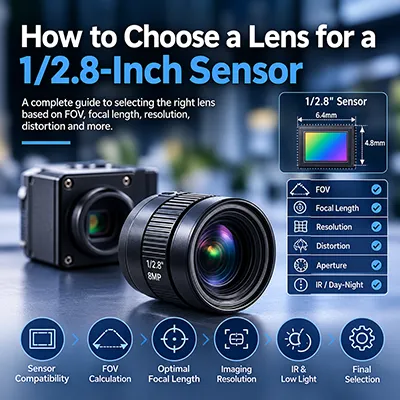



How to Choose a Lens for a 1/2.8-Inch Sensor
10/06/2026
Choosing the right lens for a 1/1.8-inch sensor involves more than matching the sensor format. Engineers must also consider image circle coverage, lens mount, focal length, field of view (FOV), working distance, resolution, and optical distortion. The wrong lens can produce dark image corners, insufficient detail, or inaccurate measurements, even when the camera itself has a high-resolution sensor.
This guide explains how to choose a lens for a 1/1.8-inch sensor using a practical, step-by-step process. You will learn how to compare M12 and C-Mount lenses, calculate focal length, evaluate resolution and distortion, and narrow down suitable products for machine vision, industrial inspection, robotics, and surveillance applications.
Quick Answer: How to Choose a Lens for a 1/1.8-Inch Sensor
To select a compatible lens for a 1/1.8-inch sensor, follow these essential checks:
- Confirm image circle coverage: The lens must cover the sensor’s active imaging area to avoid vignetting and incomplete image coverage.
- Check the lens mount: Verify mechanical compatibility, flange distance or back-focus requirements, and available installation space.
- Calculate focal length: Use the required field of view, working distance, and actual sensor dimensions to estimate the appropriate focal length.
- Match resolution: Evaluate the lens’s resolving performance against the camera’s resolution and pixel size.
- Evaluate optical quality: Consider distortion, edge sharpness, aperture, illumination, and working conditions.
- Choose for the application: Prioritize the parameters that matter most for inspection, measurement, robotics, or monitoring.
For a broader overview of industrial lens selection, see the TOWIN Machine Vision Lens Selection Guide.
1. Understand the Requirements of a 1/1.8-Inch Sensor
What Does a 1/1.8-Inch Sensor Mean?
A 1/1.8-inch sensor is a common format in industrial imaging, machine vision, and network camera systems. However, the format designation is not the sensor’s literal physical diagonal measurement. Before selecting a lens, check the camera manufacturer’s datasheet for the sensor’s actual active width, height, pixel size, and resolution.
These details affect image coverage, field of view, and the optical performance required from the lens. Two cameras with the same nominal sensor format may also have different resolution and pixel-pitch requirements.
For more background, read the TOWIN Sensor Guide, which explains sensor format, pixel size, resolution, and lens compatibility.
Why Image Circle Compatibility Matters
Every lens projects an image circle onto the image plane. The active sensor area must fit within the usable image circle of the lens. If the lens does not cover the sensor adequately, the image may show dark corners, reduced edge illumination, or incomplete coverage.
For a 1/1.8-inch sensor, do not rely only on the lens category name. Check the specified image format or image-circle diameter in the actual product datasheet. Also consider whether the lens maintains sufficient sharpness and illumination near the corners.
Sensor compatibility is the first screening step, but it does not guarantee that a lens will meet the application’s resolution, field-of-view, or measurement requirements.
2. M12 vs. C-Mount: Which Lens Type Should You Choose?
M12 and C-Mount lenses can both be relevant to industrial imaging, but they serve different mechanical and optical design requirements. The correct choice depends on the camera interface, available space, required image quality, and application.
| Selection Factor | M12 / S-Mount Lens | C-Mount Lens |
|---|---|---|
| Design priority | Compact size and lightweight integration | Industrial camera integration and a broad range of optical configurations |
| Mechanical check | Thread compatibility, lens holder, focus adjustment, and clearance | C-Mount interface, flange distance, back focus, and clearance |
| Optical check | Image circle, resolution, distortion, and edge performance | Image circle, resolution, distortion, and edge performance |
| Typical design consideration | Space-constrained embedded vision systems | Industrial inspection and applications requiring flexible optical configurations |
Neither mount is automatically better for every 1/1.8-inch sensor. The specific lens model must satisfy the camera’s mechanical interface and optical requirements.
Explore the available TOWIN M12 lenses and TOWIN C-Mount lenses to compare lens formats and product options.
3. Compare the Key Lens Parameters
Focal Length, Field of View, and Working Distance
Focal length determines the angular coverage of a lens in combination with the sensor dimensions. Working distance describes the distance between the lens and the object, while field of view (FOV) describes the physical area captured by the camera.
For a fixed sensor and working distance, a shorter focal length generally captures a wider area, while a longer focal length captures a narrower area. The correct choice depends on the target size and the amount of detail required.
| Imaging Requirement | What to Evaluate | Selection Priority |
|---|---|---|
| Capture a large area | Required FOV and lens coverage | Wide enough coverage without unacceptable distortion |
| Inspect small details | Object size, working distance, and image sampling | Suitable magnification and resolving performance |
| Image objects at a long distance | Working distance, target dimensions, and installation limits | Appropriate focal length and focusing range |
| Measure object dimensions | FOV, distortion, edge sharpness, and calibration | Geometric accuracy across the required image area |
For an initial estimate under conventional imaging conditions, focal length can be approximated using:
Focal length ≈ Sensor dimension × Working distance ÷ Field-of-view dimension
Use consistent units for all dimensions. This relationship is a preliminary estimate, not a substitute for the lens’s optical specifications. Actual results can vary with focusing distance, lens design, and distortion.
Use the TOWIN FOV Calculator to estimate the required field of view, or try the Focal Length Calculator to narrow down candidate focal lengths.
Resolution and Pixel Size
Camera megapixel count and lens resolving performance are related but different specifications. A 5MP, 8MP, or 12MP camera describes the camera’s image sampling capability; it does not by itself establish the detail that the complete optical system can resolve.
When selecting a lens for a 1/1.8-inch sensor, consider:
- Camera resolution: Identify the sensor’s actual pixel count and image dimensions.
- Pixel size: Smaller pixels place greater demands on optical performance if fine detail must be resolved.
- Lens resolution: Check the manufacturer’s supported resolution and, where available, MTF data.
- Field performance: Review image quality across the sensor, not only at the center.
- Operating conditions: Aperture, focus, illumination, vibration, and exposure time can all affect captured detail.
Do not select a lens solely by matching the megapixel label to the camera. The lens must deliver suitable image quality at the working aperture, focus distance, and field position used in the application.
Learn more about optical performance in the TOWIN Optical Design Guide.
Distortion and Edge Image Quality
Lens distortion changes the geometric position of image points. It is particularly important in dimensional measurement, object positioning, alignment, and machine vision applications that rely on image coordinates.
A wide-angle lens may capture more of the scene but can require greater attention to distortion and edge performance. A low-distortion lens can be a better candidate for precision inspection, although the complete system must still be calibrated and validated.
When comparing lenses, check how distortion is specified, whether the figure refers to TV distortion or another measurement method, and whether the product’s optical performance meets the required tolerance.
Read the Lens Distortion Guide for a more detailed explanation, or browse the TOWIN Low Distortion Lens category for relevant product options.
Aperture, Depth of Field, and Lighting
Aperture controls the amount of light entering the lens and influences depth of field and optical performance. A lower F-number generally allows more light to reach the sensor, which can help in low-light conditions. However, the most suitable aperture also depends on the required depth of field, exposure time, illumination, and lens characteristics.
For objects with different heights or varying positions, depth of field may be as important as nominal resolution. For fast-moving objects, exposure time and lighting can be critical to avoiding motion blur.
Before choosing a lens, establish the expected lighting conditions, object distance range, and whether the system operates under visible light, near-infrared illumination, or both.
4. Real Product Comparison: Lenses for a 1/1.8-Inch Sensor
Once the sensor format and main imaging requirements are clear, comparing actual product specifications helps narrow the selection. The following TOWIN products illustrate how focal length, field of view, resolution, and distortion differ across lens designs.
| Model | Focal Length | Resolution | Horizontal FOV | Max. Distortion | Key Consideration |
|---|---|---|---|---|---|
| C0411820M5 | 4.0 mm | 5MP | 83° | 0.5% | Wide-angle coverage |
| C0611820M5 | 6 mm | 5MP | 60° | 0.1% | Balance between coverage and low distortion |
| C0811820M5 | 8 mm | 5MP | 47° | 0.1% | Narrower coverage with low distortion |
| C105011820M8 | 12–50 mm | 8MP | 38°–9° | 1.5% | Adjustable field of view |
Note: Product specifications are provided for initial comparison. Confirm the current product datasheet, distortion definition, field-of-view conditions, and mechanical requirements before final selection.
How Should You Interpret These Specifications?
- For wide coverage: The 4 mm example provides a wider horizontal field of view than the 6 mm and 8 mm examples. Verify that its distortion and edge performance are acceptable for the application.
- For low-distortion imaging: The 6 mm and 8 mm examples specify 0.1% maximum distortion. The better choice depends on the required coverage and object distance.
- For variable framing: A 12–50 mm zoom lens allows the field of view to be adjusted, but its resolution, distortion, focusing range, and operating mechanism must suit the intended use.
- For higher-resolution imaging: The 8MP zoom example may be worth evaluating when its focal-length range and optical performance meet the system requirements. Do not assume that the higher megapixel rating alone makes it the best option.
Browse the complete 1/1.8-inch 5MP Recognition Lens category to compare additional models designed for this sensor format.
5. A Step-by-Step Lens Selection Guide
Step 1: Confirm the Camera Specifications
Record the sensor format, actual sensor dimensions, resolution, pixel size, camera mount, and any restrictions on lens diameter or length. These details establish the basic compatibility requirements.
Step 2: Define the Required Field of View
Determine the width and height of the object area that must appear in the image. Include any margin required for object movement, alignment, or inspection tolerances.
Step 3: Measure the Working Distance
Identify the distance between the lens and the object, including any limitations imposed by the machine structure, enclosure, or safety requirements. A fixed working distance makes it easier to estimate the necessary focal length.
Step 4: Estimate the Focal Length
Use the sensor’s actual dimensions, target coverage, and working distance to estimate a focal length. Compare that estimate with the available lens specifications and calculate the expected field of view for each candidate.
Step 5: Match Resolution and Optical Performance
Check resolution, MTF data where available, distortion, edge sharpness, aperture, and depth of field. For measurement or inspection, establish measurable acceptance criteria instead of relying on general terms such as high resolution or low distortion.
Step 6: Verify Mechanical and Environmental Compatibility
Confirm the mount, back focus, available installation space, focus adjustment, and any filter or illumination requirements. If the camera operates in a demanding environment, verify the lens’s specified operating conditions and protection requirements.
Step 7: Test the Candidate Lens
Before finalizing a production system, test the candidate lens with the actual camera, working distance, illumination, and target. Evaluate image coverage, focus across the field, distortion, and repeatability under representative operating conditions.
This workflow follows the general approach in the TOWIN Lens Selection Guide. You can also use the FOV Calculator during the initial design stage.
6. Lens Recommendations by Application
Machine Vision Inspection
Machine vision inspection often requires reliable detail recognition and consistent image quality across the field. Evaluate resolution, edge sharpness, distortion, working distance, and illumination together. For dimensional measurement, low distortion and system calibration are particularly important.
Explore TOWIN’s Machine Vision solutions for more information about industrial imaging applications.
Robotics Vision
Robotics applications may prioritize compact integration, sufficient scene coverage, object localization, and stable imaging during operation. The best lens depends on the camera position, object distance, required accuracy, and available installation space.
See the Robotics Vision solutions page for related application information.
Security and Traffic Monitoring
For monitoring applications, evaluate the required coverage, target distance, illumination changes, and whether a fixed or variable focal length is more suitable. If day-and-night operation is required, confirm spectral compatibility with the camera and illumination system.
Learn more about Smart Security and Smart Traffic applications.
Precision Measurement
Measurement systems need more than a compatible sensor format. Lens distortion, focus consistency, optical resolution, camera calibration, and the measurement algorithm all contribute to the final result. Define the acceptable measurement error first, then evaluate whether a low-distortion lens or a specialized optical design is necessary.
For additional technical context, refer to the TOWIN Lens Distortion Guide.
7. Common Mistakes to Avoid
- Choosing by sensor format alone: A 1/1.8-inch designation does not confirm mount compatibility, resolution, or edge performance.
- Choosing focal length without calculating FOV: A lens may fit the camera but fail to capture the required object area.
- Relying only on megapixel labels: The complete imaging system’s performance depends on the sensor, lens, focus, lighting, and operating conditions.
- Ignoring distortion: Geometric distortion can affect measurement and positioning even when an image looks sharp.
- Checking only the image center: The lens should provide acceptable coverage and image quality across the area used by the application.
- Skipping system-level testing: A datasheet cannot replace validation with the actual camera, working distance, target, and illumination.
8. Frequently Asked Questions
Q1: How do I choose a lens for a 1/1.8-inch sensor?
A: Start by confirming image circle coverage and mount compatibility. Then define the field of view and working distance, estimate focal length, and evaluate resolution, distortion, aperture, and edge performance according to the application.
Q2: Can a 1/1.8-inch sensor use an M12 lens?
A: It can if the specific M12 lens provides sufficient image circle coverage and meets the camera’s mechanical and optical requirements. Do not assume every M12 lens covers a 1/1.8-inch sensor; verify the individual product specifications.
Q3: Is a C-Mount lens better than an M12 lens for a 1/1.8-inch sensor?
A: Not in every situation. C-Mount and M12 lenses have different mechanical and design characteristics. Select the mount that fits the camera and installation space, then compare image circle, resolution, focal length, distortion, and application requirements.
Q4: What focal length is suitable for a 1/1.8-inch sensor?
A: There is no single focal length for every 1/1.8-inch sensor application. The appropriate focal length depends on the sensor’s actual dimensions, the required field of view, and the working distance. Use a FOV or focal-length calculator to estimate a starting point.
Q5: Does a 1/1.8-inch sensor require a 5MP or 8MP lens?
A: The sensor format alone does not determine the required resolution. Consider the camera’s pixel count and pixel size, the smallest detail that must be resolved, and the lens’s optical performance. Verify the manufacturer’s specifications and test the complete system when image detail is critical.
Q6: How can I calculate the field of view?
A: You need the sensor’s active dimensions, focal length, and working distance. The exact relationship depends on the optical system and focus distance. Start with the TOWIN FOV Calculator and verify the result against the lens datasheet or a practical test.
Q7: When should I choose a low-distortion lens?
A: Consider a low-distortion lens when geometric accuracy is important, such as in dimensional measurement, alignment, positioning, or precision inspection. The acceptable distortion level depends on the required accuracy and the calibration method; there is no single threshold for every application.
Q8: What information should I provide when requesting a lens recommendation?
A: Provide the camera model or sensor specifications, mount type, required field of view, working distance, target dimensions, resolution requirements, lighting conditions, operating environment, and application. These details help narrow down suitable lens candidates more efficiently.
For application-specific assistance, contact the TOWIN team with your camera and imaging requirements.
Conclusion: Choose the Right Lens for Your 1/1.8-Inch Sensor
Choosing the right lens requires more than matching the nominal sensor format. You must verify image circle coverage and mechanical compatibility, calculate the required field of view, and match focal length, resolution, distortion, aperture, and optical performance to the application.
Understanding how to choose a lens for a 1/1.8-inch sensor helps engineers compare suitable candidates systematically instead of selecting a lens based on a single specification. Start with the camera datasheet, use the required field of view and working distance to narrow the focal length, and validate the final candidate under real operating conditions.
Explore the TOWIN 1/1.8-inch lens selection to compare available models, or contact TOWIN to discuss a lens solution for your machine vision or industrial imaging application.