



What Is a Robotics Vision Lens?
06/06/2026
How Sensor Size Affects Field of View
06/08/2026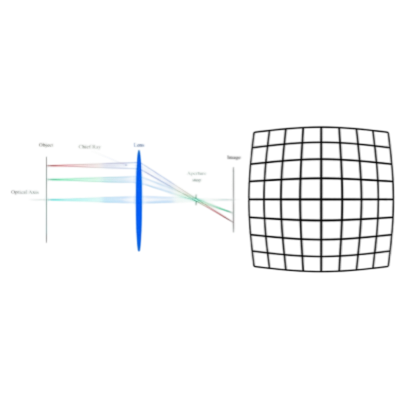
Optical Distortion is one of the most important optical considerations in modern endoscope systems. Whether used in gastrointestinal examinations, minimally invasive surgery, bronchoscopy, or arthroscopy, endoscopes rely on highly specialized lens systems to deliver clear and accurate images from inside the human body.
The quality of an endoscope image depends heavily on lens design. Factors such as resolution, field of view, illumination, color reproduction, and distortion control directly affect diagnostic accuracy and clinical outcomes.
As medical imaging technology continues to advance toward HD, 4K, and AI-assisted diagnostics, selecting the right optical lens system has become increasingly important.
For manufacturers and system integrators developing advanced healthcare devices, understanding the different lens types used in endoscope systems is essential.
What Is an Endoscope Lens?
An endoscope lens is a precision optical component designed to capture, transmit, and focus light from internal body structures onto an image sensor or viewing system.
Unlike conventional camera lenses, endoscope lenses must operate within extremely compact mechanical constraints while maintaining excellent image quality.
Modern endoscope systems are widely used in:
- Gastrointestinal endoscopy
- Bronchoscopy
- Laparoscopy
- Arthroscopy
- ENT procedures
- Urology
- Capsule endoscopy
To achieve reliable imaging performance, endoscope optics must provide:
- High resolution
- Wide field of view
- Low distortion
- High contrast
- Excellent color fidelity
- Compact dimensions
For a broader overview of healthcare imaging technologies, visit our Medical Imaging Solutions page.
How Does an Endoscope Lens System Work?
An endoscope optical system typically consists of multiple lens groups working together.
Optical Structure
Object Tissue
↓
Objective Lens
↓
Relay Lens System
↓
Image Sensor Interface
↓
CMOS Sensor
↓
Display System
Each optical component serves a specific function.
Objective Lens
The objective lens captures light reflected from tissues and organs.
Its primary responsibilities include:
- Forming the initial image
- Providing the required field of view
- Maintaining image sharpness
- Minimizing aberrations
Wide-angle objective lenses are commonly used to maximize surgical visibility.
Relay Lens
Relay lenses transmit the optical image through the endoscope tube.
Key characteristics include:
- Long-distance image transmission
- High optical efficiency
- Compact design
- Stable image quality
Relay lenses are especially common in rigid endoscopes.
Image Sensor Interface Lens
This lens group projects the optical image onto the CMOS sensor.
Important requirements include:
- Sensor compatibility
- High MTF performance
- Low vignetting
- Accurate image scaling
Learn more about sensor compatibility in our Image Sensor Guide.
Types of Lenses Used in Endoscope Systems
Several specialized lens technologies are commonly used in medical endoscopy.
Objective Lenses
Objective lenses are responsible for image acquisition.
Advantages:
- High resolution
- Wide viewing angle
- Short working distance
- Low distortion
Common applications:
- Gastroscopes
- Colonoscopes
- Laparoscopes
Relay Lenses
Relay lenses transfer images along the optical path.
Advantages:
- Efficient image transmission
- Reduced image degradation
- Compact packaging
Applications:
- Rigid endoscopy systems
- Surgical visualization devices
GRIN Lenses (Gradient Index Lenses)
GRIN lenses use a refractive index gradient rather than traditional curved surfaces.
Advantages:
- Ultra-compact size
- Lightweight construction
- Excellent transmission efficiency
Applications:
- Miniature endoscopes
- Disposable medical devices
- Micro-imaging systems
Wide-Angle Lenses
Wide-angle optics improve visibility inside confined anatomical spaces.
Benefits:
- Larger field of view
- Better navigation
- Enhanced procedural awareness
To understand field-of-view calculations, visit our FOV Calculator.
High-Resolution Imaging Lenses
Modern HD and 4K endoscopes require advanced imaging optics.
Benefits include:
- Improved tissue visualization
- Enhanced diagnostic confidence
- Better image detail
Key Lens Parameters for Endoscope Imaging
Selecting an endoscope lens requires careful evaluation of multiple optical parameters.
| Parameter | Importance |
|---|---|
| Resolution | Determines image detail |
| Focal Length | Controls magnification |
| Field of View | Defines visible area |
| Distortion | Affects image accuracy |
| MTF | Measures image sharpness |
| Relative Illumination | Controls edge brightness |
| Lens Diameter | Impacts device size |
Resolution
Higher resolution enables physicians to identify fine anatomical structures and abnormalities.
Focal Length
Short focal lengths are commonly used to achieve wider viewing angles within confined spaces.
Field of View (FOV)
The field of view determines how much anatomy can be observed in a single image.
For more information, see our Lens Selection Guide.
Distortion Control
At this stage of the imaging chain, Optical Distortion becomes critically important.
Excessive barrel distortion or pincushion distortion can alter anatomical appearance and affect measurement accuracy.
Modern medical optics therefore prioritize:
- Low distortion design
- Geometric accuracy
- Consistent image representation
For a detailed explanation, visit our Distortion Guide.
MTF Performance
Modulation Transfer Function (MTF) measures how effectively a lens reproduces image detail.
Higher MTF values generally indicate:
- Better contrast
- Improved sharpness
- Higher imaging quality
Learn more about lens engineering in our Optical Design Guide.
Endoscope Lens Selection Guide
Step 1: Define the Medical Application
Different procedures require different optical characteristics.
Examples:
- Gastroenterology
- Urology
- Arthroscopy
- ENT
- Laparoscopy
Step 2: Determine Required Field of View
Consider whether the application prioritizes:
- Wide-area observation
- High magnification
- Precision inspection
Step 3: Match the Image Sensor
Lens performance must align with sensor specifications.
Consider:
- Sensor size
- Pixel size
- Resolution
- Sensor format
Step 4: Evaluate Image Quality Requirements
Review:
- Resolution
- Contrast
- Distortion
- Color fidelity
- Low-light performance
Step 5: Verify Mechanical Constraints
Check:
- Lens diameter
- Housing dimensions
- Working distance
- Integration requirements
Challenges in Endoscope Lens Design
Developing endoscope optics presents several engineering challenges.
Miniaturization
Medical devices continue to become smaller while maintaining higher image quality.
Low-Light Imaging
Internal anatomical environments often provide limited illumination.
Distortion Suppression
Controlling geometric errors is essential for clinical accuracy.
Advanced optical design techniques help minimize image deformation while preserving image sharpness.
Sterilization Resistance
Optical components for medical use need to endure repeated sterilization cycles while maintaining stable performance.
Medical Imaging Lens Solutions
Medical imaging applications demand precision optics capable of delivering reliable performance under strict clinical requirements.
Towin supports healthcare imaging applications through:
- High-resolution optical design
- Low-distortion lens development
- Compact lens architecture
- Sensor matching support
- Customized optical solutions
Explore our Medical Imaging Solutions to learn more about healthcare-focused optical technologies.
Frequently Asked Questions
Q: What lens is used in an endoscope?
A: Most endoscope systems use a combination of objective lenses, relay lenses, and sensor interface optics to capture and transmit images.
Q: Why are GRIN lenses used in endoscopes?
A: GRIN lenses provide excellent optical performance in extremely compact packages, making them ideal for miniature medical devices.
Q: What focal length is commonly used in endoscopes?
A: Most endoscopes use relatively short focal lengths to achieve wide viewing angles.
Q: Why is distortion control important in medical imaging?
A: Distortion can alter image geometry and affect diagnostic interpretation. Low-distortion optics improve image accuracy.
Q: Can endoscope lenses support 4K imaging?
A: Yes. Modern endoscope systems increasingly use HD and 4K sensors paired with high-performance imaging optics.
Conclusion
Endoscope systems rely on a combination of objective lenses, relay lenses, GRIN lenses, and sensor interface optics to achieve accurate medical imaging. Selecting the appropriate lens requires careful consideration of resolution, field of view, sensor compatibility, image quality, and mechanical constraints.
As healthcare imaging technology advances toward higher resolutions and AI-assisted diagnostics, lens performance becomes increasingly critical. Among all optical considerations, Optical Distortion remains one of the most important factors influencing image accuracy, diagnostic confidence, and overall medical imaging quality.
.png)