


What Lenses Are Used in Endoscope Systems?
06/05/2026
What Is Optical Distortion in Industrial Lenses?
06/07/2026
A Robotics Vision Lens is a specialized industrial optical lens designed to help robots perceive, analyze, and interact with their environment. In modern automation systems, the lens serves as the critical optical interface between the physical world and the camera sensor, directly affecting image quality, positioning accuracy, object recognition performance, and overall robotic efficiency.
From robotic arms and pick-and-place systems to AGVs, AMRs, and AI-powered inspection robots, selecting the right Robotics Vision Lens is essential for achieving reliable and repeatable machine vision performance. To better understand how vision technology supports industrial automation, explore our Robotics Vision Solutions.
What Is a Robotics Vision Lens?
A Robotics Vision Lens is an optical component specifically engineered for robotic vision applications. It collects and focuses light onto an image sensor, enabling robots to capture accurate visual information for navigation, guidance, inspection, measurement, and decision-making.
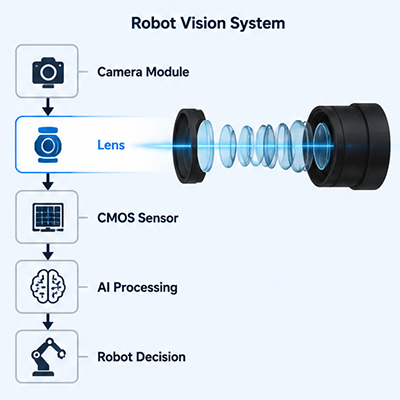
A typical robotic vision system consists of:
- Vision Lens
- Industrial Camera
- Image Sensor
- Image Processing Software
- AI or Robot Controller
The quality of the captured image depends heavily on the lens. Even the most advanced camera sensor cannot compensate for poor optical performance, making lens selection a critical part of robotic system design.
How Does a Robotics Vision Lens Work?
The working principle of a robotic vision system is straightforward:
Step 1: Light Enters the Lens
Light reflected from an object enters the optical system.
Step 2: The Lens Focuses the Image
Multiple optical elements precisely focus incoming light to create a clear image.
Step 3: Image Reaches the Sensor
The focused image is projected onto the camera sensor. If you are unfamiliar with sensor formats and compatibility requirements, refer to our Sensor Guide.
Step 4: Software Processes Visual Data
Machine vision algorithms analyze shapes, positions, patterns, codes, or defects.
Step 5: Robot Executes an Action
- Object detection
- Pick-and-place operations
- Path planning
- Obstacle avoidance
- Barcode reading
- Quality inspection
Without a properly selected lens, robotic accuracy and repeatability can be significantly reduced.
Why Lens Selection Matters in Robotics Vision
Positioning Accuracy
Robots often operate with millimeter-level precision. Optical distortion or insufficient resolution can introduce positioning errors.
AI Recognition Performance
Artificial intelligence systems rely on high-quality visual input. Clear images improve detection and classification accuracy.
Navigation Reliability
AGVs and AMRs depend on accurate visual data for localization, mapping, and obstacle avoidance.
Production Efficiency
Higher imaging quality reduces errors, downtime, and rework, improving overall productivity.
Key Specifications of a Robotics Vision Lens
Focal Length
F.l. determines image magnification and field of view.
| Focal Length | Typical Application |
|---|---|
| 4–8 mm | Mobile robots and navigation |
| 12–25 mm | General robotics vision |
| 35–50 mm | Long-distance inspection |
Short focal lengths provide wider coverage, while longer focal lengths offer greater magnification. For a deeper understanding of focal length selection, read our Lens Selection Guide.
Field of View (FOV)
Field of view defines the observable area captured by the camera.
A wider FOV is often preferred for mobile robots, AGVs, and warehouse automation systems. A narrower FOV is suitable for precision inspection and robotic guidance. You can calculate the appropriate viewing area using our FOV Calculator.
Sensor Compatibility
The lens image circle must adequately cover the camera sensor.
| Sensor Format |
|---|
| 1/2.5″ |
| 1/1.8″ |
| 2/3″ |
| 1″ |
Matching lens and sensor formats ensures optimal image quality. New users can learn the basics from our Sensor Guide.
Resolution
As robotic vision systems increasingly adopt 5MP, 8MP, 12MP, and higher-resolution cameras, lenses must provide sufficient resolving power to support sensor performance.
Distortion
Distortion affects measurement accuracy and object positioning.
- Barrel distortion
- Pincushion distortion
- Mustache distortion
For robotic guidance and metrology applications, low-distortion lenses are highly recommended. Learn more in our comprehensive Distortion Guide.
Working Distance
Working distance refers to the distance between the lens and the target object.
| Application | Typical Distance |
|---|---|
| Pick-and-Place | 100–500 mm |
| Robot Guidance | 500–1500 mm |
| Navigation | 1–20 m |
Selecting the correct focal length and working distance combination is critical for achieving the desired field of view.
Types of Robotics Vision Lenses
FA lenses are commonly used in factory automation and industrial robot guidance systems because they provide excellent image quality and industrial-grade durability.
These lenses minimize geometric distortion and are ideal for robotic positioning, calibration systems, and precision measurement.
Wide-angle lenses provide large fields of view for AGVs, AMRs, warehouse robots, and SLAM applications.
Telecentric Lens
Telecentric optics maintain consistent magnification across varying object distances and are widely used in high-precision measurement systems.
How to Choose the Right Robotics Vision Lens
1. Define the Application
Determine whether the system is used for navigation, guidance, inspection, or measurement.
2. Select Camera Sensor Size
Choose a lens compatible with the intended sensor format. Our Sensor Guide explains common sensor sizes and compatibility requirements.
3. Calculate Required FOV
Determine the area that must be captured by the vision system. Use our FOV Calculator to simplify the calculation process.
4. Choose the Appropriate Focal Length
The focal length should provide the desired field of view at the specified working distance. Our Lens Selection Guide can help you determine the best option.
5. Verify Lens Resolution
Ensure the lens can support the sensor’s pixel density and imaging requirements.
6. Evaluate Distortion Requirements
Applications involving measurement or positioning often require low-distortion optics. Read our Distortion Guide to understand distortion performance and selection criteria.
7. Validate Under Real Conditions
Test the system under actual lighting and environmental conditions before deployment.
Common Robotics Vision Applications
Robot Guidance
Vision-guided robots use optical systems to identify object positions and improve motion accuracy.
Pick-and-Place Automation
High-speed robotic arms depend on reliable imaging for accurate object handling.
AGVs and AMRs
Autonomous vehicles require wide-angle vision systems for navigation and obstacle avoidance.
AI Inspection Robots
Automated inspection systems use machine vision to identify defects and maintain product quality.
Collaborative Robots
Cobots use vision systems to safely interact with humans and dynamic environments.
At the core of all these applications is a properly selected Robotics Vision Lens that delivers accurate and repeatable visual information.
Frequently Asked Questions
Q: What is the difference between a Robotics Vision Lens and a standard camera lens?
A: A Robotics Vision Lens is designed for industrial environments and emphasizes accuracy, durability, low distortion, and compatibility with machine vision systems.
Q: Do robotic vision systems require low-distortion lenses?
A: For positioning, calibration, and measurement tasks, low-distortion lenses are strongly recommended.
Q: How do I choose the correct focal length?
A: Focal length should be selected based on sensor size, field of view, and working distance requirements.
Q: Are high-resolution lenses necessary?
A: As camera resolutions continue to increase, higher-resolution lenses help maximize system performance.
Q: Which lens is best for AGVs and AMRs?
A: Wide-angle, low-distortion lenses are commonly used for autonomous navigation applications.
Q: Can one lens support multiple robotic applications?
A: In some cases, yes. However, application-specific optimization typically provides the best performance.
Conclusion
Robotic vision systems depend on accurate optical imaging to guide decisions, movements, and automation processes. Factors such as focal length, field of view, resolution, sensor compatibility, working distance, and distortion all play important roles in system performance.
Whether you are developing a robotic arm, autonomous mobile robot, AGV, inspection platform, or AI-driven automation solution, selecting the appropriate Robotics Vision Lens can significantly improve accuracy, reliability, and operational efficiency.
To learn more about industrial imaging solutions and lens options for automation projects, visit our Robotics Vision Solutions page and discover how the right Robotics Vision Lens can enhance your robotic system performance.