

Little siblings: s-Mount lenses as replacement for c-mount lenses
07/10/2013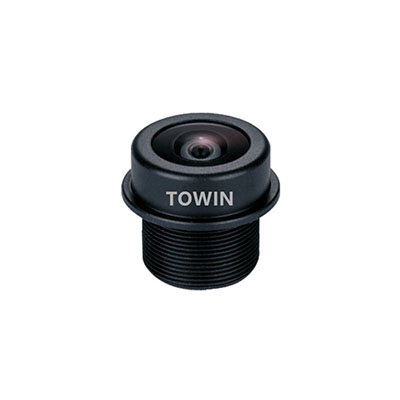
An S-Mount lens is a compact lens commonly used in embedded cameras, board cameras, robotics, automotive imaging, and smart security devices. Many S-Mount lenses use an M12×0.5 threaded interface, which is why they are also commonly called M12 lenses.
Compared with C-Mount lenses, S-Mount lenses are generally designed for more compact mechanical integration. However, selecting the correct lens requires more than checking the thread diameter. Sensor compatibility, image circle, focal length, working distance, and optical performance must also be evaluated.
This guide explains S-Mount lens specifications, M12×0.5 mounting, camera compatibility, and the main differences between S-Mount and C-Mount systems.
S-Mount Lens: Quick Overview
- Many S-Mount lenses use an M12×0.5 threaded interface.
- The compact mount is suitable for small camera modules and embedded vision products.
- Lens compatibility depends on thread dimensions, mounting geometry, image circle, and focus range.
- S-Mount and C-Mount are different mechanical interfaces and are not directly interchangeable.
1. What Is an S-Mount Lens?
An S-Mount lens is a compact optical assembly designed for a threaded mounting interface commonly used in board cameras and embedded imaging modules. The M12×0.5 specification refers to a nominal 12 mm thread diameter and a 0.5 mm thread pitch.
S-Mount lenses are available in different optical configurations, including wide-angle, fisheye, low-distortion, pinhole, and infrared-corrected designs. Their suitability depends on the sensor format, field of view, working distance, and application.
Explore the TOWIN S-Mount / M12 lens product range for available optical categories.
2. Understanding the M12×0.5 Thread Specification
The M12×0.5 designation describes the mechanical thread used by many S-Mount lenses:
- M12: Nominal thread diameter of 12 mm.
- 0.5: Thread pitch of 0.5 mm.
- Threaded installation: The lens is screwed into a compatible camera holder or lens barrel.
However, matching the thread does not automatically guarantee complete optical compatibility. The lens holder, available adjustment range, sensor position, focus locking method, and mechanical clearance must also be checked.
3. S-Mount Lens Structure and Installation
An S-Mount lens is typically installed by threading the lens barrel into a compatible camera holder. Focus is commonly adjusted by rotating the lens relative to the sensor assembly, although the adjustment and locking mechanisms vary by product.
During installation, consider:
- Thread engagement and mounting depth.
- Lens-to-sensor distance and available focus range.
- Alignment between the optical axis and sensor center.
- Mechanical locking and vibration resistance.
- Clearance between the lens barrel and camera enclosure.
For OEM projects, evaluate the mechanical holder and lens assembly together instead of treating the lens as an isolated component.
4. S-Mount vs C-Mount: Key Differences
S-Mount and C-Mount are two different lens mounting interfaces. Their main differences are thread specifications, mechanical dimensions, flange geometry, and typical system integration.
| Feature | S-Mount / M12 | C-Mount |
|---|---|---|
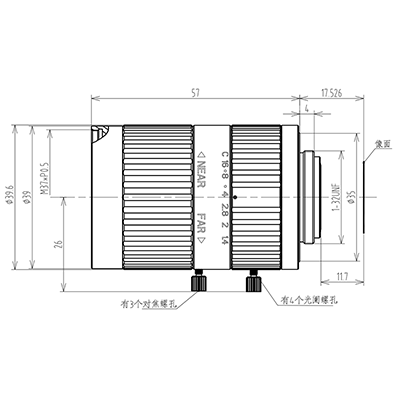
| Thread | M12×0.5 | 1″-32 UN |
| Nominal thread diameter | 12 mm | 25.4 mm |
| Flange focal distance | Not one universal standardized value for all lens assemblies | 17.526 mm nominal |
| Mechanical design | Compact threaded lens barrel | Industrial threaded mount |
| Typical integration | Board cameras and embedded modules | Industrial cameras and inspection systems |
| Focus adjustment | Often by lens rotation | Often by focus ring or adjustment mechanism |
| Optical performance | Depends on individual lens design | Depends on individual lens design |
For a broader comparison of these two interfaces, read M12 Lens vs C-Mount Lens for Machine Vision.
5. Sensor Compatibility and Image Circle
The sensor format supported by an S-Mount lens depends on its optical design and specified image circle. Some lenses are designed for smaller image sensors, while other models may support larger formats.
Before purchasing an S-Mount lens, verify:
- Sensor format and active sensor dimensions.
- Lens image circle and corner coverage.
- Sensor pixel size and required resolution.
- Optical performance across the full image field.
- Mechanical clearance and focus adjustment range.
Read the camera sensor guide to understand how sensor size affects lens selection.
6. Common Types of S-Mount Lenses
Wide-Angle S-Mount Lenses
Wide-angle lenses are used when a camera needs to capture a larger scene within a limited working distance. They are common in compact monitoring systems and embedded vision products.
Fisheye S-Mount Lenses
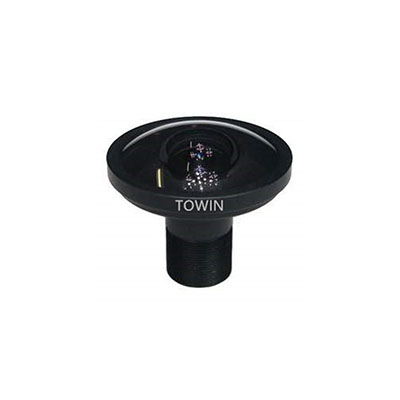
Fisheye lenses provide an ultra-wide field of view with significant geometric distortion. They may be useful for panoramic imaging, surround-view cameras, and specialized monitoring applications.
Low-Distortion S-Mount Lenses
Low-distortion lenses cut geometric distortion and work well for applications that need more accurate object positioning or measurement.
IR-Corrected S-Mount Lenses
IR-corrected lenses are designed to maintain focus performance across specified visible and near-infrared wavelength ranges. Always check the wavelength range and focus-shift specifications for the individual product.
Browse M12 / S-Mount lens categories to compare available optical designs.
7. Typical Applications of S-Mount Lenses
- Embedded vision: Compact cameras integrated into intelligent devices.
- Robotics: Vision modules for navigation, positioning, and object recognition.
- Automotive imaging: Compact camera modules for vehicle-related imaging systems.
- Smart security: Small cameras for monitoring and surveillance.
- Drone imaging: Lightweight optical systems for aerial imaging.
Explore M12 lens applications for more information about compact imaging solutions.
8. How to Choose an S-Mount Lens
- Confirm the thread: Verify M12×0.5 compatibility with the camera holder.
- Check the sensor: Confirm the image circle and sensor format.
- Select focal length: Calculate the required field of view based on object size and working distance.
- Review optical quality: Evaluate resolution, distortion, relative illumination, and aperture.
- Check mechanical requirements: Consider barrel length, focus adjustment, locking, and installation clearance.
For more detailed selection steps, see the industrial lens selection guide.
9. Frequently Asked Questions
1. Is an S-Mount lens the same as an M12 lens?
Many S-Mount lenses use an M12×0.5 threaded interface and are commonly called M12 lenses. Always confirm the exact mechanical specification of the lens and camera holder.
2. What does M12×0.5 mean?
M12 indicates a nominal thread diameter of 12 mm, while 0.5 indicates a thread pitch of 0.5 mm.
3. Is an S-Mount lens compatible with a C-Mount camera?
Not directly. The two mounts have different thread dimensions and mounting geometry. You may need an adapter or custom mechanical assembly, and you must verify optical alignment, focus range, and image coverage.
4. Does every S-Mount lens support a 1/2-inch sensor?
No. Sensor compatibility depends on the lens image circle and optical design. Check the individual product specification before selecting a lens.
5. Can S-Mount lenses be used for industrial machine vision?
Yes. They can be suitable for compact inspection cameras and embedded machine vision systems when the optical and mechanical specifications meet the application requirements.
6. How is an S-Mount lens focused?
Many S-Mount designs use lens rotation to adjust focus by changing the lens position relative to the sensor. The available range and locking mechanism vary by model.
7. Can an S-Mount lens be customized?
We can assess customization for focal length, field of view, distortion, image circle, aperture, optical materials, and mechanical dimensions to match your project requirements.
Conclusion
S-Mount lenses are compact optical solutions commonly using an M12×0.5 threaded interface. They fit many embedded camera and compact imaging applications, as long as users match the lens properly to the camera sensor and mechanical assembly.
When selecting an S-Mount lens, verify thread compatibility, image circle, focal length, focus range, and optical performance. For applications requiring a different industrial mounting configuration, also explore TOWIN C-Mount lenses.
Looking for an M12 / S-Mount Lens?
Share your sensor format, focal length, field of view, and mechanical requirements with TOWIN. We can help evaluate an appropriate lens configuration for your camera project.