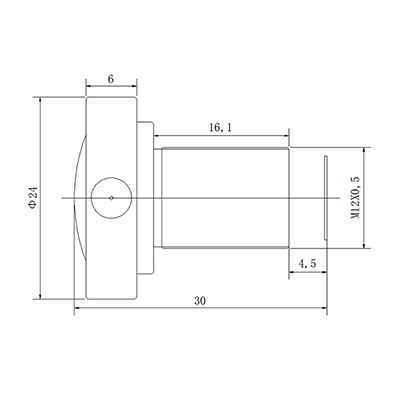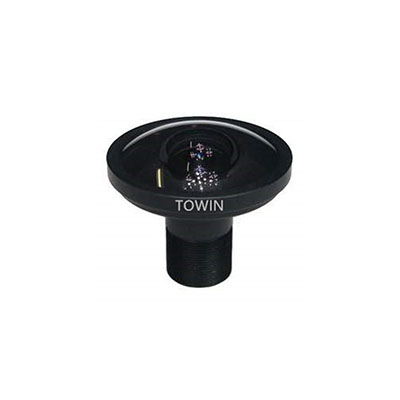



Fisheye Lens with Ergonomic Design
10/11/2025
Sub-millimeter pinhole lens
10/11/2025
A 40mm lens delivers a relatively narrow field of view compared with shorter focal length lenses. In machine vision, it captures small inspection zones or distant targets. Actual coverage depends heavily on sensor size and working distance.
Focal length alone is not enough to select a 40mm industrial lens. Engineers must also match sensor format, FOV, working distance, resolution, distortion, aperture and lens mount.
Quick Answer: What Is a 40mm Lens Good For?
A 40mm lens works best for applications requiring a narrow field of view. Common industrial use cases include fixed-position inspection, close component observation and tasks where the target fills most of the frame. Real performance relies on sensor, working distance and optical design.
1. What Does a 40mm Focal Length Mean?
Focal length (mm) refers to the distance from the lens principal plane to the image plane when focused at infinity. It directly controls viewing angle and magnification.
With identical sensor size and working distance, longer focal lengths produce narrower FOV, while shorter focal lengths capture wider areas. This rule is critical for machine vision system design.
Important optical principle:
40mm focal length does not define a fixed FOV. The actual viewing angle is determined by both focal length and active sensor dimensions.
How Does Focal Length Affect Field of View?
Field of view (FOV) is the physical area visible at a given working distance. For machine vision, horizontal object FOV can be estimated with this simplified formula:
Approximate FOV Formula:
Horizontal Object FOV ≈ (Sensor Width × Working Distance) / Focal Length
This is a thin-lens geometric approximation. Real results shift with optical design, focus, distortion and effective sensor size.
Example: 8mm sensor width, 40mm focal length, 500mm working distance
FOV ≈ (8 × 500) / 40 = 100mm
This simplified model means the camera captures roughly a 100mm wide area. Use our TOWIN FOV Calculator for accurate sizing before lens selection.
2. Industrial Applications for a 40mm Lens
Choose a 40mm lens when you need a tighter FOV than shorter focal lengths offer. It isolates the target and reduces distracting background data. Final suitability depends on target size, installation constraints, sensor and resolution requirements.
2.1 Component Inspection
Electronic and mechanical component inspection often needs high magnification on small features. A 40mm lens frames a compact inspection area. Validate resolution, distortion, depth of field and lighting to guarantee stable defect detection.
2.2 Machine Vision Measurement
Many vision systems measure dimensions, detect edges and confirm part positions. 40mm optics fit certain fixed-distance measurement setups. Still, focal length cannot guarantee accuracy. Distortion, calibration, alignment and optical resolution all matter.
For precision metrology, review low-distortion industrial lenses and check official distortion specs.
2.3 Robotics and Object Positioning
Robotic vision identifies parts and guides picking or movement. A 40mm lens works well when the camera sits far from the target and only a small region needs tracking. Always balance FOV, working distance and depth of field.
Browse TOWIN industrial vision solutions for robotics and automated imaging.
2.4 Target Monitoring & Observation
When you only need to watch a defined region instead of a full scene, a narrow FOV from a 40mm lens helps isolate the target. Match illumination, operating wavelength and environmental conditions for reliable contrast.
3. How Sensor Size Changes 40mm Lens Performance
Sensor size is one of the top matching factors. Two setups with the same 40mm lens can deliver completely different FOV if sensors differ.
With the same focal length and working distance, a larger sensor captures a wider scene — provided the lens image circle fully covers the sensor without vignetting.
| Optical Parameter | Imaging Impact |
|---|---|
| Sensor Size | Defines image area and directly changes FOV. |
| Focal Length | Longer focal length = narrower FOV. |
| Working Distance | Greater distance = larger captured object area. |
| Image Circle | Must fully cover the active sensor area. |
| Resolution | Must resolve the smallest required feature. |
A 40mm lens paired with a 1/1.8” sensor has a different viewing angle versus the same lens on a 1” sensor. Always reference actual sensor dimensions, not just nominal sensor format.
Read our Industrial Camera Sensor Guide to learn sensor formats, pixel size, image circles and lens compatibility.
4. Is a 40mm Lens Automatically Low Distortion?
No. 40mm focal length does not equal low distortion.
Distortion is an optical aberration that bends straight lines in captured images, commonly barrel or pincushion distortion. It comes from optical design, not focal length. Always check manufacturer datasheets.
Why Low Distortion Matters for Machine Vision
Distortion skews shape, position and dimension readings, which breaks measurement and inspection reliability. Low-distortion optics are critical for:
- Dimensional measurement and precision inspection
- PCB and electronic component inspection
- Robot guidance and part positioning
- Geometric verification and automated QC
- Applications requiring consistent image geometry
Match the lens distortion rating to your accuracy tolerance. Never treat a longer focal length as a replacement for validated low-distortion optics.
5. Real Lens Example: TOWIN 8–40mm C-Mount Zoom Lens
This zoom model illustrates how focal length tuning changes FOV in industrial imaging.
TOWIN C084011814A5 – 8–40mm C-Mount Zoom Lens
This 5MP industrial zoom lens supports adjustable focal length from 8mm to 40mm. At its 40mm end, FOV narrows significantly compared to the 8mm setting with the same sensor and working distance.
| Specification | Product Parameters |
|---|---|
| Model | C084011814A5 |
| Focal Length | 8–40mm |
| Sensor Format | 1/1.8″ |
| Resolution | 5MP |
| Field of View | 47°–11° |
| Aperture | F1.4 |
| Distortion | 6.1% |
| Mount | C-Mount |
| Iris | DC Auto Iris |
Note: The 40mm position here is the upper end of a zoom range, not a fixed prime lens. Its 6.1% distortion means it is not suitable for low-distortion measurement work.
This example shows why focal length must be evaluated together with sensor, FOV, aperture, resolution and distortion.
See more zoom options in our C-Mount Vari-Focal and Zoom Lens range.
6. Step-by-Step Guide to Select Industrial Lens Focal Length
Do not pick a focal length by number alone. Follow this workflow to avoid wrong FOV or insufficient detail.
Step 1: Confirm Camera Sensor Size
Get active sensor dimensions and confirm the lens image circle covers the sensor to avoid vignetting.
Step 2: Define Required FOV
Measure the target inspection area, and add margin around the object.
Step 3: Lock Working Distance
Set the distance between lens and object, considering mechanical clearance and mounting limits.
Step 4: Calculate Target Focal Length
Use sensor size, working distance and required FOV to compute the needed focal length and compare against available lenses.
Step 5: Check Resolution and Distortion
Ensure optical resolution resolves your smallest feature. Prioritize distortion specs for measurement tasks.
Step 6: Verify Mount Compatibility
Confirm C-Mount, CS-Mount, M12 or other interface matches your camera. Flange distance directly affects focus performance.
For full guidance, read the TOWIN Industrial Lens Selection Guide.
Engineering Tip
Before choosing a 40mm industrial lens, evaluate sensor size, FOV, working distance, resolution and distortion tolerance as a group.
Start with the FOV Calculation Guide, then run numbers on the FOV Calculator.
7. Why Choose TOWIN for Industrial Lens Solutions?
Vision projects need matched optics, not just a focal length number. TOWIN supplies industrial lenses and OEM/ODM optical support for machine vision, robotics and smart camera systems.
Our lineup includes:
- C-Mount Industrial Lenses for factory automation and machine vision
- Industrial Lens Basics to learn focal length and optical parameters
- Sensor Matching Resources for lens-camera compatibility
- Industrial Vision Solutions for diverse application demands
We can deliver standard lenses or custom optical configurations based on your imaging requirements.
Looking for the Right Industrial Lens?
Run your FOV calculation first, then send us your sensor size, working distance, target FOV and application. TOWIN will recommend suitable lenses or custom optical designs.
Frequently Asked Questions
Q1: What is a 40mm industrial lens used for?
A 40mm lens suits machine vision tasks that need a narrow FOV. Typical jobs include fixed inspection stations and target observation. Sensor size and working distance decide its actual coverage.
Q2: When should I use a 40mm lens for machine vision?
Select it when you need tighter framing than shorter focal lengths. Always validate sensor compatibility, resolution, working distance, distortion and aperture before ordering.
Q3: Does a 40mm lens have low distortion?
Not automatically. Focal length does not control distortion. Distortion performance comes from optical design and must be confirmed on the datasheet.
Q4: How does sensor size affect a 40mm lens?
Sensor size changes FOV. At the same focal length and working distance, a larger sensor captures a wider scene if the lens image circle covers it.
Q5: What is the difference between a 40mm prime and an 8–40mm zoom lens?
A 40mm prime lens has one fixed focal length, usually with better optical consistency. An 8–40mm zoom lens lets you adjust FOV across its range, but often comes with higher distortion and less stability.
Q6: How do I calculate the FOV of a 40mm lens?
FOV depends on sensor dimensions, focal length and working distance. The simplified formula is: Horizontal Object FOV ≈ (Sensor Width × Working Distance) / Focal Length. Use our FOV Calculator for reliable results.
Q7: 40mm vs 25mm lens for industrial inspection: which is better?
Neither is universally better. At identical sensor and WD, 40mm delivers narrower FOV and higher magnification. Pick based on target size, required coverage and camera mounting position.
Q8: What specs do I need to provide for lens selection?
Prepare sensor size, target FOV, working distance, resolution requirement, mount type, aperture range, distortion tolerance and operating environment. Your camera model and part dimensions also help speed up recommendations.
Conclusion
A 40mm lens is valuable when your vision system needs a narrow field of view. But it only works well when matched to the full optical system, not chosen by focal length alone.
For industrial imaging, evaluate sensor size, working distance, FOV, resolution and distortion together. A 40mm lens fits certain inspection and monitoring tasks, while shorter or longer focal lengths may be better for other setups.
Understanding these optical relationships helps you pick stable, reliable machine vision optics. Explore TOWIN’s lens portfolio and technical resources to find your matching optical solution.
Need help selecting an industrial lens? Contact TOWIN with your camera and application requirements.