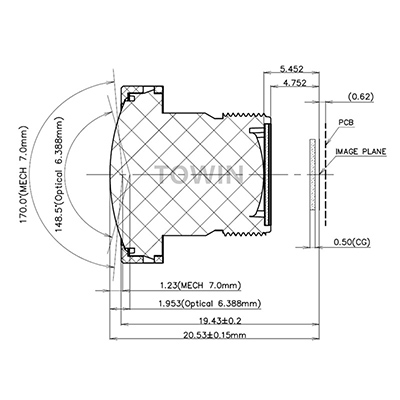



2/3″ 6-15mm C mount IR corrected CCTV lens
09/11/2025
Dustproof pinhole lens
09/12/2025
A machine vision lens is an optical component that captures light from an object and forms an image on a camera sensor for automated inspection, measurement, identification, and positioning. In industrial imaging systems, the lens directly affects image detail, contrast, field of view, and geometric accuracy.
Unlike a lens selected only for general photography, a machine vision lens must meet the optical and mechanical requirements of a specific imaging application. These requirements may include sensor compatibility, resolution, focal length, working distance, distortion, and operating conditions. Understanding these factors helps engineers build reliable machine vision systems for factory automation and quality control.
How Does a Machine Vision Lens Work?
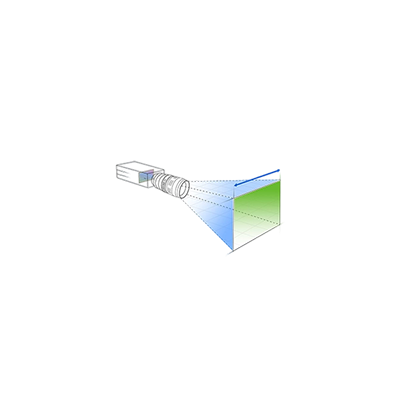
A machine vision lens collects light reflected or transmitted by a target and focuses it onto the image sensor inside an industrial camera. The sensor converts the incoming light into electrical signals, which are processed into a digital image. Machine vision software then analyzes the image to identify defects, measure dimensions, recognize patterns, or guide automated equipment.
The lens, camera sensor, lighting, and image processing system work together. Even a high-resolution camera may produce insufficient detail if the lens cannot resolve the required features or if the lighting creates poor contrast. For this reason, lens performance should be evaluated as part of the complete imaging system.
Key Characteristics of Machine Vision Lenses
1. Focal Length and Field of View
Focal length influences the relationship between sensor size, working distance, and the area captured by the camera. Under comparable imaging conditions, a shorter focal length generally provides a wider field of view, while a longer focal length provides a narrower field of view.
The field of view (FOV) is the width and height of the real-world area visible in an image. Engineers should determine the required inspection area and working distance before selecting a focal length. Use the machine vision FOV calculator to estimate the required field of view and support the initial lens selection process.
For a more detailed explanation, read how to choose the right focal length for machine vision .
2. Sensor Compatibility and Image Circle
A machine vision lens must provide sufficient image coverage for the camera sensor. If the lens image circle is too small, the captured image may show dark corners or vignetting. Sensor format also affects the field of view produced by a particular focal length.
Before selecting a lens, verify the sensor format, active sensor dimensions, lens image circle, mount type, and mechanical compatibility. The guide to machine vision camera sensor formats explains these factors in greater detail.
3. Optical Resolution and MTF
Optical resolution describes a lens’s ability to reproduce fine details. Modulation Transfer Function (MTF) describes how effectively an optical system transfers contrast at different spatial frequencies.
These characteristics are important when a machine vision system must detect small scratches, inspect printed features, read fine markings, or measure small components. Lens performance should be matched to the camera’s pixel size, sensor resolution, target details, and required inspection accuracy. A higher megapixel count alone does not guarantee better usable image detail.
Learn more about MTF and optical performance in machine vision lenses to understand how contrast and resolution affect image quality.
4. Lens Distortion and Measurement Accuracy
Lens distortion causes image points to deviate from their ideal geometric positions. Although some applications can tolerate distortion or correct it through calibration, dimensional measurement and precision positioning often require tighter distortion control.
When evaluating a lens for inspection, consider the permitted measurement error, the target’s position within the image, calibration requirements, and distortion specifications. The appropriate lens depends on the complete application rather than a single specification.
5. Aperture, Depth of Field, and Lighting
The aperture controls how much light passes through the lens. It affects exposure, depth of field, and image quality. A wider aperture can help in low-light conditions, while a smaller aperture may increase depth of field but reduce the amount of light reaching the sensor.
The correct aperture depends on target movement, available lighting, exposure time, required depth of field, and the lens’s optical performance. Proper illumination and exposure settings are also essential for consistent machine vision results.
Machine Vision Lens vs. Standard Camera Lens
Machine vision lenses and standard camera lenses both form optical images, but their suitability depends on the requirements of the imaging system. Industrial applications may place greater emphasis on repeatability, sensor compatibility, dimensional accuracy, and integration with automated inspection equipment.
| Comparison Factor | Machine Vision Lens | Standard Camera Lens |
|---|---|---|
| Primary application | Automated inspection, measurement, and guidance | Photography, video, and general imaging |
| Optical priorities | Application-specific resolution, distortion, and image coverage | Performance optimized for the intended photography or video use |
| System compatibility | Selected according to sensor, mount, working distance, and FOV | Selected according to camera mount, sensor, and intended use |
| Measurement applications | May be designed for controlled geometric accuracy | Suitability depends on optical performance and calibration |
These are general distinctions, not absolute rules. Some standard camera lenses can work in machine vision systems, while some industrial applications require specialized low-distortion or telecentric optics.
Common Industrial Applications of Machine Vision Lenses
Automated Quality Inspection
Machine vision lenses help cameras capture product surfaces, edges, and small features for automated quality inspection. Depending on the application, the system may identify scratches, missing components, surface defects, or assembly errors on a production line.
Precision Measurement
In dimensional inspection, image detail and geometric accuracy are important. Lens selection should consider distortion, working distance, calibration, sensor resolution, and the required measurement tolerance.
Electronics and PCB Inspection
Electronic component inspection often requires clear images of small solder joints, component markings, pins, and circuit features. The lens must provide adequate resolution and image coverage for the camera and inspection task.
Robotics and Automated Positioning
In robotic guidance, machine vision cameras locate objects and provide position information to automated equipment. The lens must capture the target reliably at the required working distance and across the intended field of view.
How to Choose the Right Machine Vision Lens
Choosing the right machine vision lens starts with defining the imaging task rather than selecting a focal length in isolation. Use the following checklist to establish the main requirements.
- Identify the camera sensor. Confirm sensor format, active dimensions, pixel size, and camera mount.
- Define the field of view. Determine the target width and height that must appear in the captured image.
- Measure the working distance. Account for the physical space between the lens and the target.
- Estimate the focal length. Use sensor dimensions, working distance, and required field of view to establish a starting point.
- Check optical performance. Evaluate resolution, MTF, distortion, aperture, and depth of field against the application requirements.
- Verify mechanical and environmental requirements. Confirm mount compatibility, available installation space, focus adjustment, lighting conditions, and operating environment.
- Validate the complete imaging system. Test the lens with the intended camera, lighting, target, and processing method before final deployment.
For a more detailed process, follow the machine vision lens selection guide . If you are selecting a lens for a specific industrial camera, see how to select the right lens for a machine vision camera .
Explore TOWIN Machine Vision Lenses
TOWIN provides industrial optical solutions for machine vision and automated imaging applications. The appropriate lens depends on sensor format, focal length, field of view, resolution, distortion requirements, and mechanical integration.
Explore 1.1-inch, 20MP machine vision lenses to review product specifications, including focal length, supported sensor format, resolution, aperture, and distortion. You can also browse the complete TOWIN industrial lens product range to compare available optical solutions.
For application-specific requirements, review the relevant lens specifications and validate performance with the intended camera and inspection setup.
Frequently Asked Questions
What is a machine vision lens used for?
A machine vision lens captures images for automated inspection, measurement, object recognition, defect detection, and robotic guidance. It helps the camera reproduce the visual details required by the application.
What is the difference between a machine vision lens and a camera lens?
Both lenses form images, but machine vision lenses are selected for the optical, mechanical, and measurement requirements of industrial imaging systems. The correct choice depends on sensor compatibility, resolution, distortion, working distance, and the intended task.
How do I match a lens to a camera sensor?
Check that the lens supports the sensor format and provides sufficient image coverage. Then evaluate mount compatibility, pixel size, resolution, focal length, and required field of view. A lens that is mechanically compatible may still be optically unsuitable for a particular sensor or application.
Does focal length affect field of view?
Yes. With the same sensor format and comparable imaging conditions, a shorter focal length generally produces a wider field of view, while a longer focal length produces a narrower field of view. Working distance and sensor dimensions must also be considered.
Why is low distortion important in machine vision?
Low distortion helps preserve geometric relationships between objects and their captured images. This can be particularly important for dimensional measurement, precision inspection, and positioning. The required distortion level depends on the application’s accuracy requirements and calibration method.
Conclusion
A machine vision lens is a critical part of an industrial imaging system because it determines how light from the target is captured and represented on the camera sensor. Focal length, field of view, sensor compatibility, optical resolution, distortion, and aperture all influence the resulting image.
By defining the imaging requirements first and evaluating the lens together with the camera, lighting, and processing system, engineers can make more informed lens selection decisions. Explore TOWIN’s machine vision lens options or consult the lens selection guide to identify an appropriate starting point for your application.