


High-Contrast Wide Angle Lens
08/22/2025
Astronomy pinhole lens
08/22/2025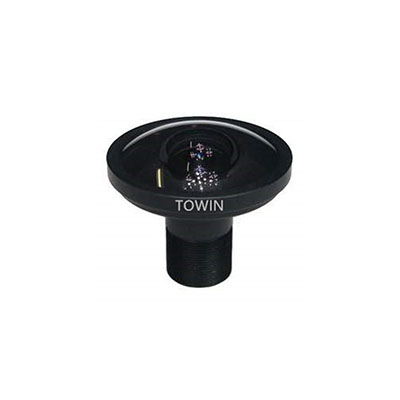
Understanding the types of fisheye lenses is essential when selecting an optical solution for ultra-wide-angle imaging. Fisheye lenses are designed to capture an exceptionally large field of view (FOV), often approaching or exceeding 180 degrees, making them suitable for panoramic imaging, automotive surround-view systems, security cameras, robotics, and other embedded vision applications.
The two main types of fisheye lenses are circular fisheye lenses and full-frame fisheye lenses. They differ in how the image is projected onto the camera sensor and how much of the sensor area is covered. Beyond these two categories, focal length, sensor size, optical projection, resolution, and distortion characteristics also determine the final image.
This guide explains the main fisheye lens types, compares their imaging characteristics, and discusses how to choose an industrial fisheye lens for your camera system.
1. What Is a Fisheye Lens?
A fisheye lens is an ultra-wide-angle optical lens designed to capture a very large field of view. Unlike conventional rectilinear lenses, which attempt to keep straight lines straight, fisheye lenses use specialized optical projection to fit a wide viewing angle into a relatively small image area.
This design produces characteristic curved lines, particularly near the edges of an image. Although this distortion may be undesirable in applications requiring accurate geometric measurements, it can be beneficial when a camera needs to capture a large surrounding area from a single position.
Depending on the optical design and sensor configuration, fisheye lenses can provide viewing angles of 180 degrees or more. Some ultra-wide-angle models are designed for applications requiring coverage beyond a conventional hemispherical field of view.
Fisheye lenses are commonly used in:
- Automotive surround-view and rear-view camera systems
- Panoramic security and surveillance cameras
- Robotics and autonomous navigation
- Drone and aerial imaging
- Smart home and embedded vision devices
- Wide-area monitoring and spatial awareness systems
For compact imaging systems, M12 fisheye lenses are particularly useful because their small form factor allows integration into miniature camera modules and embedded vision devices.
2. What Are the Main Types of Fisheye Lenses?
The two most widely recognized fisheye lens types are circular fisheye and full-frame fisheye. The main difference is how the projected image occupies the camera sensor.
2.1 Circular Fisheye Lens
A circular fisheye lens produces a circular image surrounded by black or unused areas when the image circle is smaller than the rectangular sensor frame. It is designed to capture a very wide angular field, often approximately 180 degrees in multiple directions, depending on the optical design.
Because the image is contained within a circular area, the corners of the rectangular sensor may not receive image information. The result is a distinctive circular viewing effect.
Key characteristics:
- Produces a circular image within the sensor frame.
- Can capture an extremely wide field of view.
- May leave unused or black corners in the recorded image.
- Creates strong curved-line effects near the image boundaries.
- Can be useful for specialized panoramic and hemispherical imaging.
Typical applications:
- 360-degree and hemispherical monitoring
- Panoramic security systems
- Specialized surveillance cameras
- Scientific and environmental imaging
When selecting a circular fisheye lens, check the image circle diameter and the active sensor dimensions. A lens that produces a circular image on one sensor may create a different image coverage pattern on another sensor.
2.2 Full-Frame Fisheye Lens
A full-frame fisheye lens produces a rectangular image that covers the sensor frame rather than leaving a circular image surrounded by black corners. In many photographic configurations, the lens provides an approximately 180-degree diagonal field of view.
Unlike a circular fisheye lens, a full-frame fisheye lens uses more of the available sensor area. This makes it useful when the imaging system needs a wide viewing angle while retaining a conventional rectangular image format.
Key characteristics:
- Fills the rectangular image frame.
- Uses more of the available sensor area.
- Typically provides a very wide diagonal field of view.
- Retains characteristic fisheye image curvature.
- Can be integrated into compact industrial and embedded camera systems.
Typical applications:
- Wide-area security cameras
- Automotive camera systems
- Robotics and embedded vision
- Panoramic imaging devices
- Compact AI camera modules
2.3 Circular vs. Full-Frame Fisheye: Key Differences
Although both designs capture ultra-wide-angle images, their image coverage and sensor utilization are different.
| Feature | Circular Fisheye | Full-Frame Fisheye |
|---|---|---|
| Image shape | Circular | Rectangular |
| Sensor coverage | May leave unused corners | Designed to fill the image frame |
| Field of view | Often approximately 180° in multiple directions | Often approximately 180° diagonally |
| Image appearance | Distinct circular projection | Curved lines within a rectangular frame |
| Typical use | Hemispherical and panoramic imaging | Wide-area and embedded imaging |
| Selection priority | Image circle and angular coverage | Sensor coverage and diagonal FOV |
Which type should you choose?
Choose a circular fisheye lens when the imaging system requires a circular viewing area and exceptionally wide angular coverage. Choose a full-frame fisheye lens when the application needs a rectangular image that uses more of the sensor area.
For industrial camera modules, the actual image format, sensor size, image circle, and required field of view should always be checked against the lens datasheet.
3. How Does Fisheye Lens Focal Length Affect Field of View?
Fisheye lens focal length is an important parameter when selecting an ultra-wide-angle optical system. It affects the relationship between the camera sensor, the captured scene, and the angular field of view.
In general, a shorter focal length can provide a wider field of view when the sensor size and optical projection are held constant. However, focal length alone cannot determine the actual viewing angle of a fisheye lens.
3.1 Relationship Between Focal Length and FOV
For a conventional rectilinear lens, the horizontal field of view can be estimated using:
FOV = 2 × arctan (Sensor Width / 2f)
Where:
- FOV = Horizontal field of view
- Sensor Width = Active horizontal sensor dimension
- f = Lens focal length
However, this formula assumes rectilinear projection. Fisheye lenses use different projection models, so the same formula should not be used to predict their actual field of view.
For a simplified equidistant fisheye projection, the relationship between image height from the optical axis and the incident ray angle is:
r = f × θ
Where r is the image height, f is the focal length, and θ is the incident angle in radians. Other fisheye projection models produce different relationships.
For accurate lens selection, use the manufacturer’s specified horizontal, vertical, and diagonal FOV values for the intended sensor.
3.2 Why Sensor Size Matters
The same fisheye lens can produce different image coverage and field-of-view values when paired with different image sensors.
For example, a lens designed for a 1/2.3-inch sensor may not provide the same horizontal or diagonal FOV when used with a smaller 1/3-inch sensor. The active sensor dimensions determine how much of the projected image is recorded.
When evaluating a fisheye lens, check the following parameters together:
- Sensor format and active imaging dimensions
- Lens image circle
- Effective focal length
- Horizontal, vertical, and diagonal FOV
- Optical projection characteristics
- Resolution and image quality
For additional guidance, read our M12 Lens Solutions guide to understand sensor compatibility and compact lens configurations.
3.3 Industrial Fisheye Lens Focal Length Examples
Industrial fisheye lenses are available in a wide range of focal lengths. Compact M12 and S-mount models often use short focal lengths to achieve very wide-angle imaging within limited installation space.
For example, TOWIN offers different fisheye lens configurations, including:
| Example Lens | Focal Length | Resolution | Specified FOV |
|---|---|---|---|
| CCL1170185MP | 1.85mm | 12MP | 185° |
| CCL12014MP | 1.4mm | 5MP | 185° |
| CCL12015MPF | 1.5mm | 16MP | 180° |
Note: These are examples of different product configurations, not a controlled comparison. FOV values depend on the specified sensor or image circle and the manufacturer’s measurement convention. Always consult the individual product datasheet before selecting a lens.
You can explore more models and compare focal length, sensor compatibility, resolution, and FOV on the TOWIN fisheye lens product page.
You can also use the FOV Calculator as an initial reference for camera and lens field-of-view calculations. Its standard calculation uses a thin-lens, rectilinear model, so actual fisheye lens FOV should be verified against the product specifications.
4. Fisheye Lens vs. Rectilinear Wide-Angle Lens
Fisheye lenses and rectilinear wide-angle lenses are both designed to capture a broad scene, but they use different optical projection characteristics.
A rectilinear lens attempts to preserve straight lines in the scene as straight lines in the image, particularly near the centre of the frame. A fisheye lens uses a different projection to capture a much wider angular field, resulting in curved lines toward the image edges.
| Feature | Fisheye Lens | Rectilinear Wide-Angle Lens |
|---|---|---|
| Projection | Fisheye projection | Rectilinear projection |
| Field of view | Can exceed 180° | Usually below 180° |
| Straight lines | Appear curved away from the centre | Generally remain straight |
| Image distortion | Strong intentional geometric distortion | Generally lower geometric distortion |
| Main advantage | Very wide scene coverage | More natural geometric representation |
| Typical applications | Panoramic and surround-view imaging | Inspection and conventional imaging |
When Should You Choose a Fisheye Lens?
A fisheye lens is appropriate when capturing a very large area is more important than maintaining straight-line geometry. It can reduce blind spots and provide broad scene information for monitoring and spatial-awareness systems.
When Should You Choose a Rectilinear Lens?
A rectilinear lens is generally more suitable for applications requiring accurate geometric representation, such as dimensional measurement, precision inspection, and applications where straight-line features must remain visually consistent.
If accurate image geometry is a priority, explore TOWIN’s low distortion lens solutions instead of assuming that a fisheye lens can provide the same optical characteristics.
5. What Are the Different Fisheye Lens Projection Types?
In addition to circular and full-frame designs, fisheye lenses can be classified according to their optical projection models. A projection model describes how incoming light angles are mapped onto the image plane.
Four commonly discussed projection models are equidistant, equisolid angle, stereographic, and orthographic projection.
5.1 Equidistant Projection
Equidistant projection follows a linear relationship between the incident angle and image radius:
r = fθ
Equal angular increments produce equal radial image increments. This model is useful when angular spacing needs to be represented consistently across the image.
5.2 Equisolid Angle Projection
Equisolid angle projection follows the relationship:
r = 2f × sin(θ/2)
It is designed so that equal solid angles correspond to equal image areas, subject to the optical system’s ideal projection model. This can be useful in imaging applications where angular area representation matters.
5.3 Stereographic Projection
Stereographic projection follows:
r = 2f × tan(θ/2)
It provides a different mapping of angular information onto the image plane and can preserve certain local angular relationships. It is commonly discussed in specialized panoramic and scientific imaging designs.
5.4 Orthographic Projection
Orthographic projection follows:
r = f × sin(θ)
This projection maps incident angles according to the sine function. It has different image-area characteristics from equidistant and equisolid projections and is limited in angular coverage by its mathematical mapping.
Important: These projection models are not the same as circular and full-frame fisheye categories. Circular and full-frame describe image coverage, while projection models describe the mathematical mapping of incoming rays onto the image plane. A particular lens design should be evaluated using its actual optical specifications rather than its category name alone.
6. How to Choose an Industrial Fisheye Lens
Choosing an industrial fisheye lens requires more than selecting the shortest available focal length or the widest advertised FOV. The lens must match the image sensor, mechanical structure, resolution requirements, working environment, and intended application.
6.1 Check Sensor Size and Image Circle
First, confirm that the lens supports the camera sensor format. The lens image circle must adequately cover the active sensor area to avoid unwanted vignetting or incomplete image coverage.
For compact camera modules, M12 and S-mount fisheye lenses are common options. Check the specified sensor format and image circle before confirming compatibility.
6.2 Select the Required Field of View
Determine how much of the surrounding scene the camera needs to capture. A wider FOV can reduce blind spots, but it may also reduce the number of pixels available to represent objects within a particular region.
For automotive surround-view, security monitoring, and robotic navigation, evaluate the actual scene coverage and camera installation position rather than selecting a lens based only on its advertised maximum FOV.
6.3 Match Resolution and Image Quality
The lens resolution should be compatible with the image sensor. A high-megapixel sensor requires an optical system capable of delivering sufficient detail across the image area.
For example, a 12MP sensor does not automatically produce a detailed 12MP image if the lens cannot resolve the required spatial information. Evaluate MTF performance, edge sharpness, chromatic aberration, and illumination uniformity when image quality is important.
6.4 Consider Aperture and Lighting Conditions
The maximum aperture affects how much light reaches the sensor. A lower f-number generally allows more light to pass through the lens, which can be beneficial in low-light environments.
However, aperture selection should also consider depth of field, exposure time, sensor sensitivity, optical performance, and the available illumination. For industrial systems, a suitable aperture is one that balances image brightness with the required image quality and operating conditions.
6.5 Evaluate Distortion and Image Processing
Geometric distortion is an inherent characteristic of fisheye imaging. It is not necessarily an optical defect. The important consideration is whether the distortion is suitable for the intended application.
For panoramic viewing, a highly distorted image may be acceptable or even desirable. For object recognition, measurement, or machine vision, the system may require calibration and fisheye correction algorithms to transform the image into a more useful representation.
Do not confuse fisheye projection distortion with manufacturing defects such as poor optical alignment, excessive chromatic aberration, or uneven image sharpness.
6.6 Confirm Mount and Mechanical Compatibility
Check the lens mount, thread specification, total track length (TTL), back focal length, lens diameter, and available installation space.
M12 × 0.5 is widely used in compact embedded camera systems. The correct mount is important, but mechanical compatibility alone does not guarantee optical compatibility. The lens must also match the sensor’s image circle and optical requirements.
For more detailed selection guidance, read our Lens Selection Guide.
7. Industrial Applications of Fisheye Lenses
Fisheye lenses are used in many imaging systems where a wide viewing angle and broad scene coverage are essential. Their compact optical designs make them particularly useful in embedded cameras and specialized industrial imaging devices.
7.1 Automotive Surround-View Systems
Automotive surround-view systems use multiple cameras to capture different areas around a vehicle. Wide-angle and fisheye lenses can help cover front, rear, and side viewing areas, supporting parking assistance and vehicle surroundings monitoring.
Important selection factors include field of view, sensor compatibility, environmental durability, temperature performance, and image correction requirements.
7.2 Smart Security and Surveillance
Fisheye lenses can capture a broad indoor or outdoor monitoring area from a single camera position. They are useful for wide-area surveillance, panoramic monitoring, and applications where reducing blind spots is important.
For additional information about optical solutions for security cameras, explore TOWIN Smart Security Lens Solutions.
7.3 Robotics Vision
Robots and autonomous mobile systems often need broad visual information for navigation, obstacle detection, and environmental awareness. A fisheye lens can provide a wide viewing angle while maintaining a compact camera configuration.
The appropriate lens should be selected according to the robot’s mounting position, required viewing range, sensor resolution, and image-processing capabilities.
7.4 Drone and Aerial Imaging
Compact fisheye and ultra-wide-angle lenses can be used in drones and UAV camera modules where a broad viewing area is required within a limited payload size.
Depending on the application, lens selection may also need to consider weight, vibration resistance, resolution, illumination, and geometric correction requirements.
Learn more about TOWIN Drone Imaging Lens Solutions for compact aerial imaging systems.
7.5 Panoramic and Embedded Imaging
Panoramic camera modules and embedded vision devices often use fisheye lenses to capture a large scene within a small installation space. These systems can be used in smart devices, monitoring equipment, robotics platforms, and specialized vision products.
For these applications, M12 fisheye lenses offer a compact mounting configuration and multiple focal length options.
8. Frequently Asked Questions About Fisheye Lens Types
Q1: What are the two main types of fisheye lenses?
A: The two main types are circular fisheye lenses and full-frame fisheye lenses. Circular fisheye lenses produce a circular image within the sensor frame, while full-frame fisheye lenses are designed to fill the rectangular image area. Their actual field of view depends on the optical design and sensor configuration.
Q2: What is the difference between circular and full-frame fisheye lenses?
A: A circular fisheye lens produces a circular image that may leave black or unused corners on a rectangular sensor. A full-frame fisheye lens covers the rectangular sensor frame. The main difference is image coverage and sensor utilization.
Q3: What focal length is best for a fisheye lens?
A: The best focal length depends on the sensor size, required field of view, image circle, and application. Short focal lengths are commonly used for extremely wide-angle imaging, while other focal lengths may be more suitable for narrower coverage. Always check the manufacturer’s FOV specifications for the intended sensor.
Q4: Does a shorter focal length always provide a wider field of view?
A: Not in every comparison. For the same sensor size and comparable optical projection, a shorter focal length generally provides a wider field of view. However, different sensor dimensions, image circles, and fisheye projection designs can produce different results. Focal length should not be evaluated independently of the other optical parameters.
Q5: What is the opposite of a fisheye lens?
A: A rectilinear lens is often considered the opposite of a fisheye lens in terms of image projection. A rectilinear lens is designed to keep straight lines straight, while a fisheye lens maps a much wider angular field into the image and produces characteristic curved lines.
Q6: Are fisheye lenses suitable for machine vision?
A: Yes, fisheye lenses can be used in machine vision applications that require very wide scene coverage, such as robot navigation, spatial awareness, and wide-area monitoring. However, applications requiring precise dimensional measurement or low geometric distortion may need a rectilinear low-distortion lens instead.
Q7: How do I choose an M12 fisheye lens?
A: Start by checking the camera sensor format, image circle, required FOV, focal length, resolution, and M12 × 0.5 mechanical compatibility. Also consider aperture, distortion characteristics, and operating conditions. The best choice is the lens that satisfies the complete optical and mechanical requirements of your camera system.
Q8: Can fisheye lens distortion be corrected?
A: Yes. Software calibration and image-processing algorithms can transform fisheye images into rectified or panoramic views. The correction method depends on the lens projection model, camera calibration parameters, and the intended output image. Software correction may also change the usable image area and effective resolution.
9. Explore TOWIN Fisheye Lens Solutions
Selecting the right fisheye lens requires matching optical performance with the camera sensor, field of view, installation space, and application requirements.
TOWIN provides a range of industrial fisheye lenses and compact M12/S-mount optical solutions for wide-angle imaging applications. Available configurations include different focal lengths, sensor formats, FOV options, and resolution levels.
Whether you are developing a panoramic camera, automotive vision system, security camera, robotics platform, or embedded imaging device, choosing the correct optical configuration is essential for achieving reliable image performance.
Explore our product range:
- Explore TOWIN Fisheye Lenses
- Browse M12 Lens Products
- Explore M12 Lens Solutions
- Read the Lens Selection Guide
Need a customized fisheye lens?
If your project requires a specific focal length, sensor format, field of view, resolution, or mechanical configuration, contact TOWIN to discuss your optical requirements and OEM/ODM development needs.