


Low Distortion Lens – M801912811420F
09/15/2025
Wide Angle Lens – M802213011625F67
09/15/2025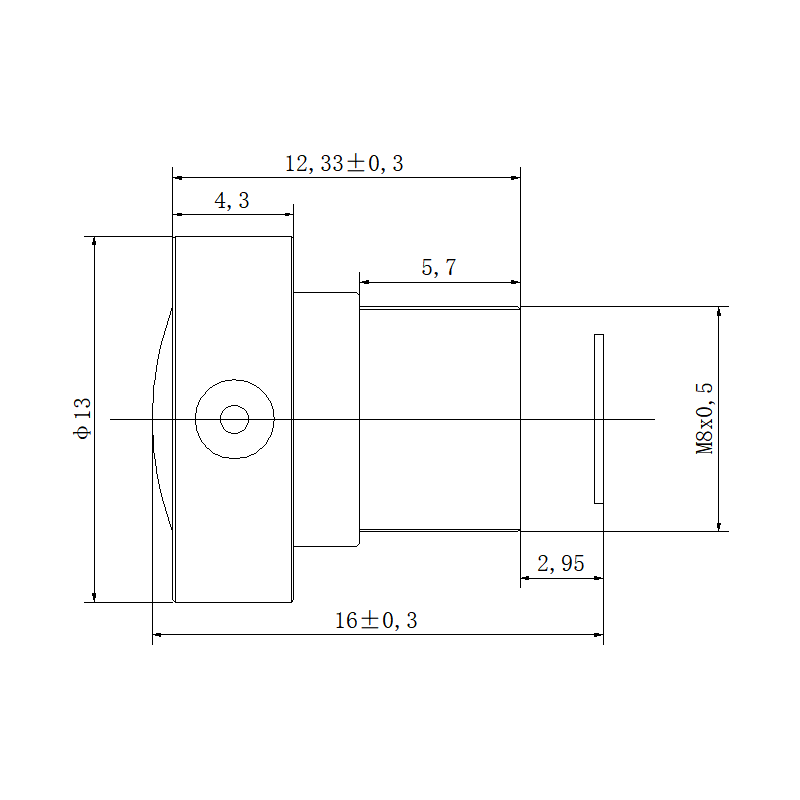
Wide Angle Lens – M802013212520F
2.0mm M8 8MP wide angle lens with 152° diagonal FOV, F2.0 aperture, M8×0.5 mount, manual focus and 4G3P+IRCF construction.
M802013212520F is Wide-angle 1/3.2″ M8X0.5 Mount CCTV lens with Built-In IR Filter, 152° diagonal FOV, 8-Megapixel, F2.0 for security surveillance.
| IMAGE FORMAT | 1/3.2″ |
| FOCAL LENGTH | 2.0mm |
| F.O.V. | 152°(D=5.68) |
| 125°(H=4.48) | |
| 94°(V=3.36) | |
| RESOLUTION | 8 MegaPixel |
| TV DISTORTION | <-24% |
| APERTURE | F2.0 |
| MOUNT | M8X0.5 |
| IRIS | Fixed |
| FOCUS | Manual |
| ZOOM | Fixed |
| T.T.L. | 16.00mm |
| STRUCTURE | 4G3P+IRCF |
2.0mm M8 8MP 152° Wide Angle Lens
This 2.0mm M8 wide angle lens is designed for compact camera modules requiring an extremely broad field of view in a miniature optical package. With a 152° diagonal FOV, 125° horizontal FOV, and 94° vertical FOV on a 1/3.2″ sensor, it captures a very large scene area from a compact camera position.
The lens provides 8MP resolution, F2.0 aperture, and an M8×0.5 mount, making it suitable for high-resolution embedded imaging systems where installation space is limited. Its manual focus and fixed zoom configuration allow the optical setup to be adjusted during camera assembly while maintaining a fixed 2.0mm focal length.
With a 16.00mm TTL and 4G3P + IRCF optical structure, this lens offers a compact solution for wide-area monitoring, embedded sensing, and other applications where maximum scene coverage is more important than precise geometric reproduction.
Product Highlights at a Glance
- 152° diagonal FOV for extremely broad scene coverage
- 8MP resolution for detailed wide-area imaging
- 2.0mm focal length for compact ultra-wide-angle camera designs
- F2.0 aperture for practical light collection
- M8×0.5 miniature mount for embedded camera modules
- Manual focus and fixed zoom for controlled optical setup
2.0mm M8 Wide Angle Lens Applications
Core Application Scenes
The defining characteristic of this lens is its 152° diagonal field of view. The 2.0mm focal length allows a compact camera to cover a very large scene, making it useful where the camera’s installation position is fixed and broad visual coverage is required.
The 8MP resolution provides sufficient image detail for wide-area observation, while the F2.0 aperture supports practical imaging in indoor and controlled-light environments. The M8×0.5 mount keeps the mechanical interface suitable for miniature camera assemblies.
Because the specified TV distortion is below -24%, this lens is intended for applications where broad visual coverage takes priority over accurate geometric reproduction. It is therefore more appropriate for scene monitoring, environmental observation, embedded sensing, and other wide-area imaging tasks than precision measurement.
Designed for compact wide-angle imaging applications that require maximum scene coverage from a miniature M8 camera lens.
Compatible Device List
- Compact 8MP camera modules
- Embedded wide-angle camera systems
- Miniature monitoring cameras
- Indoor wide-area monitoring devices
- Smart IoT imaging modules
- Compact robotic sensing cameras
- Embedded environmental observation cameras
- Wide-area security camera modules
- Space-constrained industrial imaging devices
- Short-range scene-monitoring cameras
For other miniature lens options, see TOWIN’s M8/M7/M6/M5/M3.5 Small Mount Lenses.
If you need to compare the relationship between sensor size, focal length, and field of view, use the FOV Calculator. The Sensor Guide can also help with sensor and lens matching.
For broader information about choosing an optical configuration, see the Lens Selection Guide.
Frequently Asked Questions
Q: What is the field of view of this 2.0mm M8 lens?
A: On a 1/3.2″ sensor, the lens provides 152° diagonal FOV, 125° horizontal FOV, and 94° vertical FOV.
Q: What sensor format is this lens designed for?
A: The lens is specified for a 1/3.2″ image format and provides an 8MP resolution capability.
Q: Is this a low distortion lens?
A: No. The specified TV distortion is below -24%, so it is not classified as a low distortion lens. The design prioritizes extremely wide scene coverage.
Q: Is this 2.0mm M8 lens a fisheye lens?
A: The lens has a very wide 152° diagonal FOV, but based on the supplied product classification it should be positioned as a wide angle lens rather than automatically categorized as a fisheye lens.
Q: What is the mount of this wide angle lens?
A: It uses an M8×0.5 mount, which is intended for compact and miniature camera assemblies.
Q: Does the lens use autofocus?
A: No. The specification indicates manual focus. The zoom is also fixed, with a fixed 2.0mm focal length.
Q: What does the IRCF specification mean?
A: IRCF means infrared cut filter. It filters infrared wavelengths before they reach the image sensor. This does not mean the optical system is an IR-corrected lens.
Q: What applications are suitable for this 8MP M8 lens?
A: It is suitable for compact wide-area monitoring, embedded imaging, IoT cameras, robotic sensing, and other applications where very broad scene coverage is more important than low geometric distortion.
Online contact