


Low Distortion Lens – M601216009424F
09/13/2025
Low Distortion Lens – M615013001960F
09/14/2025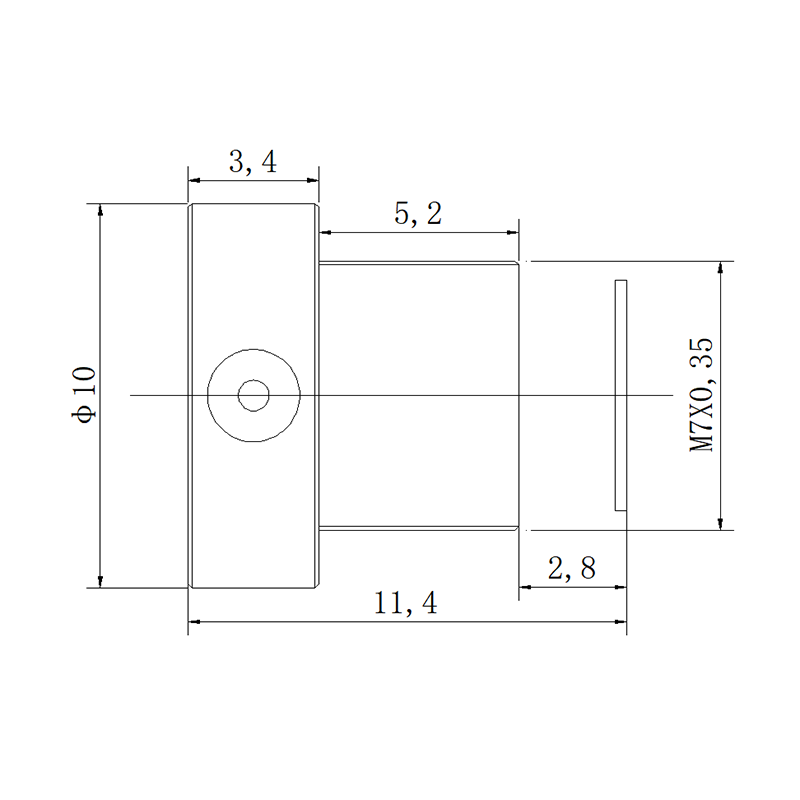
Wide Angle Lens – M702012913420F-1
2.0mm M7 2MP wide angle fixed focal lens with 116° diagonal FOV, F2.0 aperture, 0.1m M.O.D. and 5P+IRCF optical structure.
M702012913420F-1 is Low distortion Wide angle CCTV lens with Built-In IR Filter, 116° 1/4″ F2.0 M7X0.35 mount, for high-performance security surveillance.
| IMAGE FORMAT | Max Φ6.4mm |
| FOCAL LENGTH | 2.0mm |
| F.O.V. (1/4″) | 116°(D=4.59) |
| 101°(H=3.88) | |
| 68°(V=2.44) | |
| TV DISTORTION | <-10% (1/4″) |
| RESOLUTION | 2 MP |
| APERTURE | F2.0 |
| MOUNT | M7X0.35 |
| C.R.A. | <22.9° |
| R.I. | >55% |
| M.O.D. | 0.1m |
| B.F.L. | 3.5mm |
| TTL | 11.0mm |
| STRUCTURE | 5P+IRCF |
2.0mm M7 Wide Angle Miniature Lens
This 2.0mm M7 wide angle miniature lens is a compact fixed focal lens designed for 1/4″ 2MP camera modules requiring broad scene coverage and close-range imaging. With a 116° diagonal FOV, 101° horizontal FOV, 0.1m minimum object distance, and M7 × 0.35 mount, it provides a practical optical solution for compact embedded cameras and miniature vision devices where both wide coverage and limited installation space are important.
Product Highlights at a Glance
- 116° diagonal FOV provides broad coverage for compact camera systems.
- 2MP resolution supports practical imaging for embedded vision applications.
- 0.1m M.O.D. enables close-range imaging from a short working distance.
- M7 × 0.35 mount provides a compact mechanical interface for miniature cameras.
- >55% relative illumination helps maintain useful image brightness across the image field.
2.0mm M7 Wide Angle Miniature Lens Applications
Core Application Scenes
This 2.0mm M7 wide angle miniature lens is designed for compact camera systems that need to observe a broad area from a relatively short working distance. Its 116° diagonal and 101° horizontal field of view provide extensive scene coverage, while the 0.1m minimum object distance makes it particularly suitable for applications where the camera is positioned close to the monitored subject.
The lens can be considered for compact embedded cameras, smart electronic devices, miniature robotic modules, short-range monitoring equipment, and space-constrained visual sensors. In these systems, the combination of a wide viewing angle and 0.1m M.O.D. allows the camera to capture nearby objects without requiring a large installation distance.
The 2MP optical specification is well matched to applications that require practical image detail without the optical and mechanical requirements associated with higher-resolution industrial cameras. The F2.0 aperture provides a useful balance between light gathering and compact optical construction.
The >55% relative illumination specification is also an important characteristic for wide-angle camera integration. Maintaining sufficient illumination toward the image edges can help produce more consistent brightness across the captured scene.
With a 3.5mm B.F.L. and 11.0mm TTL, the lens provides defined mechanical dimensions for engineers designing compact camera housings. The integrated IRCF further supports visible-light camera modules that require infrared filtering.
Designed for close-range wide-area imaging in compact embedded and miniature vision systems.
Compatible Device List
- Miniature Camera Modules: Suitable for 1/4″ 2MP camera systems requiring a wide field of view and compact mounting.
- Embedded Vision Devices: The M7 × 0.35 interface supports integration into compact smart devices and embedded imaging equipment.
- Short-Range Monitoring Cameras: The 0.1m M.O.D. makes the lens suitable for monitoring relatively nearby objects and areas.
- Miniature Robotic Systems: The broad FOV can help compact robotic devices capture more of their nearby environment.
- Custom Camera Housings: The defined 3.5mm B.F.L. and 11.0mm TTL facilitate mechanical and optical integration into customized camera assemblies.
For engineers looking for other miniature threaded lens configurations, Towin’s Other Mount Lenses provides additional compact mounting options. For M12-based embedded camera designs, the M12 Lenses category provides a broader range of compact optical solutions.
When designing a miniature camera, matching the lens image format with the sensor is essential. Towin’s Sensor Guide provides guidance on sensor and lens compatibility, while the Lens Selection Guide covers key parameters such as focal length, FOV, resolution, and optical format.
Because wide-angle lenses can introduce significant geometric distortion, engineers can also refer to the Distortion Guide when evaluating how distortion affects the final image.
For system-level field-of-view calculations, the FOV Calculator can help estimate viewing coverage based on the selected sensor and focal length.
Frequently Asked Questions
Q: What type of lens is the 2.0mm M7 lens?
A: It is a wide angle fixed focal miniature lens designed for 1/4″ 2MP camera modules, with a 116° diagonal field of view.
Q: Is this lens a fisheye lens?
A: No. Although it provides a wide 116° diagonal FOV, the available specifications do not indicate a fisheye optical design. It is classified as a wide angle miniature lens.
Q: What sensor format is this lens designed for?
A: The specified field of view is based on a 1/4″ image format, with an image circle of up to Φ6.4mm.
Q: What is the minimum object distance?
A: The M.O.D. is 0.1m, allowing the lens to focus on relatively close subjects and making it suitable for short-range imaging applications.
Q: What is the distortion specification?
A: The specified TV distortion is less than -10% at 1/4″. This is characteristic of the lens’s wide-angle optical design and is not positioned as a low distortion lens.
Q: What is the advantage of the >55% relative illumination specification?
A: Higher relative illumination helps maintain useful brightness toward the edges of the image, which is particularly relevant for wide-angle optical systems.
Q: What mounting thread does this lens use?
A: The lens uses an M7 × 0.35 mounting thread, providing a compact mechanical interface for miniature camera modules.
Q: What is the purpose of the IRCF?
A: IRCF stands for infrared cut filter. It helps reduce unwanted infrared wavelengths reaching the image sensor and is commonly used in visible-light camera modules.
Online contact
| SENSOR | |
|---|---|
| E.F.L. | |
| H. F.O.V. | |
| RESOLUTION | |
| Max Dist. | |
| FNo. | |
| FEATURE | |
| MOUNT | |
| T.T.L.(mm) | |
| MARK |