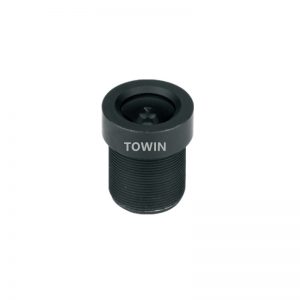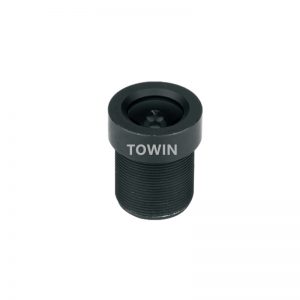



Low Distortion Lens – CCL132914MP
08/06/2025
Wide Angle Lens – CCL1270410MPF
08/06/2025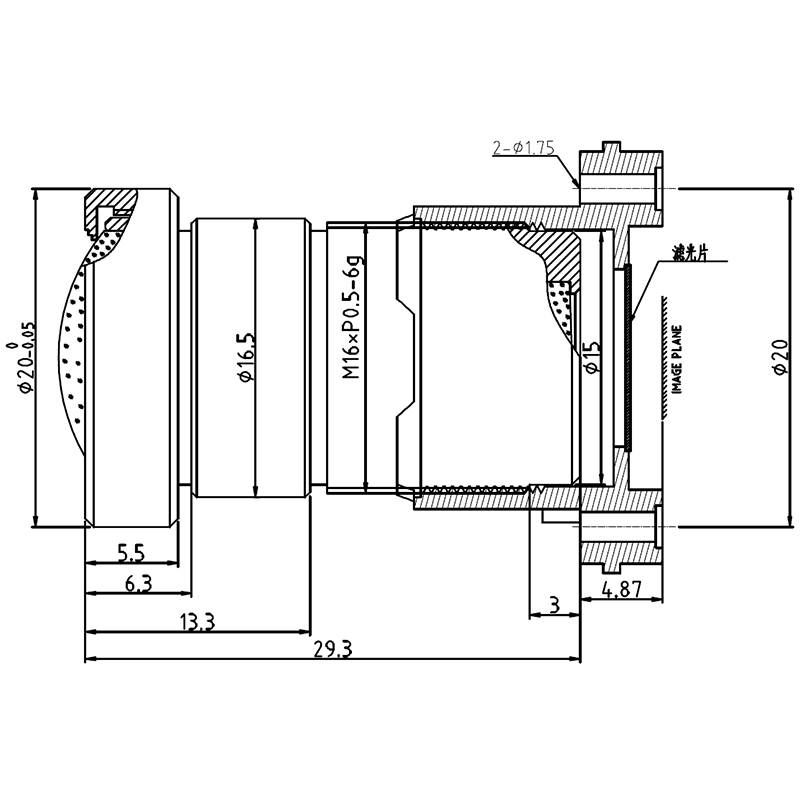
Wide Angle Lens – CCL1250410MPF
8MP 4mm M16 fixed focal Wide Angle lens for 1/2.5″ sensors with 106° D/82° H/60° V FOV, F1.0 aperture, <-35% distortion and 0.2m M.O.D.
CCL1250410MPF is 4mm High-Resolution 8-Megapixel Wide-angle Lens, 1/2.5″ M16XP0.5 mount, fixed aperture F1.0, suitable for low-light conditions.
| IMAGE FORMAT | 1/2.5″ |
| FOCAL LENGTH | 4mm |
| F.O.V.(1/2.5″) | 106°(D) |
| 82°(H) | |
| 60°(V) | |
| DISTORTION | <-35% |
| RESOLUTION | 8 Megapixel |
| MOUNT | M16XP0.5 |
| APERTURE | F1.0 |
| IRIS | Fixed |
| M.O.D. | 0.2m |
| B.F.L. | 5.36mm |
| T.T.L. | 35.75mm |
| CONSTRUCTION: | Lens+Holder+Filter |
For applications requiring other wide-angle optical configurations, Towin’s Other Mount Lenses category provides additional special-mount lens solutions.
8MP 4mm M16 F1.0 Wide Angle Lens
This 8MP 4mm M16 wide angle lens combines a 106° diagonal field of view, 82° horizontal FOV, and ultra-fast F1.0 aperture for broad-area imaging with high optical brightness. Designed for 1/2.5″ sensors, the lens provides 8-megapixel resolution, a compact M16x0.5 interface, and a 0.2m minimum object distance for wide-view CCTV and embedded imaging applications.
M16 F1.0 Wide Angle Lens Core Highlights
- 106° diagonal FOV provides broad scene coverage for wide-area monitoring.
- 82° horizontal FOV captures a large monitoring area from a single camera position.
- 8MP optical resolution supports high-detail imaging with compatible 1/2.5″ sensors.
- F1.0 ultra-fast aperture maximizes light-gathering capability for challenging illumination.
- M16x0.5 mount with integrated holder and filter construction supports specialized compact camera assemblies.
M16 F1.0 Wide Angle Lens Applications
Core Application Scenes
This 4mm M16 wide angle lens is designed for camera systems that need to capture a broad area from a relatively short installation distance. With an 82° horizontal and 106° diagonal field of view, it can cover a large portion of a scene without requiring the camera to be positioned far from the monitored area.
The lens is particularly suited to wide-area CCTV, indoor security monitoring, entrance surveillance, retail observation, compact embedded cameras, and general situational-awareness imaging. The 4mm focal length provides broad perspective coverage, while the 0.2m minimum object distance allows the lens to be used for relatively close-range scenes.
A defining characteristic of this optical design is its <-35% distortion. The substantial negative distortion is consistent with a strongly wide-angle optical approach, allowing the lens to achieve broad scene coverage within a compact optical package. Applications should therefore prioritize area coverage over geometrically rectified imaging.
The F1.0 aperture is another major advantage. Compared with slower optical systems, the large aperture is designed to provide strong light-gathering capability, making this lens particularly relevant to indoor or low-illumination camera environments where maintaining usable image brightness is important.
The Lens + Holder + Filter construction also makes this model different from a basic standalone lens assembly. It can be integrated as an optical module into camera designs requiring a predefined holder and filter configuration.
Compatible Device List
- 1/2.5″ 8MP CCTV cameras: Designed for compatible high-resolution surveillance camera modules.
- Wide-area indoor security cameras: The 82° horizontal FOV supports broad monitoring from a single camera position.
- Entrance and doorway cameras: The 4mm focal length and 0.2m M.O.D. can accommodate relatively close installation positions.
- Retail and commercial surveillance cameras: Suitable for monitoring larger areas such as stores, reception zones, and open indoor spaces.
- Embedded wide-angle camera modules: The M16x0.5 interface and integrated holder/filter construction support specialized camera assemblies.
- Low-light indoor imaging systems: The F1.0 aperture provides a high light-gathering configuration for applications with limited illumination.
For broader security applications, this lens can be evaluated alongside Towin’s Smart Security solutions.
Wide-Angle Optical Characteristics
The combination of 106° diagonal FOV, 82° horizontal FOV, and <-35% distortion is central to the design of this lens.
Unlike a low-distortion lens, which is designed to preserve straight lines and geometric relationships, this optical configuration accepts significant barrel distortion to achieve a much broader viewing angle. This makes it suitable for applications where capturing more of the surrounding environment is more important than maintaining rectilinear image geometry.
For example, a security camera positioned near an entrance may need to capture people approaching from different directions. A wide-angle optical design can provide broader scene awareness without requiring multiple conventional narrow-FOV lenses.
Engineers evaluating the effect of distortion on their application can refer to Towin’s Distortion Guide when comparing wide-angle and low-distortion optical designs.
F1.0 Aperture & Low-Light Imaging
The F1.0 aperture is one of the strongest specifications of this model. A large aperture allows more light to reach the sensor, which can be advantageous when the available illumination is limited.
This characteristic can be useful for indoor surveillance, entrances, commercial environments, and other applications where artificial lighting may vary throughout the day.
However, exposure performance ultimately depends on the complete camera system, including the image sensor, shutter settings, gain, image processing, and actual scene illumination.
FOV & Installation Considerations
With an 82° horizontal field of view, the lens can capture a broad scene at relatively short distances. The 0.2m M.O.D. also allows the camera to be positioned close to the monitored subject.
For installation planning, engineers should consider the camera mounting height, working distance, target position, and desired coverage area together rather than selecting the lens from focal length alone.
Towin’s FOV Calculator can be used to estimate scene coverage based on camera and lens parameters.
For applications requiring a different focal length or optical configuration, the Lens Selection Guide provides additional guidance for comparing sensor format, FOV, working distance, and lens characteristics.
Designed for wide-area CCTV, indoor security monitoring, entrance surveillance, retail imaging, and embedded camera applications requiring 8MP resolution, F1.0 aperture, and broad-angle coverage.
Frequently Asked Questions
Q: What type of lens is this 4mm M16 lens?
A: It is a 4mm fixed focal wide-angle lens with fisheye characteristics, designed for 1/2.5″ sensors and providing 106° diagonal, 82° horizontal, and 60° vertical fields of view.
Q: What is the horizontal field of view?
A: The horizontal field of view is 82°, while the diagonal and vertical fields of view are 106° and 60°, respectively.
Q: What is the advantage of the F1.0 aperture?
A: F1.0 provides a very large optical aperture, allowing strong light-gathering capability. This can be beneficial for camera systems operating in relatively low or variable illumination.
Q: What sensor size is compatible with this lens?
A: The specified image format is 1/2.5″, and the lens is designed for compatible 1/2.5″ image sensors.
Q: Is this a low-distortion lens?
A: No. The specified distortion sits below -35%, so this lens prioritizes broad-angle coverage instead of low geometric distortion.
Q: What is the minimum object distance?
A: The specified M.O.D. is 0.2m, so the lens supports relatively close-range wide-area monitoring.
Q: What does the Lens + Holder + Filter construction mean?
A: The optical assembly includes the lens together with a holder and filter, providing a more integrated configuration for compatible camera module designs.
Q: Is this lens IR corrected?
A: Supplied parameters do not specify IR correction, so marketers cannot market the lens as an IR Corrected Lens unless extra optical data verifies this characteristic.
Online contact