


Wide Angle Lens – S02114010820
08/20/2025
Wide Angle Lens – S02512710326F
08/20/2025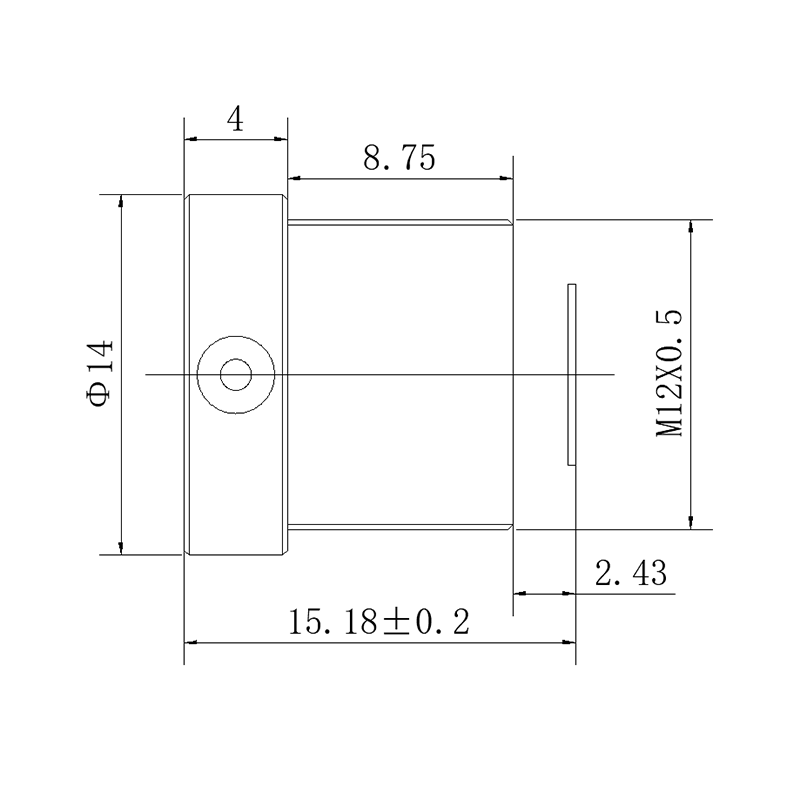
M12 Lenses – S02512709622D8
2.5mm M12 wide angle lens with 105° FOV, <1% distortion and Visible/850nm dual-pass filter for compact vision systems.
S02512709622D8 is M12-mount 2.5mm wide-angle 2-Megapixel CCTV lens with low distortion (<-1%), fixed F2.2 aperture, and IR dual-pass filter for surveillance applications.
| IMAGE FORMAT | Max Φ6.9 |
| FOCAL LENGTH | 2.5mm |
| F.O.V. @1/2.7″ | 105°(D) |
| 96°(H) | |
| 64°(V) | |
| F.O.V. @1/2.9″ | 97°(D) |
| 90°(H) | |
| 59°(V) | |
| RESOLUTION | 2 MP |
| DISTORTION | <-1% |
| APERTURE | F2.2 |
| MOUNT | M12x0.5 |
| IRIS | Fixed |
| M.O.D. | 0.2m |
| T.T.L. | 15.18mm |
| STRUCTURE | 2G2P+850nm IR |
| 850nm IR: | Visible and 850nm Dual pass filter |
2.5mm 2MP M12 Wide Angle Low Distortion 850nm IR Lens
This 2.5mm 2MP M12 lens combines a wide field of view, less than 1% distortion, and visible-light/850nm dual-pass optical performance in a compact fixed-focus design. It supports up to 105° diagonal FOV on a 1/2.7″ sensor, making it suitable for compact vision systems that require broad scene coverage and controlled image geometry.
With an M12x0.5 mount, F2.2 fixed aperture, 0.2m M.O.D., and 15.18mm TTL, this M12 wide angle lens is designed for embedded cameras, smart vision devices, and imaging systems operating across visible and 850nm near-infrared wavelengths.
M12 Wide Angle Lens Highlights
- 105° diagonal FOV on a 1/2.7″ sensor for broad scene coverage.
- <1% distortion supports controlled wide-angle imaging.
- Visible + 850nm dual-pass design enables dual-band optical applications.
- 2.5mm fixed focal length provides a compact wide-angle configuration.
- M12x0.5 mount and 15.18mm TTL simplify integration into compact camera modules.
2.5mm M12 Wide Angle Lens Applications
Core Application Scenes
This 2.5mm M12 wide angle lens is designed for compact imaging systems that need broad scene coverage without the strong geometric distortion associated with fisheye optics. On a 1/2.7″ sensor, its 105° diagonal and 96° horizontal FOV allow a single camera to observe a relatively large area while maintaining less than 1% specified distortion.
A key feature of this lens is its Visible and 850nm Dual Pass Filter. Rather than being limited to visible-light imaging, the optical design supports transmission in the visible range and around 850nm, making it suitable for vision systems that combine conventional image capture with near-infrared illumination or sensing.
For smart security and intelligent monitoring devices, the 850nm capability can be useful when paired with an appropriate 850nm illumination source. The wide FOV helps cover larger areas from a fixed camera position, while the low-distortion design provides more controlled image geometry for downstream computer vision and image-analysis algorithms.
The compact M12x0.5 mounting format and 15.18mm TTL also make the lens suitable for embedded vision devices where installation space is limited. It can be integrated into compact sensing modules, edge-AI cameras, robotic perception systems, and specialized monitoring equipment.
Designed for compact dual-band vision, near-infrared-assisted imaging, smart monitoring, and embedded visual sensing applications.
Compatible Device List
- Smart Security Cameras: Suitable for compact monitoring cameras that combine visible-light imaging with 850nm near-infrared illumination.
- Embedded Vision Modules: The M12x0.5 mount and compact optical structure support integration into embedded camera assemblies.
- 850nm Imaging Systems: Compatible with vision devices using approximately 850nm illumination for enhanced near-infrared scene capture.
- Edge-AI Cameras: The wide FOV provides broad scene coverage for object detection, occupancy analysis, and other vision-based processing.
- Robotic Vision Modules: Suitable for compact robotic platforms requiring a relatively wide viewing area within a small camera housing.
- Specialized Monitoring Equipment: The combination of low distortion and dual-pass optical transmission can support custom visible/NIR imaging equipment.
For more compact lens options, the M12 Lenses product range provides different focal lengths and optical configurations. Application engineers can also review the M12 Lens solution for M12-based camera system development.
When matching this lens with a camera sensor, the Sensor Guide can help verify sensor format and image-circle compatibility. For broader lens selection criteria, refer to the Lens Selection Guide.
For applications where visible and near-infrared imaging are both required, optical transmission and filter characteristics should be considered together with the camera sensor and illumination source.
The required viewing angle can be evaluated using the FOV Calculator, while the Focal Length Calculator can help determine focal length requirements based on sensor size, working distance, and target coverage.
Frequently Asked Questions
Q: What type of lens is this 2.5mm M12 lens?
A: It is a fixed focal, wide-angle, low-distortion M12 lens with a 2.5mm focal length, F2.2 fixed aperture, and M12x0.5 mount.
Q: What is the field of view of this lens?
A: On a 1/2.7″ sensor, the lens provides 105° diagonal, 96° horizontal, and 64° vertical FOV. On a 1/2.9″ sensor, the FOV is 97° diagonal, 90° horizontal, and 59° vertical.
Q: What is the distortion specification?
A: The specified distortion is less than -1%. This controlled distortion makes the lens suitable for wide-angle applications where excessive geometric deformation is undesirable.
Q: Does this lens support 850nm near-infrared imaging?
A: Yes. The optical construction includes an 850nm IR design with a Visible and 850nm Dual Pass Filter, allowing the lens to support visible-light and 850nm near-infrared transmission.
Q: Is this a fisheye lens?
A: No. Although the lens provides a 105° diagonal FOV on a 1/2.7″ sensor, its specified distortion is less than -1%. It is better categorized as a wide-angle low-distortion lens rather than a fisheye lens.
Q: What sensor sizes can this lens support?
A: The lens provides specified FOV values for 1/2.7″ and 1/2.9″ sensors, with a maximum image circle specification of Φ6.9mm. Actual compatibility should be confirmed against the camera sensor’s active imaging area.
Q: What applications can benefit from the 850nm dual-pass design?
A: Applications can include smart monitoring, embedded vision, near-infrared-assisted imaging, edge-AI cameras, and specialized sensing systems that use 850nm illumination together with visible-light imaging.
Q: What is the minimum object distance of this lens?
A: The specified M.O.D. is 0.2m, or 200mm. This makes the lens suitable for relatively close-range imaging while maintaining a wide field of view.
Online contact
| SENSOR | |
|---|---|
| E.F.L. | |
| H. F.O.V. | |
| RESOLUTION | |
| Max Dist. | |
| FNo. | |
| FEATURE | |
| MOUNT | |
| IRIS | |
| T.T.L.(mm) | |
| MARK |